Begleiten Sie uns auf eine literarische Weltreise!
Buch zum Bücherregal hinzufügen
Grey
Einen neuen Kommentar schreiben Default profile 50px
Grey
Jetzt das ganze Buch im Abo oder die ersten Seiten gratis lesen!
All characters reduced
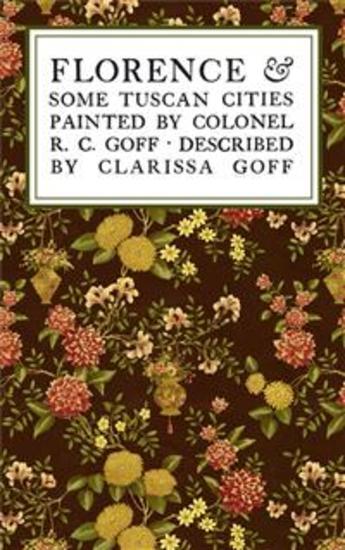
Florence & Some Tuscan Cities - Illustrated - cover

Florence & Some Tuscan Cities - Illustrated

Clarissa Goff

Verlag: Full Well Ventures

  • 0
  • 0
  • 0

Beschreibung

Book features about 75 illustrations, paintings by the Colonel Robert Charles Goff (1837-1922), and a text by Clarissa Goff, his second wife, describing the couple’s jaunts through various cities of the Tuscan region of Italy, where they viewed the architectural and artistic works so characteristic of the picturesque cites that include Florence, Arcetri, Fiesole, Prato, Pistoia, Pisa, Viareggio and Lucca, with anecdotes about the architects and painters, noble families and British visitors who played various roles in the history of Tuscany.
Verfügbar seit: 23.03.2022.

Weitere Bücher, die Sie mögen werden

  • The Hollow Crown - Shakespeare on How Leaders Rise Rule and Fall - cover

    The Hollow Crown - Shakespeare...

    Eliot A. Cohen

    • 0
    • 0
    • 0
    What Shakespeare's plays can teach us about modern-day politics 


    William Shakespeare understood power: what it is, how it works, how it is gained, and how it is lost. 


    In The Hollow Crown, Eliot A. Cohen reveals how the battling princes of Henry IV and scheming senators of Julius Caesar can teach us to better understand power and politics today. The White House, after all, is a court—with intrigue and conflict rivaling those on the Globe's stage—as is an army, a business, or a university. And each court is full of driven characters, in all their ambition, cruelty, and humanity. Henry V's inspiring speeches reframe John F. Kennedy's appeal, Richard III's wantonness illuminates Vladimir Putin's brutality, and The Tempest's grace offers a window into the presidency of George Washington. 


    An original and incisive perspective, The Hollow Crown shows how Shakespeare's works transform our understanding of the leaders who, for good or ill, make and rule our world.
    Zum Buch
  • Tracing Time - Seasons of Rock Art on the Colorado Plateau - cover

    Tracing Time - Seasons of Rock...

    Craig Childs

    • 0
    • 0
    • 0
    "An engaging glimpse into a world both fascinating and fundamentally unknowable to those who aren't born into it." —R. E. BURRILLO, author of Behind the Bears Ears 


    Craig Childs bears witness to rock art of the Colorado Plateau—bighorn sheep pecked behind boulders, tiny spirals in stone, human figures with upraised arms shifting with the desert light, each one a portal to the open mouth of time. With a spirit of generosity, humility, and love of the arid, intricate landscapes of the desert Southwest, Childs sets these ancient communications in context, inviting listeners to look and listen deeply.
    Zum Buch
  • Handful of Poems - cover

    Handful of Poems

    Massiel Alfonso

    • 0
    • 0
    • 0
    Love, as certain as death, profoundly shapes our lives with its complex feelings. In "Handful of Poems," Massiel Alfonso shares her intimate journey through the joys and sorrows of love, exploring vulnerability and the resilience born from heartache. Her poems explore themes of healing and self-discovery, inspiring listeners to find strength in vulnerability and embrace life's emotional challenges with courage."Handful of Poems" isn't just poetry; it's a journey of reflection. Each poem resonates deeply, touching your heart and revealing the beauty in personal growth and embracing one's true self. Whether you're experiencing the highs of love or the lows of heartbreak, "Handful of Poems" offers comfort, insight, and a connection to life's shared experiences.This audiobook is a must for anyone who wants to explore love and personal growth through the beauty of poetry.
    Zum Buch
  • Manifesto for the Revitalisation of Cities - A Solution to Portugal's Housing Crisis - cover

    Manifesto for the Revitalisation...

    Miguel Rebelo

    • 0
    • 0
    • 0
    The housing crisis in Portugal serves to illustrate a problem that has implications beyond the borders of the country, shedding light on challenges that are faced by major European and global cities. The rise in housing prices, driven by real estate speculation, the growth of tourism and the influx of foreign investment, has made it increasingly challenging for many in the population, especially the middle and lower classes, to access home ownership or renting. 
    The digitalisation of work has opened the possibility for highly qualified professionals to consider where they would like to live, regardless of the physical location of their job. Cities like Lisbon and Porto have become increasingly attractive destinations, offering a good quality of life combined with a range of professional opportunities. Nevertheless, this phenomenon has placed additional strain on the real estate market, leading to rising prices and the displacement of residents to the outskirts. 
    The housing policies that have been adopted thus far have not been as effective as might have been hoped, and in some cases may even have had the opposite effect. It seems that measures such as strict rent control, poorly targeted subsidies and the massive construction of new housing without proper urban and infrastructural planning have not solved the problem, and in some cases may have made it worse. Perhaps it would be beneficial to reconsider these approaches, acknowledging their shortcomings and adapting them to reflect the current situation. 
    It may be worth considering rehabilitating vacant buildings as a viable and sustainable solution. By restoring existing buildings, we can explore ways to increase the supply of affordable housing, revitalise run-down urban areas and preserve historical and cultural heritage to promote more inclusive and sustainable cities.
    Zum Buch
  • The New Female Antihero - The Disruptive Women of Twenty-First-Century US Television - cover

    The New Female Antihero - The...

    Gillian Silverman, Sarah Hagelin

    • 0
    • 0
    • 0
    The New Female Antihero examines the hard-edged spies, ruthless queens, and entitled slackers of twenty-first-century television. 
      
    The last ten years have seen a shift in television storytelling toward increasingly complex storylines and characters. In this study, Sarah Hagelin and Gillian Silverman zoom in on a key figure in this transformation: the archetype of the female antihero. Far from the sunny, sincere, plucky persona once demanded of female characters, the new female antihero is often selfish and deeply unlikeable. 
      
    In this entertaining and insightful study, Hagelin and Silverman explore the meanings of this profound change in the role of women characters. In the dramas of the new millennium, they show, the female antihero is ambitious, conniving, even murderous; in comedies, she is self-centered, self-sabotaging, and anti-aspirational. Across genres, these female protagonists eschew the part of good girl or role model. In their rejection of social responsibility, female antiheroes thus represent a more profound threat to the status quo than do their male counterparts. From the devious schemers of Game of Thrones, The Americans, Scandal, and Homeland, to the joyful failures of Girls, Broad City, Insecure, and SMILF, female antiheroes register a deep ambivalence about the promises of liberal feminism. They push back against the myth of the modern-day super-woman—she who “has it all”—and in so doing, they give us new ways of imagining women’s lives in contemporary America.
    Zum Buch
  • Gupta Empire - Golden Age of Art Science and Literature - cover

    Gupta Empire - Golden Age of Art...

    Rolf Hedger

    • 0
    • 0
    • 0
    The Gupta Empire, one of the most influential dynasties in Indian history, emerged in the early 4th century CE. It marked the beginning of a new era characterized by political stability, territorial expansion, and remarkable advancements in various fields. The foundation of the empire was laid by Chandragupta I, whose leadership and strategic alliances set the stage for the golden age that followed. 
    The origins of the Gupta dynasty remain somewhat obscure, but historical records suggest that they were a powerful regional clan in the Magadha region, present-day Bihar. Unlike the Mauryan Empire, which had a centralized administrative structure, the Gupta rulers adopted a more decentralized approach, allowing local rulers to maintain a degree of autonomy while still pledging allegiance to the empire. This governance model contributed to their long-lasting rule and ensured stability across their vast territories. 
    Chandragupta I, who ascended the throne around 320 CE, played a crucial role in the establishment of the empire. His most significant achievement was his matrimonial alliance with the Licchavi princess Kumaradevi, which not only strengthened his position but also expanded his influence in the fertile Ganges basin. This strategic marriage helped him consolidate power and gain the support of powerful regional factions. As a result, the empire's boundaries began to expand, laying the groundwork for future conquests.
    Zum Buch