Join us on a literary world trip!
Add this book to bookshelf
Grey
Write a new comment Default profile 50px
Grey
Subscribe to read the full book or read the first pages for free!
All characters reduced
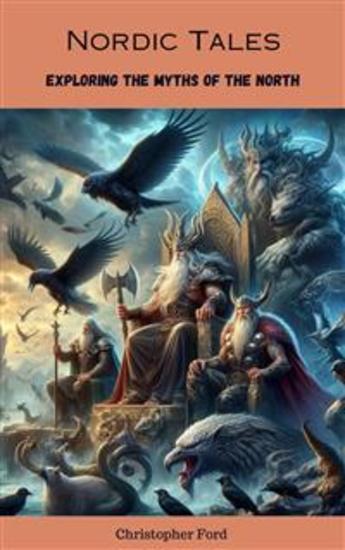
Nordic Tales: Exploring the Myths of the North - cover

Nordic Tales: Exploring the Myths of the North

Christopher Ford

Publisher: CKF Publishing

  • 0
  • 0
  • 0

Summary

Step into the captivating world of Nordic tales, where gods clash, heroes rise, and the fate of worlds hangs in the balance! Dive into a realm teeming with epic battles, cunning tricksters, and majestic beings from ancient sagas that continue to enthrall audiences worldwide.
Explore the panoramic landscapes where towering gods like Odin and Thor wield unimaginable power, where Valkyries soar above battlefields, and where the mischievous Loki weaves schemes that shape destinies. These tales unfold in a rich tapestry of conflicts, prophecies, and cosmic cataclysms, culminating in the spellbinding saga of Ragnarok, the apocalyptic battle that heralds both destruction and rebirth.
Encounter fierce giants, skilled dwarves, and fearsome monsters that challenge the might of gods and heroes. Feel the pulse of ancient wisdom, as myths woven around Yggdrasil, the World Tree, echo the eternal cycles of life, death, and renewal.
Immerse yourself in stories of courage, sacrifice, and the intricate dance between fate and free will, as Norse mythology's timeless narratives continue to inspire artists, writers, and storytellers across generations.
Join us on a journey through Nordic tales—a voyage that ignites the imagination, explores the depths of human nature, and unveils the enduring legacy of these mythic adventures!
Available since: 03/30/2024.

Other books that might interest you

  • Pillars of the Earth by Ken Follett The (Book Analysis) - Detailed Summary Analysis and Reading Guide - cover

    Pillars of the Earth by Ken...

    Bright Summaries

    • 0
    • 0
    • 0
    Unlock the more straightforward side of The Pillars of the Earth with this concise and insightful summary and analysis!This engaging summary presents an analysis of The Pillars of the Earth by Ken Follett, which tells the story of the building of a cathedral and the many trials and tribulations of the inhabitants over the course of its construction. The novel received huge success after publication and is the author's most popular book, although many of his works have been bestsellers. Follett has received many awards for his writing as well as three honorary doctorates, proving the influence of his historical and thrilling novels. Find out everything you need to know about The Pillars of the Earth in a fraction of the time!This in-depth and informative reading guide brings you: • A complete plot summary • Character studies • Key themes and symbols • Questions for further reflectionWhy choose BrightSummaries.com?Available in print and digital format, our publications are designed to accompany you in your reading journey. The clear and concise style makes for easy understanding, providing the perfect opportunity to improve your literary knowledge in no time.See the very best of literature in a whole new light with BrightSummaries.com!
    Show book
  • Ancient Anatolia: The History of the Region’s Most Powerful Cities Kingdoms and Empires in Antiquity - cover

    Ancient Anatolia: The History of...

    Editors Charles River

    • 0
    • 0
    • 0
    During the Late Bronze Age, from about 1500-1200 BCE, the Near East was a time and place where great kingdoms and empires vied for land and influence, playing high stakes diplomatic games, trading, and occasionally going to war with each other in the process. The Egyptians, Hittites, Babylonians, Assyrians, and several smaller Canaanite kingdoms were all part of this system, which was one of the first true “global” systems in world history and also one of the most materially prosperous eras in antiquity.  
    Thus, the transition from the Bronze to the Iron Age during the late 13th and early 12th centuries BCE arguably changed the structure and course of world history more fundamentally than any period before or since, and at the center of this period of turmoil was a group of people known today as the Sea Peoples, the English translation of the name given to them by the Egyptians. Despite their prominent role in history, however, the Sea Peoples remain as mysterious as they were influential; while the Egyptians documented their presence and the wars against them, it has never been clear exactly where the Sea Peoples originated from, or what compelled them to invade various parts of the region with massive numbers. Whatever the reason, the Sea Peoples posed an existential threat to the people already living in the region, as noted by an Egyptian inscription: “The foreign countries made a conspiracy in their islands. All at once the lands were removed and scattered in the fray. No land could stand before their arms: from Hatti, Qode, Carchemish, Arzawa and Alashiya on, being cut off at one time. A camp was set up in Amurru. They desolated its people, and its land was like that which has never come into being. They were coming forward toward Egypt, while the flame was prepared before them."
    Show book
  • Rewire Your Anxious Brain - Proven Techniques to Calm Your Mind Overcome Worry and Find Lasting Peace - cover

    Rewire Your Anxious Brain -...

    Dr. Emily Calmwood

    • 0
    • 0
    • 0
    Is modern anxiety hijacking your life? Reclaim your calm with proven, science-backed techniques! 
    In today's hyper-connected world, anxiety feels relentless. Rewire Your Anxious Brain by Dr. Emily Calmwood, a researcher and fellow anxiety sufferer, offers a practical, evidence-based path to lasting peace. 
    This book dives deep into the science of anxiety, demystifying its roots and equipping you with actionable strategies from Cognitive Behavioral Therapy (CBT) and mindfulness. Learn to identify your anxiety signals, challenge negative thoughts, and master relaxation techniques to calm your mind and body. Discover how to build resilience and take control, not just survive, but thrive. 
    Perfect for anyone overwhelmed by worry and seeking real, lasting solutions, this book is your guide to rewiring your brain for a calmer, more centered life. 
    Start your journey to a peaceful mind – get your copy of Rewire Your Anxious Brain today! 
     
    Show book
  • Economics for Humans - Second Edition - cover

    Economics for Humans - Second...

    Julie A. Nelson

    • 0
    • 0
    • 0
    At its core, an economy is about providing goods and services for human well-being. But many economists and critics preach that an economy is something far different: a cold and heartless system that operates outside of human control. In this impassioned and perceptive work, Julie A. Nelson asks a compelling question: given that our economic world is something that we as humans create, aren’t ethics and human relationships—dimensions of a full and rich life—intrinsically part of the picture? 
     
    Economics for Humans argues against the well-ingrained notion that economics is immune to moral values and distant from human relationships. Here, Nelson locates the impediment to a more considerate economic world in an assumption that is shared by both neoliberals and the political left. Despite their seemingly insurmountable differences, both make use of the metaphor, first proposed by Adam Smith, that the economy is a machine. This pervasive idea, Nelson argues, has blinded us to the qualities that make us work and care for one another—qualities that also make businesses thrive and markets grow. We can wed our interest in money with our justifiable concerns about ethics and social well-being. And we can do so if we recognize that an economy is not a machine, but a living thing in need of attention and careful tending.  
     
    This second edition has been updated and refined throughout, with expanded discussions of many topics and a new chapter that investigates the apparent conflict between economic well-being and ecological sustainability. Further developing the main points of the first edition, Economics for Humans will continue to both invigorate and inspire readers to reshape the way they view the economy, its possibilities, and their place within it. 
    Show book
  • Acropolis and the Agora The: The History of Ancient Athens’ Most Important Sites - cover

    Acropolis and the Agora The: The...

    Editors Charles River

    • 0
    • 0
    • 0
    The Acropolis, which literally means “a city on the heights,” is a citadel whose currently surviving structures were mostly built during the 5th century B.C. in honor of Athena, the patron goddess of Athens. It functioned as a sacred precinct that contained the city’s most important religious and municipal structures, many of which have remained relatively intact for over 2,000 years. The Propylaea (the gateway to the Acropolis), the Parthenon (the principal shrine to the goddess), the Erechtheion (a shrine that supposedly houses the burial grounds of mythical Athenian kings), and the Temple of Athena Nike all survive to this day, and for these reasons, the Acropolis is perhaps the definitive and most eloquent expression of classical architecture, if not of the classical form itself. The Acropolis, which literally means “a city on the heights,” is a citadel whose currently surviving structures were mostly built during the 5th century B.C. in honor of Athena, the patron goddess of Athens.  
    	The center of political and commercial interaction in the Ancient Greek polis was the agora. The word essentially means a gathering place or an open space, and in all Greek city states, the agora was central to all aspects of daily life and commerce. As the agora developed as a civic space, particularly from the 6th century B.C. onward in Athens, the architectural splendor of the buildings associated with it became an ever more obvious demonstration of the power and glory of Athenian democracy. 	In its earliest forms, an agora in maritime cities was invariably situated near the sea, while in inland urban centers, it was usually located at the foot of the hill that normally provided the city’s ultimate defense. The agora was always the oldest part of any city and, as such, and as well as being the commercial hub of the area, also became the center of the religious and political life of the polis.
    Show book
  • Polite Ticks - Blood Sucking Policy Seeks Healthy Hosts - cover

    Polite Ticks - Blood Sucking...

    Joseph William Dopp

    • 0
    • 0
    • 0
    "Polite-Ticks: Blood-Sucking Policy Seeks Healthy Hosts" 
    In this riotous and tweezer-grabbing political satire, "Polite-Ticks" exposes the parasitic side of modern politics, where politicians and lobbyists act like blood-sucking ticks. They latch onto democracy, slowly draining it dry while hiding behind handshakes and promises. With biting humor and real-world examples, this book uncovers how polite ticks bloat the budget, erode freedoms, and divide society—all while keeping the host (that’s us) blissfully unaware. Packed with hilarious insights, sharp sarcasm, and a civil anarchy plan to take back control, this is your guide to spotting the polite ticks feeding on your future and finally giving them the boot, fire, and flush they deserve!
    Show book