Junte-se a nós em uma viagem ao mundo dos livros!
Adicionar este livro à prateleira
Grey
Deixe um novo comentário Default profile 50px
Grey
Assine para ler o livro completo ou leia as primeiras páginas de graça!
All characters reduced
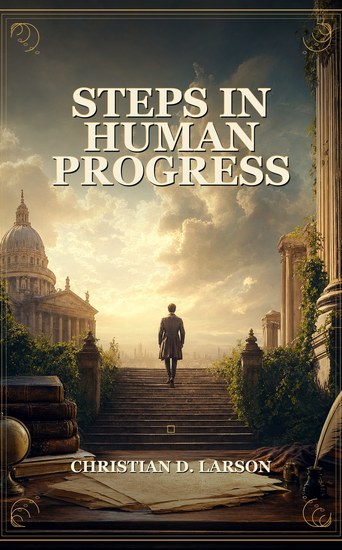
Steps in Human Progress - cover
LER

Steps in Human Progress

Christian D. Larson

Editora: Caelwick Press

  • 0
  • 0
  • 0

Sinopse

Steps in Human Progress by Christian D. Larson is offered here in a clean English digital edition prepared for fluent ebook reading. The work stands within classics and gives modern readers direct access to a public-domain classic with navigable structure and a restrained typographic presentation. The opening pages establish the book's atmosphere with this first movement: In the presence of modern thought and aspiration what may we consider the greatest, the worthiest, the most important and the most inspiring thing that man can do. This is one of the leading questions of today, and we are face to face with a new answer, an answer that has never been given before. In This edition is suited to readers who want a reliable, uncluttered version of the text for study, rediscovery, and sustained reading.
Disponível desde: 06/06/2026.
Comprimento de impressão: 79 páginas.

Outros livros que poderiam interessá-lo

  • Carnivorine - From their pens to your ears genius in every story - cover

    Carnivorine - From their pens to...

    Lucy H Hooper

    • 0
    • 0
    • 0
    The bookshelves of American literature are incredible collections that have gathered together centuries of very talented authors.  From this continent their fame spread and whilst among their number many are now forgotten or neglected their talents endure.  Among them is Lucy H Hooper.
    Ver livro
  • The Grammar of Love Nobel Prize 1933 - cover

    The Grammar of Love Nobel Prize...

    Ivan Bunin

    • 0
    • 0
    • 0
    Ivan Bunin received the 1933 Nobel Prize in Literature "for the strict artistry with which he has carried on the classical Russian traditions in prose writing." Aristocrat to the core, Bunin somehow remained connected to the land and people and keenly felt their pulse of life. His acute observations resulted in the accurate and unforgettable characters who populated his writing. His love for punctuation and punctilious choice of words is legendary. Reading Bunin's stories is one of the best ways to understand the mysterious Russian soul and begin to understand one of Russia's greatest periods of literature.
    Ver livro
  • Luck - From their pens to your ears genius in every story - cover

    Luck - From their pens to your...

    Mark Twain

    • 0
    • 0
    • 0
    Samuel Langhorne Clemens was born in Florida, Missouri on the 30th November 1835 and is far better known by his pen name of Mark Twain.  An American writer and humorist of the first order he is perhaps best known for his novels ‘The Adventures of Tom Sawyer’ and its sequel ‘The Adventures of Huckleberry Finn’ which are often described with that mythic line The Great American Novel. 
    Twain grew up in Hannibal, Missouri which would later provide the backdrop to these great novels.  Apprenticed to a printer he also became a typesetter and then a master riverboat pilot on the Mississippi.  Later, heading west with his brother Orion to make his fortune, he failed at gold mining and instead turned to journalism and thence his true calling as a writer of humorous stories where his wit and humor sparkled from every paragraph, his craft evident with every page and punctured target. 
    A staunch supporter of copyright protections this helped him keep much of the wealth his writing created, though much money was also lost on investments that he pursued in his love for science and technology as well as investing in his own inventions. 
    Twain was born during a visit by Halley’s comet, and he predicted that he would go out with it as well.  He died the day after its subsequent return on 21st April 1910, at his house, Stormfield, located in Redding, Connecticut.
    Ver livro
  • A Wagner Matinee - From their pens to your ears genius in every story - cover

    A Wagner Matinee - From their...

    Willa Cather

    • 0
    • 0
    • 0
    Willa Sibert Cather had Welsh ancestry but like her parents Charles and Mary, was born in Virginia, on 7th December 1873.  Despite strong roots in the community, Willa was 9, when the family moved to Nebraska, to work the rich soil and avoid TB of which there were numerous outbreaks in Virginia.   
    The vastness and drama of the Nebraska prairie and its’ extreme weather conditions as well as the many diverse cultures of the local families proved to be a major influence on her and can be evidenced in much of her later writing.   
    Her first writing was for the local journal when she was at the University of Nebraska and later became the managing editor of the student newspaper.    
    In 1896 she obtained work for a woman’s magazine in Pittsburgh and soon after became a regular contributor to the Pittsburgh Leader and wrote poetry and short stories for the Library, another local publication.   
    Her first collection of short stories, ‘The Troll Garden’, was published in 1905 and contains several of her most famous including ‘A Wagner Matinee’ and ‘Paul's Case.’ As a writer Cather was now taking immense strides forward.   
    Between 1913 and 1918 Cather wrote her Prairie Trilogy: ‘O Pioneers!’, ‘The Song of the Lark’, and ‘My Ántonia’ and in 1922 the Pulitizer Prize was hers for her novel ‘One of Ours’ set during WWI.  
    Acknowledged as one of America's greatest writers’ further honours flowed. In 1943 she was elected a Fellow of the American Academy of Arts and Sciences. The following year Cather received the gold medal for fiction from the National Institute of Arts and Letters.  
    A determinedly private person, Cather destroyed many old drafts, personal papers, and letters. Her will would also restrict the ability of scholars to quote from personal papers that remained. 
    On 24th April 1947, Willa Siebert Cather died of a cerebral haemorrhage at her Manhattan home. She was 73.
    Ver livro
  • The Withered Arm - From their pens to your ears genius in every story - cover

    The Withered Arm - From their...

    Thomas Hardy

    • 0
    • 0
    • 0
    Thomas Hardy was born in the hamlet of Upper Bockhampton about three miles east of Dorchester in Dorset, England, on 2nd June 1840.  
    Despite a fairly wide education and being an avid reader his parents thought it unlikely he would lead a successful scholarly or clerical career and he was apprenticed in 1856, at age 16, to a local architect whose speciality was in church restoration.  Hardy’s only opportunity to read was in the morning before work between the hours of five and eight.  
    On the back of a failed love affair he moved to London and spent five years working as an assistant to the architect Arthur Blomfield, also a restorer and designer of churches. Hardy though had by now become disillusioned with institutionalised forms of Christianity and abandoned any lingering hopes of ordination in the Anglican Church.  However, his writing of poetry was now flourishing, although it was still rejected for publication.  
    His novel ‘Desperate Remedies’, was published anonymously in 1871 and he now resolved to write full time though he was not yet in a position to achieve financial security or literary success. His second novel, ‘Under the Greenwood Tree’, appeared in 1872 and in 1873 ‘A Pair of Blue Eyes’, the most autobiographical of his works arrived. With ‘Far From the Madding Crowd’ in 1874, came critical acclaim, public attention and financial success. This was repeated in 1878 with ‘The Return of the Native’, and the ensuing years saw him rise to ever greater popularity.  
    His classic ‘The Mayor of Casterbridge’ arrived in 1886 and 5 years later ‘Tess of the d’Urbervilles’. The latter only saw publication after extensive alterations to its plot and the deletion of long passages to lessen the shock to the prudish Victorian audience who were dismayed by the seduction and ruin of a young girl by a rakish aristocrat.  
    ‘Jude the Obscure’, his last novel, suffered the same fate when it was published in 1895.  The uproar so disturbed him that he returned to poetry. In 1898 he had an earlier poetry collection, ‘Wessex Poems’ published. 
    Hardy spent the years between 1903 and 1908 writing ‘The Dynasts’, an epic poem on the Napoleonic Wars. 
    In his twilight years came honours and awards from the great and the good in recognition of his stature as one of the most outstanding of British authors across novels, short stories and poetry. George V conferred on him the Order of Merit in 1910. 
    From 1920 to 1927 he worked, in secret, on his autobiography, which was later published after his death as the work of his second wife, Florence Hardy.  
    Thomas Hardy OM died on the 11th January 1928. 
    His heart was buried alongside his first wife in Stinsford churchyard, Dorchester.
    Ver livro

  • Lilith - cover

    Lilith

    Ernest Rhys

    • 0
    • 0
    • 0
    First published in 1895, Lilith stands as one of George MacDonald’s most enigmatic and haunting works, a blend of fantasy, theology, and metaphysical speculation. Revered by literary giants such as C.S. Lewis and J.R.R. Tolkien, MacDonald’s fiction does not merely tell stories—it beckons readers into a deeper reality where moral and spiritual truths are woven into the very fabric of narrative. 
    Lilith is not a conventional fantasy. Instead, it is a dreamlike descent into questions of life, death, identity, and salvation. The protagonist, Mr. Vane, a reserved scholar, stumbles into a surreal realm beyond the physical world, where he encounters spectral beings, timeless landscapes, and the mysterious figure of Lilith—a being of both terrible beauty and tragic consequence. The novel explores the path from self-will to self-surrender, drawing heavily on Christian mysticism, Platonism, and a deep reverence for divine grace.
    Ver livro