¡Acompáñanos a viajar por el mundo de los libros!
Añadir este libro a la estantería
Grey
Escribe un nuevo comentario Default profile 50px
Grey
Suscríbete para leer el libro completo o lee las primeras páginas gratis.
All characters reduced
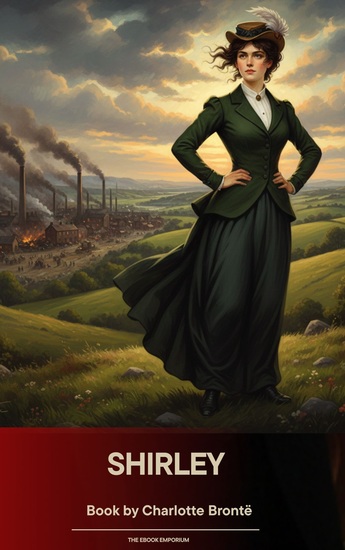
Shirley - cover

Shirley

Charlotte Brontë

Editorial: The Ebook Emporium

  • 0
  • 0
  • 0

Sinopsis

"I believe in the spirit of the age; it is a spirit of progress, though its path is often through blood."

Set in Yorkshire during the turbulent years of 1811–1812, Shirley is Charlotte Brontë's most ambitious social novel. Against a backdrop of the Luddite riots and the economic strangulation of the Napoleonic Wars, the story weaves together the lives of two very different women: the shy, repressed Caroline Helstone and the vibrant, independent heiress Shirley Keeldar.

The Clash of Progress and Tradition: At the heart of the crisis is Robert Moore, a mill owner whose determination to modernize his factory puts him at odds with his starving workers. As tensions escalate into violent attacks on the mill, the characters are forced to navigate a world of shifting loyalties, class warfare, and the harsh realities of the Industrial Revolution.

A Masterpiece of Shared Experience: While Jane Eyre focused on the individual, Shirley explores the power of community and the "Woman Question." Brontë masterfully portrays the bond between Shirley and Caroline as they challenge the restrictive roles imposed upon them by society. It is a novel of intellectual depth and political passion, blending gritty historical realism with a poignant search for personal fulfillment.

Witness the birth of the modern world through the eyes of two unforgettable women. Purchase "Shirley" today and experience Brontë's most expansive historical drama.
Disponible desde: 05/01/2026.
Longitud de impresión: 521 páginas.

Otros libros que te pueden interesar

  • Sketches by Boz - cover

    Sketches by Boz

    Charles Dickens

    • 0
    • 0
    • 0
    Charles Dickens's first published book, Sketches by Boz (1836) heralded an exciting new voice in English literature. This richly varied collection of observation, fancy and fiction shows the London he knew so intimately at its best and worst - its streets, theatres, inns, pawnshops, law courts, prisons, omnibuses and the river Thames - in honest and visionary descriptions of everyday life and people. Through pen portraits that often anticipate characters from his great novels, we see the condemned man in his prison cell, garrulous matrons, vulgar young clerks and Scrooge-like bachelors, while Dickens's powers for social critique are never far from the surface, in unflinching depictions of the vast metropolis's forgotten citizens, from child workers to prostitutes. A startling mixture of humor and pathos, these Sketches reveal London as wonderful terrain for an extraordinary young writer. Sketches is a remarkable achievement and looks towards Dickens's giant novels in its profusion of characters, its glimpses of surreal modernity and its limitless fund of pathos and comic invention." Support Us and visit our site at https://manifoldmedia.net/donate
    Ver libro
  • Middlemarch (Book 1: Miss Brooke) - cover

    Middlemarch (Book 1: Miss Brooke)

    George Eliot

    • 0
    • 0
    • 0
    Middlemarch (Book 1: Miss Brooke), A Study of Provincial Life is a novel by English author George Eliot, the pen name of Mary Ann Evans. It appeared in eight installments (volumes) in 1871 and 1872. Set in Middlemarch, a fictional English Midlands town, from 1829 to 1832, it follows distinct, intersecting stories with many characters. Issues include the status of women, the nature of marriage, idealism, self-interest, religion, hypocrisy, political reform, and education. Leavened with comic elements, Middlemarch approaches significant historical events in a realist mode: the Reform Act 1832, early railways, and the accession of King William IV. It looks at medicine of the time and reactionary views in a settled community facing unwelcome change. Eliot began writing the two pieces that formed the novel in 1869–1870 and completed it in 1871. Initial reviews were mixed, but it is now seen widely as her best work and one of the great English novels.
    Ver libro
  • A Man with Two Lives - From their pens to your ears genius in every story - cover

    A Man with Two Lives - From...

    Ambrose Bierce

    • 0
    • 0
    • 0
    Ambrose Gwinnett Bierce was born on 24th June 1842 at Horse Cave Creek in Meigs County, Ohio. His parents were poor but they introduced him to literature at an early age, instilling in him a deep appreciation of books, the written word and the elegance of language.  
    Growing up in Koscuisko County, Indiana poverty and religion were defining features of his childhood, and he would later describe his parents as “unwashed savages” and fanatically religious, showing him little affection but always quick to punish. He came to resent religion, and his introduction to literature appears to be their only positive effect. 
    At age 15 Bierce left home to become a printer’s devil, mixing ink and fetching type at The Northern Indian, a small Ohio paper. Falsely accused of theft he returned to his farm and spent time sending out work in the hopes of being published. 
    His Uncle Lucius advised he be sent to the Kentucky Military Institute. A year later he was commissioned as an Officer.  As the Civil War started Bierce enlisted in the 9th Indiana Infantry Regiment.  
    In April 1862 Bierce fought at the Battle of Shiloh, an experience which, though terrifying, became the source of several short stories. Two years later he sustained a serious head wound and was off duty for several months. He was discharged in early 1865.  
    A later expedition to inspect military outposts across the Great Plains took him all the way to San Francisco. He remained there to become involved with publishing and editing and to marry, Mary Ellen on Christmas Day 1871.  They had a child, Day, the following year.  
    In 1872 the family moved to England for 3 years where he wrote for Fun magazine. His son, Leigh, was born, and first book, ‘The Fiend’s Delight’, was published.  
    They returned to San Francisco and to work for a number of papers where he gained admiration for his crime reporting. In 1887 he began a column at the William Randolph Hearst’s San Francisco Examiner.  
    Bierce’s marriage fell apart when he discovered compromising letters to his wife from a secret admirer. The following year, 1889 his son Day committed suicide, depressed by romantic rejection. 
    In 1891 Bierce wrote and published the collection of 26 short stories which included ‘An Occurrence at Owl Creek Bridge’.  Success and further works including poetry followed.  
    Bierce with Hearst’s resources helped uncover a financial plot by a railroad to turn 130 million dollars of loans into a handout. Confronted by the railroad and asked to name his price Bierce answered “my price is $130 million dollars. If, when you are ready to pay, I happen to be out of town, you may hand it over to my friend, the Treasurer of the United States”.  
    He now began his first foray as a fabulist, publishing ‘Fantastic Fables’ in 1899.  But tragedy again struck two years later when his second son Leigh died of pneumonia relating to his alcoholism.  
    He continued to write short stories and poetry and also published ‘The Devil’s Dictionary’.  
    At the age of 71, in 1913 Bierce departed from Washington, D.C., for a tour of the battlefields where he had fought during the civil war. At the city of Chihuahua he wrote his last known communication, a letter to a friend. It’s closing words were “as to me, I leave here tomorrow for an unknown destination,” Ambrose Bierce then vanished without trace.
    Ver libro
  • The Rocking Horse Winner - From their pens to your ears genius in every story - cover

    The Rocking Horse Winner - From...

    D H Lawrence

    • 0
    • 0
    • 0
    David Herbert Lawrence was born on the 11th September 1885 in Eastwood, Nottinghamshire, a coal mining town where the reality of a harsh life was only useful as experiences for future literary works. 
    He was educated at Beauvale Board School and became the first local boy to receive a scholarship to attend Nottingham High School. After 3 years he became a junior clerk in Haywood’s surgical appliances factory. He was also attempting a literary career which, in the short term, led to a teacher training position in Eastwood and later a teaching qualification from University College, Nottingham.  
    Lawrence’s first efforts were poems, short stories and a draft of ‘The White Peacock’. Moving to London and a teaching position in Croydon his writing attracted the attention of Ford Madox Ford, editor of The English Review, and he commissioned him to write ‘Odour of Chrysanthemums’.  
    Wanting to write full-time he now began work on what would become ‘Sons and Lovers.   
    In 1912 he met the older and married mother-of-three Frieda Weekley. They eloped to Germany and here Lawrence could see for himself the growing tensions with France.  So keen was his interest that he was arrested and accused of being a British spy.  
    In early 1914 Frieda obtained her divorce and they returned to Britain to be married just days before the outbreak of war. Owing to her German parentage, and his own public dislike of militarism and violence, the couple were treated with contempt and suspicion throughout the war years.  
    Despite this he continued to write but his reputation in England was so tarnished and, mirrored by his own disdain for the country, he and Frieda left England in November 1919, first for Europe and then America via Ceylon and Australia. 
    They bought a ranch in Taos, New Mexico and visited Mexico several times. The third visit in March 1925 caused a near fatal attack of malaria. To convalesce they moved to Florence. Here he continued work on ‘Lady Chatterley’s Lover’ which for many years would cause controversy. A renewed interest in oil painting resulted in an exhibition in 1929 which was raided by the police and several works were confiscated.  
    D H Lawrence died of complications arising from a bout of tuberculosis on the 2nd of March 1930 in Vence, France.  He was 44.
    Ver libro
  • Where Angels Fear to Tread - cover

    Where Angels Fear to Tread

    E. M. Forster

    • 0
    • 0
    • 0
    E. M. Forster’s first novel explores the comic and tragic effects of culture clash between insular, provincial British personalities and sensual Italian culture and atmosphere. 
    Lilia Herriton, an impulsive thirty-three-year-old widow from London, travels to Tuscany, where she falls in love with both Italy and the handsome, carefree Gino Carella, a dentist's son twelve years her junior. When news reaches the snobbish Herriton family that Lilia intends to marry again, this time to an unsuitable Italian, the domineering Mrs. Herriton sends her son, Philip, to prevent the catastrophe—but he arrives too late. 
    When tragedy strikes, the Herriton family decides to bring Lilia's infant son to England to be brought up properly—but not everyone is satisfied with the situation.
    Ver libro
  • A Hero of Our Time - cover

    A Hero of Our Time

    Mikhail Lermontov

    • 0
    • 0
    • 0
    First published in Russia as Geroy Nashego Vremeni, A Hero of Our Time is set in the Russian Caucasus in the 1830s. 
    In A Hero of Our Time, Grigory Pechorin is a bored, self-centered, and cynical young army officer who believes in nothing. With impunity he toys with the love of women and the goodwill of men. He is brave, determined, and willful, but his wasted energy and potential ultimately result in tragedy. 
    This psychologically probing portrait of a disillusioned nineteenth-century aristocrat and its use of a nonchronological and multifaceted narrative structure influenced such later Russian authors as Fyodor Dostoevsky and Leo Tolstoy and presaged the antiheroes and antinovels of twentieth-century fiction.
    Ver libro