¡Acompáñanos a viajar por el mundo de los libros!
Añadir este libro a la estantería
Grey
Escribe un nuevo comentario Default profile 50px
Grey
Suscríbete para leer el libro completo o lee las primeras páginas gratis.
All characters reduced
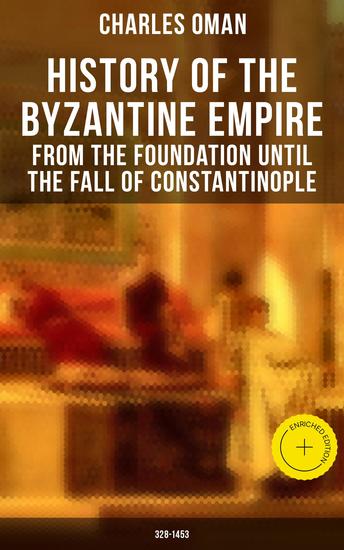
History of the Byzantine Empire: From the Foundation until the Fall of Constantinople (328-1453) - Enriched edition The Rise and Decline of the Eastern Roman Empire - cover

History of the Byzantine Empire: From the Foundation until the Fall of Constantinople (328-1453) - Enriched edition The Rise and Decline of the Eastern Roman Empire

Charles Oman

Editorial: Musaicum Books

  • 0
  • 0
  • 0

Sinopsis

In 'History of the Byzantine Empire: From the Foundation until the Fall of Constantinople (328-1453)', Charles Oman presents a comprehensive and meticulously researched account of the Byzantine Empire, tracing its development from its beginnings in the fourth century to its eventual downfall in the fifteenth century. Oman's writing style is scholarly and detailed, providing readers with a thorough understanding of the political, cultural, and religious aspects of the empire. The book is a must-read for anyone interested in the history of the Byzantine Empire and its significance in shaping the course of Western civilization. Oman's narrative is engaging and informative, making this book an essential resource for students and scholars alike. His analysis of key events and figures offers valuable insights into the complexities of the Byzantine Empire and its enduring legacy in the modern world.

In this enriched edition, we have carefully created added value for your reading experience:
- A succinct Introduction situates the work's timeless appeal and themes.
- The Synopsis outlines the central plot, highlighting key developments without spoiling critical twists.
- A detailed Historical Context immerses you in the era's events and influences that shaped the writing.
- A thorough Analysis dissects symbols, motifs, and character arcs to unearth underlying meanings.
- Reflection questions prompt you to engage personally with the work's messages, connecting them to modern life.
- Hand‐picked Memorable Quotes shine a spotlight on moments of literary brilliance.
- Interactive footnotes clarify unusual references, historical allusions, and archaic phrases for an effortless, more informed read.
Disponible desde: 21/03/2018.
Longitud de impresión: 230 páginas.

Otros libros que te pueden interesar

  • John - The World English Bible Book 43 (Unabridged) - cover

    John - The World English Bible...

    Authors Various

    • 0
    • 0
    • 0
    The Gospel of John is the fourth of the four canonical gospels. It contains a highly schematic account of the ministry of Jesus, with seven "signs" culminating in the raising of Lazarus (foreshadowing the resurrection of Jesus) and seven "I am" discourses (concerned with issues of the church-synagogue debate at the time of composition) culminating in Thomas' proclamation of the risen Jesus as "my Lord and my God". The gospel's concluding verses set out its purpose, "that you may believe that Jesus is the Christ, the Son of God, and that believing you may have life in his name.
    Ver libro
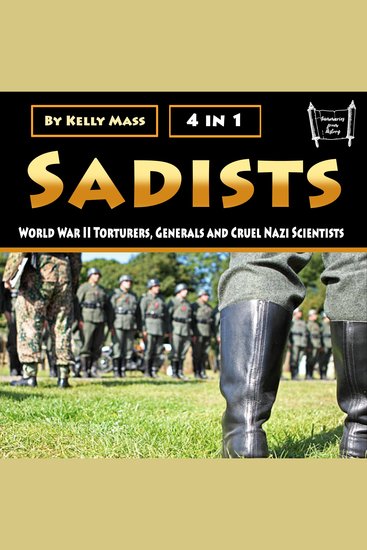
  • Sadists - World War II Torturers Generals and Cruel Nazi Scientists - cover

    Sadists - World War II Torturers...

    Kelly Mass

    • 0
    • 0
    • 0
    This is a combo of several books, which are: 
    1: Josef Mengele - Fiction books have been written about him. Documentaries have revealed the horrors he executed on innocent victims in concentration camps in Poland. Meet Dr. Josef Mengele, a man with a twisted mind who had no compassion for the subjects he experimented on. His methods were cruel. His conclusions were inconclusive, and his sadism hardly knew any boundaries. 
    2: Adolf Eichmann - You thought Adolf Hitler was bad. Well, someone who was less fortunate with power and control but equally sadistic was one of his slightly lower officers: Adolf Eichmann, the man who was in charge of many of the Holocaust deportations. In this book, you will learn more about the life of Eichmann, someone who had been slowly getting used to the idea that supposedly, the Jews were inferior and were allegedly a problem for the German civilization. 
    3: Paul Goebbels - There are doers and there are preachers. The people who were executing orders or abusing people in World War 2 wouldn’t have been able to commit any atrocities if the country hadn’t warmed up to an inhumane narrative. That’s where propaganda came in. Propaganda has long been part of various countries and societies to make the population believe something, and to find culprits, create feelings of animosity, and glorify local leaders or military campaigns. 
    4: Rudolf Hoess - We’ve all had our humble beginnings, and we seemed so innocent as children. However, for some people, given their childhood and circumstances, and then the political or war-driven environment they face, it goes completely wrong. Such was the case for Rudolf Hoess, a cruel, murderous Nazi commander who had been brainwashed by the system that justified his aid in exterminating millions of Jews.
    Ver libro
  • The Art Of War - The Classic Work With Comprehensive Annotations From The Greatest Chinese Commentators - cover

    The Art Of War - The Classic...

    Lionel Giles, Sun Tzu

    • 0
    • 0
    • 0
    There are many versions of this work in English, and it is included as a useful reflection once one has pondered Daoism’s key texts. The title is properly ‘'Sun Tzu's Military Method'. It was written at the time of the Dao and Zhuang Zi, several centuries before the Lieh Tzu. For fifteen hundred years, it was part of China’s canonical strategic anthology, which became known as the Seven Military Classics.In modern Anglophone culture it is often the only strategic text someone has read, supplanting and exceeding the previous dominant strategic text (von Clausewitz’s On War, 1832, tr. 1874). Leaders from Mao Zedong and Takeda Shingen to Võ Nguyên Giáp and Norman Schwarzkopf Jr. have explicitly acknowledged the book’s influence on them. This translation is notably the second major version of it in English. It follows a translation by Everard Ferguson Calthrop that Giles found deeply contemptible, as one can see from the introduction. It is important to note that most scholars do not consider the Art of War one of the classic Daoist texts. While it is a product and application of the philosophy, it is more of an exegetical monograph than a consideration of the philosophical underpinnings of Daoism. Much like the Zhuang Zi, it takes the core ideas and realizes them in specific practical situations. It does so with such certainty that many contest it as a ‘true’ Daoist work. As you will see from the discussions embedded elsewhere, the key Daoist texts value contradiction and paradox far too much to be as procedurally simple as the Art of War is.It is not clear that this criticism is fair, however. A much kinder perspective is that Daoism’s great failure is in its apparent lack of any utilitarian or social value. While Confucianism provides a balance, Sun Tzu’s work attempts to build a more practical version of Daoism than the key texts allow for.
    Ver libro
  • Plotting: Step-by-Step | Essential Story Plotting Conflict Writing and Plotline Tricks Any Writer Can Learn - cover

    Plotting: Step-by-Step |...

    Sandy Marsh

    • 0
    • 0
    • 0
    Your ‘Why’ for Writing, Will Also Be Their ‘Why’ for Reading 
    Are you struggling to take your story to the next level? Would you like to know the best ways to create intrigue and have your readers rave about your book? Plotting is a step-by-step guide that takes you through the process of developing compelling plots from beginning to end. 
    With tips and tricks taken straight from professional writers, the novelist will learn how to use plotlines for maximum effect, while retaining creative freedom. 
    Making Conflict Real 
    Plotting helps the author weave suspense through improved conflict-writing, centered around a developing plot. Characters are challenged, affected and emerge changed in ways that infuse emotions in your readers, so that they cannot help but be personally invested in the welfare of your protagonist. 
    8 Steps to Conflict Resolution 
    This book acts as a go-to framework for all levels of writers and introduces an 8-Step Process to adding substance to your story through plotting; these include:Get InspiredGetting DirectionTurn Your Ideas into a StoryCreate Your Story ArcStart with the End 
    From understanding the basic principles of a plotline, to placing your characters into situations that will help you get inside their head more, Marsh demonstrates the ways to make a plot event a more profound experience for the reader, to activate emotions and keep them engaged until the end of the book. 
    Order Now!
    Ver libro
  • On this Holy Island - A Modern Pilgrimage Across Britain - cover

    On this Holy Island - A Modern...

    Oliver Smith

    • 0
    • 0
    • 0
    A lyrical and insightful narrative that presents a new approach to the idea of pilgrimage, traversing paths both ancient and modern. 


    Retracing sacred travel made across time, from murmurs of ritual journeys in the depths of Ice Age to new pilgrimages of the twenty-first century, On This Holy Island is an an epic adventure across sacred British landscapes. We follow Oliver Smith as he climbs into remote sea caves, sleeps inside Neolithic tombs, scales forgotten holy mountains and once even marrons himself at sea. Following holy roads to churches, cathedrals and standing stones, this evocative and enlightening travelogue explores places prehistoric, pagan and Christian, Smith also reveals how football stadiums and music festivals have become contemporary places of pilgrimage. 


    Though the routes walked are often ancient, the pilgrims he meets are always modern. But underpinning the remarkable book is a timeless truth: that making journeys has always been a way of making meaning. So often, Smith finds, "the unravelling of a path goes in tandem with the unravelling of the soul."
    Ver libro
  • Towton and Bosworth: The History of the Wars of the Roses’ Most Important Battles - cover

    Towton and Bosworth: The History...

    Editors Charles River

    • 0
    • 0
    • 0
    Today, roses are a sign of love and luxury, but for over 30 years, they provided the symbols for two houses at war for control of the English throne. Thousands of people died and many more were injured fighting beneath the white rose of York and the red rose of Lancaster, and the noble families ruling England tore each other apart in a struggle that was as bitter as it was bloody. Though what followed was a period of strong rule under the Tudors monarchs, it ultimately came at a terrible cost, and even then, it was through Elizabeth of York that the Tudor line received its legitimacy. After all, while Henry VII won his throne in battle, Elizabeth of York was the daughter of King Edward IV of England, a Yorkist monarch. 
    Despite their limited social and economic impact, the political and personal dramas of the Wars of the Roses have ensured that they are well remembered and still part of the popular imagination. The most famous depictions of the period came from Shakespeare, whose earliest plays included Richard III and the three parts of Henry VI. Naturally, Shakespeare dramatized the tensions of what he presented as hugely destructive events, and his account, which showed the damage done by corruption and weak rule, and which turned Richard III into a popular villain, aimed to please the Tudor dynasty still in power at the time. Of course, it also played to a popular interest in high drama and the sort of personal and political conflicts that lay at the heart of the war. 
    Indeed, the Wars of the Roses were perfect material for a drama about greed, power and ambition, and many others followed Shakespeare's example. From Henry Payne's painting of a Shakespearean scene in which the two sides of the war are picked to John Everett Millais's mournful portrait of the Princes in the Tower, these pictures often evoke the tension and sorrow of the period, bringing it dramatically to life.
    Ver libro