¡Acompáñanos a viajar por el mundo de los libros!
Añadir este libro a la estantería
Grey
Escribe un nuevo comentario Default profile 50px
Grey
Suscríbete para leer el libro completo o lee las primeras páginas gratis.
All characters reduced
The History of Chivalry: Knighthood and Its Times (Vol1&2) - Complete Edition - cover

The History of Chivalry: Knighthood and Its Times (Vol1&2) - Complete Edition

Charles Mills

Editorial: DigiCat

  • 0
  • 0
  • 0

Sinopsis

In "The History of Chivalry: Knighthood and Its Times (Vol.1&2)," Charles Mills meticulously explores the intricate tapestry of medieval chivalric culture, emphasizing its evolution from the early feudal society to the romanticized ideals of later literature. Through rich narrative and detailed anecdotes, Mills captures the essence of knighthood, blending historical analysis with literary criticism. The prose is accessible yet scholarly, reflecting a deep engagement with primary sources and a nuanced understanding of the socio-political context that shaped chivalric ideals during the Middle Ages. Charles Mills, a prominent 19th-century historian, possessed a keen interest in the interplay between social customs and historical narratives. His background in history and literature, coupled with the intellectual currents of his time, influenced his perspective on chivalry as not merely a relic of the past, but a defining characteristic of European identity. Mills's scholarship is informed by the Romantic movement, which idealized chivalry, positioning it as a lens through which to critique contemporary society while celebrating the heroism of knights. This exhaustive study is essential for anyone captivated by medieval history, literature, or the social fabric of feudal Europe. Its thorough research and engaging prose make it not only informative but also enjoyable, inviting readers to consider the lasting impact of chivalric ideals on modern conceptions of honor and virtue.
Disponible desde: 12/11/2023.
Longitud de impresión: 506 páginas.


Otros libros que te pueden interesar

  • History of the Netherlands: A Captivating Guide to Ancient Germanic and Celtic Tribes the Eighty Years’ War the Dutch Empire and Republic and Modern Times - cover

    History of the Netherlands: A...

    Captivating History

    • 0
    • 0
    • 0
    A small country with a big heart and an incredible history! 
    The History of the Netherlands will guide you through the formation of a truly dynamic and diverse European nation. It is the rich and colorful story of how a collection of low-lying states aligned and bonded while others fell away. 
    Find out how the people of this country fought against nature to cultivate land below sea level. Discover how they survived wars, invasions, and natural disasters and developed a trading nation that would become the envy of Europe. Uncover the truth behind bloody battles fought between medieval royalty, warlords, and rebellious guilds of Dutch workers, all of which shaped the country we know today. 
    Learn about the path to the Northern Renaissance, a glorious time of innovative scientific developments, philosophical enlightenment, and some of the most beautiful paintings the world has seen. Explore the religious awakening that took root in the Netherlands that split the Christian Church forever. 
    Discover remarkable leaders, inspiring stories of human resourcefulness, and cautionary tales of spectacular downfalls. Listen to how a nation of craftsmen and traders founded a glittering empire and laid claim to exotic lands that brought fantastic wealth, riches, and international status despite being built on one of the most appalling practices in history. 
    The History of the Netherlands will take you on a journey through the ages and reveal some of the following:How people in the Stone Age flourished in a land without stone;Why the Romans met their match when they came against northern tribes;How a holy miracle became the making of Amsterdam;And much more! 
    Scroll up and click the “add to cart” button to discover the surprising story of a land that is so much more than bicycles, cheese, and tulips.
    Ver libro
  • The Devil's Pool - cover

    The Devil's Pool

    George Sand

    • 0
    • 0
    • 0
    With his wife dead and three young children to raise, ploughman Germaine decides that the time has come to marry again. He embarks on a journey to meet a rich widow, Catherine Leonard, in a match that has been approved by his father-in-law; however, he finds her proud and vain and surrounded by other suitors. Germaine prefers the company of Marie, a young shepherdess from his own village, but she is insistent that she wants a younger, more suitable husband...Influential French author George Sand(1804-76) is best known for two groups of novels; a series of romantic tales and a collection of country-life idylls.
    Ver libro
  • Marie Curie: A short biography - 5 Minutes: Short on time - long on info! - cover

    Marie Curie: A short biography -...

    5 Minutes, 5 Minute Biographies,...

    • 0
    • 0
    • 0
    Marie Curie, scientific genius and nobel prize laureate: Life and works in a short biography! Everything you need to know, brief and concise. Infotainment, education and entertainment at its best!
    Ver libro
  • George Herbert Mead on Social Psychology - cover

    George Herbert Mead on Social...

    George Herbert Mead, Anselm Strauss

    • 0
    • 0
    • 0
    One of the most brilliantly original of American pragmatists, George Herbert Mead published surprisingly few major papers and not a single book during his lifetime. Yet his influence on American sociology and social psychology since World War II has been exceedingly strong. 
     
    This volume is a revised and enlarged edition of the book formerly published under the title The Social Psychology of George Herbert Mead. It contains selections from Mead’s posthumous books: Mind, Self, and Society; Movements of Thought in the Nineteenth Century; The Philosophy of the Act; and The Philosophy of the Present, together with an incisive, newly revised, introductory essay by Anselm Strauss on the importance of Mead for contemporary social psychology. 
     
    “Required reading for the social scientist.”—Milton L. Barron, Nation
    Ver libro
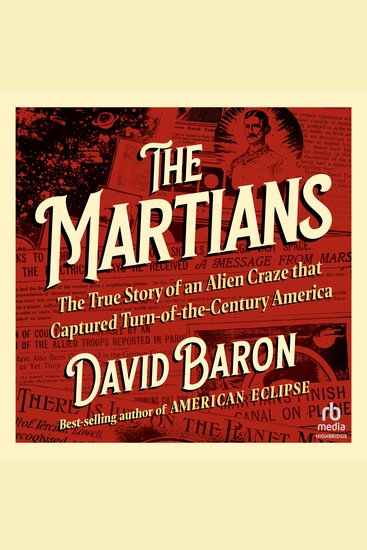
  • The Martians - The True Story of an Alien Craze that Captured Turn-of-the-Century America - cover

    The Martians - The True Story of...

    David Baron

    • 0
    • 0
    • 0
    In the early 1900s, many Americans actually believed we had discovered intelligent life on Mars, as bestselling science writer David Baron chronicles in The Martians, his truly bizarre tale of a nation swept up in Mars mania. 


    At the center of Baron's historical drama is Percival Lowell, the Boston Brahmin and Harvard scion, who observed "canals" etched into the surface of Mars. Lowell devised a grand theory that the red planet was home to a utopian society that had built gargantuan ditches to funnel precious meltwater from the polar icecaps to desert farms and oasis cities. The public fell in love with the ambitious amateur astronomer who shared his findings in speeches and wildly popular books. 


    While at first people treated the Martians whimsically―Martians headlining Broadway shows, biologists speculating whether they were winged or gilled―the discussion quickly became serious. Inventor Nikola Tesla announced he had received radio signals from Mars; Alexander Graham Bell agreed there was "no escape from the conviction" that intelligent beings inhabited the planet. Martian excitement reached its zenith when Lowell financed an expedition to photograph Mars from Chile's Atacama Desert, resulting in what newspapers hailed as proof of the Martian canals' existence.
    Ver libro
  • Kierkegaard - Existentialism and the Leap of Faith - cover

    Kierkegaard - Existentialism and...

    Hector Davidson

    • 0
    • 0
    • 0
    Søren Kierkegaard, often regarded as the father of existentialism, was born on May 5, 1813, in Copenhagen, Denmark. His early life was marked by tragedy, as his mother died when he was just a child, and his father, a deeply religious man, instilled in him a sense of guilt and the weight of existential questioning. Kierkegaard’s relationship with his father deeply influenced his philosophical development, particularly in his exploration of faith, despair, and the individual's relationship with God. 
    Kierkegaard’s intellectual journey began at the University of Copenhagen, where he studied theology and philosophy. He was deeply influenced by the works of philosophers such as Immanuel Kant and Friedrich Hegel, yet he sought to diverge from the systematic and rational approaches of these thinkers. Instead, he focused on the subjective aspects of human experience, emphasizing personal choice, individual responsibility, and the need for authentic existence. Kierkegaard believed that philosophy should not merely be an abstract pursuit but should directly address the real, lived experiences of individuals. 
    One of Kierkegaard's most significant contributions to philosophy was his critique of the established norms of society and religion. He believed that individuals often live in a state of "inauthenticity," blindly following social conventions and doctrines without truly reflecting on their own beliefs. For Kierkegaard, true existence could only be achieved through the individual’s leap of faith—an existential act that transcends reason and embraces the paradoxical nature of human life.
    Ver libro