¡Acompáñanos a viajar por el mundo de los libros!
Añadir este libro a la estantería
Grey
Escribe un nuevo comentario Default profile 50px
Grey
Suscríbete para leer el libro completo o lee las primeras páginas gratis.
All characters reduced
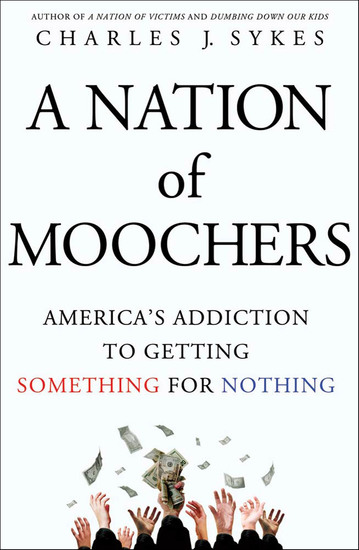
A Nation of Moochers - America's Addiction to Getting Something for Nothing - cover

A Nation of Moochers - America's Addiction to Getting Something for Nothing

Charles J. Sykes

Editorial: St. Martin's Press

  • 0
  • 0
  • 0

Sinopsis

We have experienced a shift in American character: we've become a nation of moochers. Increasingly dependent on the efforts of others over our own, Americans are free to freeload. From the corporate bailouts on Wall Street to the alarming increases in personal default and dependency, from questionable tax exemptions to enormous pension, healthcare, and other entitlement costs, the new moocher culture cuts across lines of class, race, and private and public sectors. And the millions that plan and behave sensibly, only to bail out the profligate? They're angry.Charles Sykes' argument is not against compassion or legitimate charity, but targets the new moocher culture, in which self-reliance and personal responsibility have given way to mass grasping after handouts. A Nation of Moochers is a persuasively argued and entertaining rallying cry for Americans who are tired of playing by the rules and paying for those who don't.
Disponible desde: 02/07/2024.
Longitud de impresión: 318 páginas.

Otros libros que te pueden interesar

  • The Bhagavad Gita - cover

    The Bhagavad Gita

    Barbara Miller

    • 0
    • 0
    • 0
    Moments before entering the battlefield, the great Pandava warrior, Prince Arjuna, faces a moral dilemma about the violence and death the war will cause. Questioning the meaning of life, Arjuna asks himself, "Why do I exist? Why should I fight against my loved ones? And where shall I go after I die?" Arjuna seeks out Krishna for the answers in The Bhagavad Gita, an ancient text that has been called the quintessence of the spirituality of India. Their dialogues touch upon ethical dilemmas and philosophical issues that go far beyond the war Arjuna faces.
    Ver libro
  • The Medieval Mind of C S Lewis - How Great Books Shaped a Great Mind - cover

    The Medieval Mind of C S Lewis -...

    Jason M. Baxter

    • 0
    • 0
    • 0
    C. S. Lewis had one of the great minds of the twentieth century.
    Many readers know Lewis as an author of fiction and fantasy literature, including the Chronicles of Narnia and the Space Trilogy. Others know him for his books in apologetics, including Mere Christianity and The Problem of Pain. But few know him for his scholarly work as a professor of medieval and Renaissance literature.
    What shaped the mind of this great thinker? Jason Baxter argues that Lewis was deeply formed not only by the words of Scripture and his love of ancient mythology, but also by medieval literature. For this undeniably modern Christian, authors like Dante and Boethius provided a worldview that was relevant to the challenges of the contemporary world.
    Here, readers will encounter an unknown figure to guide them in their own journey: C. S. Lewis the medievalist.
    Ver libro
  • Jews in the Garden - A Holocaust Survivor the Fate of His Family and the Secret History of Poland in World War II - cover

    Jews in the Garden - A Holocaust...

    Judy Rakowsky

    • 0
    • 0
    • 0
    Villages of Poland hide the lost secrets of World War II 


    1944: Heavy footfalls thud on the road on a rainy May night. A band of gunmen scour a hilltop farm, acting on rumors that it harbors a Jewish family. For 18 months, the Rozeneks have been hiding safely, but their luck is about to run out. Only one from the family of six will live to see the sunrise. Sixteen-year-old Hena Rozenek shelters in the woods until morning . . . and then she runs. 


    Forty years later: Holocaust survivor Sam Rakowski Ron has lived in the United States for decades, never thinking he could return to the Polish village he fled as a teenager. But now he's ready to talk about what he heard, what he saw, and what he knows about two separate families of cousins who were his neighbors, and presumably were killed during the war. The story Poland presents to the world is that Poles saved more Jews than citizens of any other nation, that any murders in Poland were committed by Nazis and Nazis alone. But Sam, while defending his countrymen, suspects a painful truth. The stories he shares with his younger cousin, Judy, an investigative journalist, send them off on a decades-long journey unlike any other to find out what happened to the Rozenek family and ultimately reveal the secrets the Polish government is still desperate to keep.
    Ver libro
  • Psychology of Pokemon The: The Power to Catch 'Em All - cover

    Psychology of Pokemon The: The...

    PhD Anthony Bean

    • 0
    • 0
    • 0
    “I see now that the circumstances of one’s birth are irrelevant. It is what you do with the gift of life that determines who you are.” – Mewtwo, Pokemon: The First Movie. 
    For more than two decades, Ash Ketchum, has been chasing his dream of becoming a Pokémon Master. His personal journey spans more than and 1,000 television episodes, 22 films, 122 Pokémon games (as of fall of 2021), discovering over 800 different species of Pokémon, numerous card games, and other merchandise children of the 90s still treasure today.  
    The Psychology of Pokémon guides gamers on a real-world quest of self-discovery so that they can Catch ‘em All. And, as part of this examination, psychologists, clinicians, video game researchers, professors, and enthusiasts unravel the mysteries of the Pokémon series by asking: 
    ·        Why is the Pokémon series so beloved by everyone even after we have grown up? 
    ·        What is the reason we trust a 10-year-old to accomplish the mission to become a Pokémon master and how does this affect our own sense of childhood? 
    ·        What can we take away from our own journey of the Pokémon series and its impact on catching them all? 
    ·        How can Ash Ketchum's perseverance and resilience teach us about Grit in the face of adversity? 
    ·        Why was 'Twitch Plays Pokémon' such an inspiration to us all? 
      
    Think you know Pokémon? The Psychology of Pokémon explores how the game resonates with a player's psychological drive toward an emotional sense of wholeness, bonding, and completion as they take part in this epic quest.
    Ver libro
  • A Rare Recording of President John F Kennedy’s "We Choose To Go To The Moon" Speech - cover

    A Rare Recording of President...

    President John F. Kennedy

    • 0
    • 0
    • 0
    "We choose to go to the Moon", officially titled the Address at Rice University on the Nation's Space Effort, is a September 12, 1962, speech by United States President John F. Kennedy to bolster public support for his proposal to land a man on the Moon before 1970. Kennedy gave the speech, largely written by presidential advisor and speechwriter Ted Sorensen, to a large crowd at Rice University Stadium in Houston, Texas. 
     
    President John Fitzgerald Kennedy (May 29, 1917 - November 22, 1963), often referred to by his initials JFK, was an American politician who served as the 35th president of the United States from 1961 until his assassination in 1963. He was the youngest person to assume the presidency by election and the youngest president at the end of his tenure. Kennedy served at the climax of the Cold War, and the majority of his foreign policy concerned relations with the Soviet Union and Cuba. A Democrat, Kennedy represented Massachusetts in both houses of the U.S. Congress prior to his presidency.
    Ver libro
  • The Shocking Truth about Political Corruption - cover

    The Shocking Truth about...

    Zoey Fraisers

    • 0
    • 0
    • 0
    Political corruption is a pervasive issue that has existed for centuries, shaping the course of governments and societies worldwide. It manifests in various forms, from bribery and fraud to nepotism and abuse of power. Regardless of the system of governance, corruption erodes trust, distorts policies, and undermines democratic principles. While many assume corruption is limited to authoritarian regimes, it is also deeply embedded in democratic institutions, where influence and money often dictate political decisions.  
      
    The roots of corruption can be traced back to the earliest civilizations, where leaders sought personal gain at the expense of their people. Throughout history, political scandals have exposed the extent of corruption within governments, from financial embezzlement to electoral fraud. These cases serve as stark reminders of how unchecked power can lead to widespread deception and exploitation. Corruption is not only a moral failure but a structural issue that allows those in power to manipulate systems designed to serve the public.  
      
    Beyond historical examples, the impact of corruption is far-reaching. It weakens economies by diverting public funds into private hands, leaving essential services such as healthcare, education, and infrastructure underfunded. It fuels inequality, as the wealthy and well-connected benefit from corrupt dealings while the average citizen suffers. When corruption becomes the norm, public trust in institutions erodes, leading to political apathy, civil unrest, and, in extreme cases, the collapse of governments. 
    Ver libro