¡Acompáñanos a viajar por el mundo de los libros!
Añadir este libro a la estantería
Grey
Escribe un nuevo comentario Default profile 50px
Grey
Suscríbete para leer el libro completo o lee las primeras páginas gratis.
All characters reduced
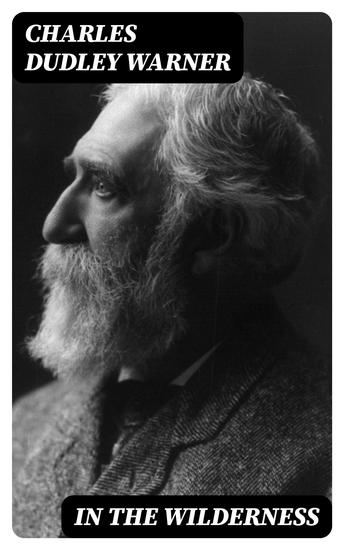
In the Wilderness - cover

In the Wilderness

Charles Dudley Warner

Editorial: DigiCat

  • 0
  • 0
  • 0

Sinopsis

In "In the Wilderness," Charles Dudley Warner immerses readers in the untamed beauty of the American wilderness, blending vibrant descriptive prose with reflective narrative. This work, published in the late 19th century, encapsulates the era's burgeoning relationship with nature and the conservation movement, showcasing Warner's keen observations of both the natural environment and society's impact upon it. Through an evocative and sometimes humorous style, he introspects on the American ethos, intertwining personal anecdotes with broader societal critiques, making the text a precursor to modern environmental literature. As a prominent figure in American literature and journalism, Warner's experiences and beliefs shaped his perspective, particularly his deep appreciation for nature and advocacy for environmental preservation. His camaraderie with contemporaries like Mark Twain and involvement in the Hartford community informed his narrative approach, blending intellect with accessibility. Warner's insights into the American landscape reflect a broader concern with industrialization and its consequences, themes that resonated with his audience and continue to be relevant today. For readers who seek a thoughtful exploration of nature and humanity's evolving role within it, "In the Wilderness" is an essential read. Warner's lyrical prose not only captivates but also challenges us to reconsider our relationship with the environment, making this book a timeless addition to any literary collection.
Disponible desde: 15/09/2022.
Longitud de impresión: 85 páginas.
Otros libros que te pueden interesar

  • Technology Touchpoints - Parenting in the Digital Dystopia - cover

    Technology Touchpoints -...

    PhD MAC Loretta L. C. Brady

    • 0
    • 0
    • 0
    This is a story about a family coming of age at the same time as smartphones and social media; a multiracial family coming into its own as windows into social injustice opened up before our very screens; and a multi-parent multi-professional family with children living differently depending on which house and which combination of family members happen to be home. While it is a story about a family, it is really the story of technological and global changes unfolding on our doorsteps. 


    While many revile the ascendance of smartphones and social media and the way they suck us into the vortex of cyberspace, there are cultural touchpoints that reflect deeper human and technology development patterns, patterns which we would all do well to understand, no matter whether or how we choose to engage in the ever-innovating digital frontiers. Informed by research and interviews with leaders in policy, human development, ethics, and technology, Loretta Brady helps listeners understand the complex systemic challenges and findings related to technology and human development. 


    We do not have to hate or fear technology. It is neither friend nor foe. But understanding its impact on our daily lives is paramount to cultivating a healthier relationship both with our digital lives and our real, lived ones.
    Ver libro
  • What You Don't Know - Successfully Lead A Software Project Without Tech Expertise - cover

    What You Don't Know -...

    Dr. Will Bralick

    • 0
    • 0
    • 0
    Starting a software development project is easy … but finishing it? Successfully? is a different story. Software CAN be developed that meets real needs and its development can be both efficient and effective. But. You have to know what you are up against. You need to know what questions to ask and how to understand the answers. 
    A non-technical manager, business owner, or SaaS founder who is responsible for the creation of a software system has a problem. A big problem. Crafting a software system is a complex process fraught with unexpected difficulties, impenetrable jargon, and hidden risks. Overwhelming. 
    Adrift in a "fog of ignorance." You don't even know what you don't know ... 
    The depth of those gaps in your knowledge may be substantial, but they can be filled selectively by reading/learning or by hiring the expertise. But in that "fog of ignorance" there is not even enough information to guide the learning or hiring. 
    This book burns off that fog to at least get you the clarity on what your "gaps in knowledge" are. 
    This book is intended for non tech SaaS founders, managers, and owner/operators who do not have a technical background but who are in a position that includes leading one or more technical projects. A great gift for your PHB. 
    Dr Will has a BS, MS, and PhD all in Computer Science as well as 40+ years managing software projects in the US Air Force, Texas Instruments, Raytheon, Collective Technologies, Club Corp, STX Cadware, and his own business Paladin Logic, Ltd. Dr Will was a pioneer in online instruction for the US Air Force, and has taught courses in Computer Science and Software Engineering at The Air Force Institute of Technology, Navel Postgraduate School, Southern Methodist University, Central Michigan University, and the University of Dallas.
    Ver libro
  • Birth of Modern Astronomy The: The History of the Scientists and Theories that Modernized Astronomy - cover

    Birth of Modern Astronomy The:...

    Editors Charles River

    • 0
    • 0
    • 0
    As interesting as the stories about Tycho Brahe are, chances are he wouldn’t be remembered if not for the important work he did, especially in the realm of astronomy. He lived in an era when the intellectual worldview of most in northern Europe was medieval in nature, influenced mostly by spirituality, mysticism, religion, and metaphysics. Brahe, however, was far-thinking in his outlook, taking advantages of the latest technological ideas and practicing empiricism to revolutionize the field of science. This work eventually led Brahe to cross paths with Johannes Kepler, whose laws on planetary motion would change everything.  
    Trying to define a man who had the qualities of a mathematician, astronomer, philosopher, inventor, and astrologer can prove difficult. But all of that can be ascribed to Johannes Kepler, one of the giants of his era who ushered in the Scientific Revolution and is often considered the first modern scientist. Kepler stood at a moment in time when the intellectual worldview of most in northern Europe was medieval in nature. Kepler, however, was far-thinking in his outlook. 
    	In his lifetime, Galileo straddled the epochs of the Renaissance and the Scientific Revolution, and it was his work and technological advances that helped usher in a brand new understanding of the solar system and the scientific method. Stephen Hawking himself has asserted, “Galileo, perhaps more than any other single person, was responsible for the birth of modern science." Of course, part of what made Galileo such a monumental figure was the fact that he was ahead of his time, and that he mostly refused to conform to the accepted dogmas of contemporary society.  
    In 1676, Sir Isaac Newton wrote in a letter, “If I have seen further it is by standing on ye sholders of Giants.” By the time he died, Newton had become science’s greatest giant, and every scientist who has followed him has stood on his shoulders. 
    Ver libro
  • The Smart Nonprofit - Staying Human-Centered in An Automated World - cover

    The Smart Nonprofit - Staying...

    Allison H. Fine, Beth Kanter

    • 0
    • 0
    • 0
    A pragmatic framework for nonprofit digital transformation that embraces the human-centered nature of your organization 


    In The Smart Nonprofit: Staying Human-Centered in an Automated World, a team of dedicated nonprofit thought leaders delivers a discussion of the information and tools nonprofit staffers and board members need to effectively use artificial intelligence without alienating the human stakeholders and donors on whom they rely. 


    Each chapter of the book offers a narrative discussion of how AI affects a particular functional area in an organization that includes case studies and practical tips for the ethical use of AI. You'll discover explorations of: 


    ● The steps you need to take to become a smart nonprofit and how to effectively lead a digitally transformed organization 


    ● How to automate program delivery, fundraising, and the back office 


    ● Likely future developments in AI for nonprofit work, including a more diverse field of programmers and data scientists and data sovereignty 


    Perfect for nonprofit leaders, board members, employees, managers, and founders, The Smart Nonprofit also belongs on the bookshelves of anyone interested in the intersection of leadership and technology.
    Ver libro
  • The Shocking Truth about Public Health Policies - cover

    The Shocking Truth about Public...

    Zoey Fraisers

    • 0
    • 0
    • 0
    Public health policies are often framed as measures designed to protect the population, improve well-being, and prevent disease. Governments, health agencies, and media outlets present these policies as the result of careful scientific research, public interest, and expert consensus. However, beneath the surface, public health is not just about science—it is deeply entangled with politics, economics, and power structures that influence decisions more than most people realize.  
      
    Many assume that public health guidelines are purely based on the best available data, but the reality is far more complex. Policies are frequently shaped by corporate interests, lobbying efforts, and political agendas rather than unbiased scientific evidence. Pharmaceutical companies, food conglomerates, and other industries wield significant influence over the very institutions meant to regulate them. This raises critical questions: Are these policies truly designed for the benefit of the people, or are they tools for financial and political gain?  
      
    The illusion of safety plays a crucial role in how these policies are accepted by the public. Fear-based messaging, emotional appeals, and selective use of data are commonly employed to justify drastic measures. The COVID-19 pandemic provided a stark example of this phenomenon—governments around the world enforced lockdowns, vaccine mandates, and surveillance measures, all under the banner of public health. Those who questioned the effectiveness or necessity of these policies were often silenced, labeled as spreading misinformation, or even punished. This suppression of dissent not only limits individual freedom but also prevents legitimate scientific debate from taking place. 
    Ver libro
  • The Quotable Darwin - cover

    The Quotable Darwin

    Janet Browne

    • 0
    • 0
    • 0
    A treasure trove of illuminating and entertaining quotations from the legendary naturalistHere is Charles Darwin in his own words—the naturalist, traveler, scientific thinker, and controversial author of On the Origin of Species, the book that shook the Victorian world. Featuring hundreds of quotations carefully selected by world-renowned Darwin biographer Janet Browne, The Quotable Darwin draws from Darwin’s writings, letters to friends and family, autobiographical reminiscences, and private scientific notebooks. It offers a multifaceted portrait that takes readers through his youth, the famous voyage of the Beagle, the development of his thoughts about evolution, his gradual loss of religious faith, and the time spent turning his ideas into a well-articulated theory about the natural origin of all living beings—a theory that dangerously included the origin of humans.The Quotable Darwin also includes many of the key responses to Darwin’s ideas from figures across the social spectrum, scientists and nonscientists alike—and criticism too. We see Darwin as an innovative botanist and geologist, an affectionate husband and father, and a lively correspondent who once told his cousin that he liked to play billiards because “it drives the horrid species out of my head.” This book gives us an intimate look at Darwin at work, at home, as a public figure, and on his travels.Complete with a chronology of Darwin’s life by Browne, The Quotable Darwin provides an engagingly fresh perspective on a remarkable man who was always thinking deeply about the natural world.
    Ver libro