Junte-se a nós em uma viagem ao mundo dos livros!
Adicionar este livro à prateleira
Grey
Deixe um novo comentário Default profile 50px
Grey
Assine para ler o livro completo ou leia as primeiras páginas de graça!
All characters reduced
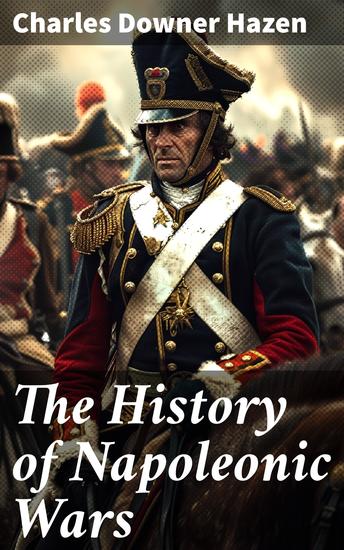
The History of Napoleonic Wars - Unveiling the Epic Conflict of Napoleon's Reign - cover
LER

The History of Napoleonic Wars - Unveiling the Epic Conflict of Napoleon's Reign

Charles Downer Hazen

Editora: Good Press

  • 0
  • 0
  • 0

Sinopse

In "The History of Napoleonic Wars," Charles Downer Hazen meticulously chronicles the multifaceted campaigns led by Napoleon Bonaparte that reshaped Europe at the turn of the 19th century. Hazen'Äôs scholarly approach combines rigorous analysis with engaging narrative, providing readers with a thorough examination of not only the battles and military strategies but also the sociopolitical contexts that influenced them. His work is characterized by a clear prose style that elucidates complex historical events, making them accessible yet profound. Positioned within the broader framework of European history, this text offers critical insights into the causes and ramifications of the Napoleonic Wars, aligning with contemporary historical discourse focused on the interplay between leadership and national identity. Charles Downer Hazen, an eminent historian and educator, was deeply influenced by the cultural and ideological upheavals of his time. His academic background in history, coupled with his keen interest in political dynamics, inspired him to explore the lasting impact of Napoleon'Äôs ambitions on Europe. Hazen's extensive research and his commitment to contextualizing historical narratives have solidified his reputation as a significant voice in the field of historical scholarship. I highly recommend "The History of Napoleonic Wars" to anyone engaged in the study of military history or European studies. Hazen'Äôs work not only enriches our understanding of a pivotal era but also invites readers to reflect on the intricate connections between warfare, politics, and society. It is a compelling read for both scholars and general readers seeking a comprehensive understanding of Napoleon'Äôs legacy.
Disponível desde: 20/12/2023.
Comprimento de impressão: 75 páginas.


Outros livros que poderiam interessá-lo

  • Raymond - cover

    Raymond

    Sir Oliver Lodge

    • 0
    • 0
    • 0
    "Raymond; or, Life and Death" by Sir Oliver Lodge is a captivating and thought-provoking exploration of the boundaries of existence, taking readers on a profound spiritual journey that delves into life, death, and the realms beyond. The book is rooted in the World War One death of the great physicist's son, and how the dead young man apparently gets back in touch with his living family. A true-life event, "Raymond" is a gripping masterpiece.
    Ver livro
  • The 4th Industrial Revolution from an Ethical Perspective - cover

    The 4th Industrial Revolution...

    Timo Plutschinski, Andrew...

    • 0
    • 0
    • 0
    As the Fourth Industrial Revolution ushers into a new era of artificial intelligence (AI) and virtual reality, how should we respond to the societal and ethical dilemmas associated with this new age of transformative scientific power? This research highlights the need for an ethical and globally shared view on how technology affects the economic, social, cultural and spiritual aspects of daily life. With thanks to the international team of experts this book is outlining consequences of the Fourth Industrial Revolution in a broad range for business and work life, for leadership, for media and communication, for churches and for personal and family life. Authors are: Prof. Dr. Jack Barentsen (USA) Andrew Bunnell (USA) Jonathan Ebsworth (United Kingdom) Prof. Dr.-Ing. Klaus Henning (Germany) Prof. Dr. Bruce A. Little (USA) Jeremy Peckham (United Kingdom) Rev. Timo Plutschinski (Germany) Sallux Publishing Printed Edition: ISBN 978-94-92697-20-2
    Ver livro
  • Egyptian Wisdom and the Hebrew Genesis - Ancient Egypt the Light of the World Book 7 - cover

    Egyptian Wisdom and the Hebrew...

    Gerald Massey

    • 0
    • 0
    • 0
    [I]t was not the genesis of the universe that is imaged in astronomical mythology. The firmament was there; already waiting to be distinguished as upper and lower, and divided into the domains of night and day, or Sut and Horus, or Ansar and Kisar. The constellations were not created from nothing when they were figured out of stars. The firmamental water was not created by being divided into upper and lower. The earth was not created because distinguished from water as ground to go upon…. Heaven and earth existed when these were nameless, and did not come into existence on account of being named. –from “Egyptian Wisdom and the Hebrew Genesis” It goes unappreciated by modern Egyptologists, but it is embraced by those who savor the concept of a “hidden history” of humanity, and those who approach all human knowledge from the perspective of the esoteric. Gerard Massey’s massive Ancient Egypt: The Light of the World–first published in 1907 and the crowning achievement of the self-taught scholar–redefines the roots of Christianity via Egypt, proposing that Egyptian mythology was the basis for Jewish and Christian beliefs. Here, Cosimo proudly presents Book 7 of Ancient Egypt, in which Massey explains how Egyptian wisdom–which greatly concerns itself with matters of the womb and birth, water, and the offspring of gods–was appropriated by the Hebrew holy books, and explains how the Hebrew account of creation is a clear repetition of Egyptian mythology. Peculiar and profound, this work will intrigue and delight readers of history, religion, and mythology. British author GERALD MASSEY (1828-1907) published works of poetry, spiritualism, Shakespearean criticism, and theology, but his best-known works are in the realm of Egyptology, including A Book of the Beginnings and The Natural Genesis.
    Ver livro
  • April 1865: The Tumultuous History of the Confederacy’s Last Month - cover

    April 1865: The Tumultuous...

    Editors Charles River

    • 0
    • 0
    • 0
    By the close of 1864, Abraham Lincoln had been reelected, the Union army had taken Nashville from General Hood, and Sherman had concluded his total war, “slash-and-burn” march of destruction to Savannah, Georgia, offering it as a Christmas present to Lincoln. Nevertheless, with everything seemingly falling to pieces, the South still held out hope of some sort of miracle, and Davis even attempted to send a peace delegation to meet with Lincoln in the early months of 1865. On January 28, 1865 as Union General Ulysses S. Grant was continuing to lay siege to Lee’s army at Petersburg, Virginia, Davis sent three commissioners headed by Vice-President Stephens to initiate informal peace talks with Lincoln. By February 3, however, the talks, known as the Hampton Roads Conference, came to a stalemate as Lincoln would accept nothing less than total union, while Davis would only accept Southern independence.  
    	Even at that point, the South was clearly on its last legs. General George H. Thomas destroyed John Bell Hood’s Confederate army at the battles of Nashville and Franklin, leaving only two large Confederate armies still in the field. Lee's army was weakened by desertion, lack of supplies and casualties, and Joseph E. Johnston’s army could barely resist against Sherman’s army as it was advancing north toward Virginia.  
    	To most observers, the South was clearly reaching its end, but Davis had no intention of quitting the war. Even while he was fleeing, he attempted to order Confederate generals in the field to keep fighting. On April 9, 1865, Lee formally surrendered his weary army to Grant at Appomattox. Appomattox is frequently cited as the end of the Civil War, but there still remained several Confederate armies across the country, mostly under the command of General Joseph E. Johnston.
    Ver livro
  • A Rare Recording of President Dwight D Eisenhower's 1961 Military-Industrial Complex Speech - cover

    A Rare Recording of President...

    President Dwight D. Eisenhower

    • 0
    • 0
    • 0
    On January 17, 1961, President Dwight Eisenhower delivered his political farewell to the American people on national television from the Oval Office of the White House. Those who expected the military leader and hero of World War II to depart his Presidency with a nostalgic, "old soldier" speech like Gen. Douglas MacArthur's, were surprised at his strong warnings about the dangers of the "military-industrial complex." As President of the United States for two terms, Eisenhower had slowed the push for increased defense spending despite pressure to build more military equipment during the Cold War’s arms race. Nonetheless, the American military services and the defense industry had expanded a great deal in the 1950s. Eisenhower thought this growth was needed to counter the Soviet Union, but it confounded him. Though he did not say so explicitly, his standing as a military leader helped give him the credibility to stand up to the pressures of this new, powerful interest group. He eventually described it as a necessary evil. The following is a transcript of the speech: 
     
    "Good Evening My Fellow Americans: 
     
    First, I should like to express my gratitude to the radio and television networks for the opportunities they have given me over the years to bring reports and messages to our nation. My special thanks go to them for the opportunity of addressing you this evening. 
     
    Three days from now, after half a century in the service of our country, I shall lay down the responsibilities of office as, in traditional and solemn ceremony, the authority of the Presidency is vested in my successor. 
     
    This evening I come to you with a message of leave-taking and farewell, and to share a few final thoughts with you, my countrymen. 
     
    Like every other citizen, I wish the new President, and all who will labor with him, Godspeed. I pray that the coming years will be blessed with peace and prosperity for all...
    Ver livro
  • Politics & Mission - Rediscovering the Political Power of What Christians Do - cover

    Politics & Mission -...

    Martin Gainsborough

    • 0
    • 0
    • 0
    Contrary to popular sentiment, Christianity is not dull or out of touch but fresh, relevant, exciting, and contemporary. The Church is political because it tells a radically different story from the dominant political norms of our day. Through a study of the Church’s liturgy, this book seeks to build confidence in the Church’s mission.
    
     
    Politics & Mission examines five pieces of liturgy—namely morning prayer, baptism, eucharist, footwashing and the funeral—detailing in turn the ways in which the language of the liturgy, which we often take for granted, is powerful and counter-cultural. Through its analysis, the book sheds light on three principal areas: what it is to be human, the challenges of contemporary mission, and the particular way in which the Church is political.
    
     
    In so doing, new resources are offered for the practicing Christian, those in Church leadership, and those looking at the Church from the outside, to reflect on and grapple with the challenges of this generation.
    Ver livro