Junte-se a nós em uma viagem ao mundo dos livros!
Adicionar este livro à prateleira
Grey
Deixe um novo comentário Default profile 50px
Grey
Assine para ler o livro completo ou leia as primeiras páginas de graça!
All characters reduced
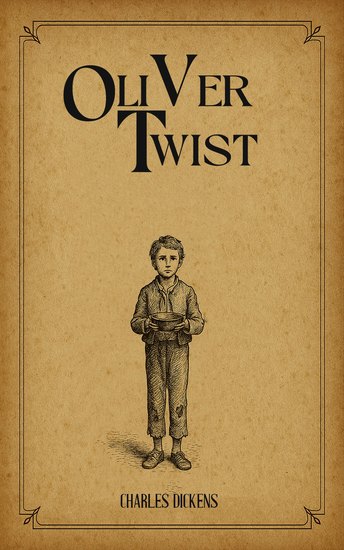
Oliver Twist - cover
LER

Oliver Twist

Charles Dickens

Editora: CLXBX

  • 0
  • 0
  • 0

Sinopse

Oliver Twist is one of Charles Dickens's most enduring and socially powerful novels, offering a vivid portrayal of poverty, crime, and compassion in Victorian England. Through the unforgettable story of a young orphan, Dickens exposes the harsh realities faced by society's most vulnerable while celebrating the resilience of innocence and the possibility of redemption.

Born into a workhouse and raised amid cruelty and neglect, Oliver Twist endures hunger, abuse, and injustice from an early age. After fleeing his brutal circumstances, he is drawn into the dark underworld of London, where he encounters a gang of thieves led by the cunning Fagin and the menacing Bill Sikes. Despite these influences, Oliver's innate goodness and moral purity remain uncorrupted.

As the story unfolds, secrets surrounding Oliver's birth come to light, intertwining his fate with characters from vastly different social worlds. Dickens contrasts the corruption of crime and institutional cruelty with acts of kindness, loyalty, and self-sacrifice, creating a powerful critique of the Poor Law system and social inequality.

Oliver Twist is a moving tale of survival, justice, and hope. Rich in memorable characters and dramatic tension, the novel highlights Dickens's deep concern for social reform and human dignity. Timeless and emotionally compelling, it remains a landmark work of English literature and a profound exploration of innocence struggling to survive in a cruel world.
Disponível desde: 05/02/2026.
Comprimento de impressão: 558 páginas.
Outros livros que poderiam interessá-lo

  • Demir-Kaya - From their pens to your ears genius in every story - cover

    Demir-Kaya - From their pens to...

    Alexander Kuprin

    • 0
    • 0
    • 0
    Alexander Kuprin was born in Narovchat, Penza in Russia on 7th September 1870. 
    At 3 his Father died and he and mother moved to Moscow. By 10 he was enrolled at the Second Moscow Military High School and there his interest in literature began. The Alexander Military Academy followed and two years later he was a sub-lieutenant and posted to an Infantry Regiment for a further four years. 
    Despite his duties he was a now a keen writer and published his first short story at this time. His military duties also garnered him experiences for his breakthrough work ‘The Duel’.  Leaving the military he left for Kiev to work for local newspapers.  He continued to publish both stories and novels and by 1901 he was in St Petersburg becoming part of a group that included Chekhov, Ivan Bunin, Maxim Gorky and Leonid Andreyev.  
    In the years that followed further controversial works and acclaim followed.  His comments on the regime meant he was also put under secret police surveillance.   
    As World War I erupted, Kuprin opened a military hospital but was then given command of an infantry company in Finland. He was soon discharged on grounds of ill health.  
    The October Revolution saw him praise Lenin, but he warned that the Bolsheviks threatened Russian culture and might cause further widespread suffering to the peasants.  As Civil War raged he took his family to Helsinki and then on to Paris. 
    Exile saw his talents decline further and his succumbing to alcoholism. He became lonely and withdrawn. The family's poverty increased his malaise.   
    In May 1937, the Kuprin’s returned to Moscow.  He now saw his work published but wrote almost nothing new.  In 1938 his health rapidly deteriorated.  Already suffering from a kidney problems and sclerosis, he had now developed cancer of the oesophagus.  
    Alexander Kuprin died on 25th August 1938.
    Ver livro
  • Poor Folk - cover

    Poor Folk

    Fyodor Dostoevsky

    • 0
    • 0
    • 0
    Two lonely souls. One shared hardship. A love written in letters that reveal everything they fear to say aloud.
    Told through intimate correspondence, Poor Folk follows humble clerk Makar Devushkin and young Varenka Dobroselova as they struggle against poverty, humiliation, and the quiet sorrow of life on society's margins. Their letters—filled with hope, shame, affection, and unspoken longing—create a portrait of human dignity that glows even in the darkest circumstances.
    
    Praised as "a stunning debut that announced Dostoevsky's genius," this novel blends social critique with deep emotional insight. Readers cherish its tenderness, realism, and the aching beauty of two people trying to comfort each other when the world offers them nothing.
    
    If you love heartfelt stories, powerful character voices, and classics that illuminate the resilience of the human spirit, this novel will move you deeply.
    
    Open the letters—and witness a love sustained by hope when everything else seems lost.
    Ver livro
  • Historic Doubts on the Life and Reign of King Richard the Third - cover

    Historic Doubts on the Life and...

    Horace Walpole

    • 0
    • 0
    • 0
    A provocative and influential reassessment of one of England’s most maligned monarchs. Challenging the traditional Tudor narrative—popularized by Shakespeare and chroniclers like Thomas More—Walpole argues that Richard III has been unfairly vilified as a tyrant and murderer. Through meticulous examination of historical sources, he questions the evidence behind accusations such as the murder of the Princes in the Tower and Richard’s physical deformities, suggesting bias and propaganda shaped his dark legacy. While not a full exoneration, Walpole’s work pioneered revisionist history and sparked debate about historical objectivity. Written with wit and scholarly rigor, Historic Doubts reflects Enlightenment skepticism and remains a landmark in the re-evaluation of medieval English history.
    Ver livro
  • The Master of Ballantrae - A Winter’s Tale - cover

    The Master of Ballantrae - A...

    Robert Louis Stevenson

    • 0
    • 0
    • 0
    Stevenson’s tragic masterpiece unfolds against a hauntingly beautiful Scottish landscape, where the 1745 Jacobite rising is dividing the country against itself. Amidst this outer conflict, one family finds itself devastatingly divided from within, as two brothers discover their opposing loyalties. Their rivalry soon spreads from war to love, as both try to win the hand of a wealthy and beautiful kinswoman. 
    Through a series of adventures, including seas voyages, piracy, and buried treasure, Stevenson weaves an acutely moving, psychologically complex story of the elemental struggle between good and evil.
    Ver livro
  • A Christmas Tree and a Wedding - cover

    A Christmas Tree and a Wedding

    Fyodor Dostoevsky

    • 0
    • 0
    • 0
    This short story by Fyodor Dostoevsky was first published in 1848. A man walking past a wedding is reminded of a children's New Year's Eve party he attended 5 years previously – a party that was clearly an excuse for the parents to make advantageous connections in a casual setting. As an outsider at the party, he was able to observe the guests in greater detail than most, and took particular note of the children playing by the Christmas tree, and the social hierarchy they unwittingly participated in. This recording is based on the 1918 translation by Constance Garnett.
    Ver livro
  • The Piazza Tales - cover

    The Piazza Tales

    Herman Melville

    • 0
    • 0
    • 0
    The Piazza Tales is a collection of six short stories by American writer Herman Melville, published by Dix & Edwards in the United States in May 1856 and in Britain in June. Except for the newly written title story, "The Piazza," all of the stories had appeared in Putnam's Monthly between 1853 and 1855. The collection includes what has long been regarded as three of Melville's most important achievements in the genre of short fiction, "Bartleby, the Scrivener", "Benito Cereno", and "The Encantadas", his sketches of the Galápagos Islands. (Billy Budd, arguably his greatest piece of short fiction, would remain unpublished in his lifetime.)
    Melville had originally intended to entitle the volume Benito Cereno and Other Sketches, but settled on the definitive title after he had written the introductory story. The book received largely favorable reviews, with reviewers especially praising "The Encantadas" but did not sell well enough to get Melville out of his financial straits, probably because short fiction for magazines had little appeal to bookbuyers. From after Melville's rediscovery to the end of the twentieth century, the short works that attracted the most critical attention were "Bartleby," "Benito Cereno" and "The Encantadas," with "The Piazza" a little behind those.
    Ver livro