Begleiten Sie uns auf eine literarische Weltreise!
Buch zum Bücherregal hinzufügen
Grey
Einen neuen Kommentar schreiben Default profile 50px
Grey
Jetzt das ganze Buch im Abo oder die ersten Seiten gratis lesen!
All characters reduced
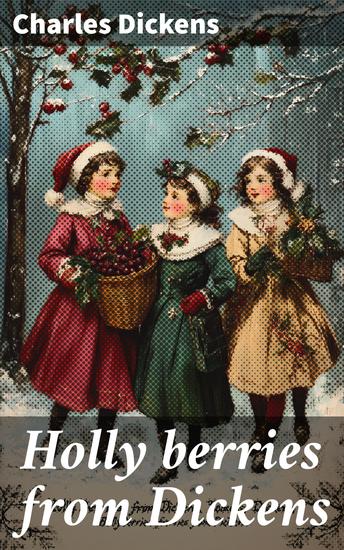
Holly berries from Dickens - cover

Holly berries from Dickens

Charles Dickens

Verlag: Good Press

  • 0
  • 0
  • 0

Beschreibung

In "Holly Berries from Dickens," readers are invited to explore a rich anthology of Charles Dickens' seasonal short stories that encapsulate the spirit of Christmas through his signature blend of vivid characterizations and moral lessons. This compilation showcases Dickens' ability to weave social commentary with enchanting narratives, portraying the joys and hardships of Victorian life. With its pastoral imagery and poignant prose, the collection serves as a reflection of the festive spirit, while addressing themes of generosity, redemption, and humanity. Charles Dickens, a titan of 19th-century literature, was deeply influenced by his own experiences of poverty and social reform. His festive tales were rooted in a desire to illuminate societal injustices and advocate for the less fortunate. Having faced his childhood struggles, Dickens viewed Christmas as an opportunity for renewal and compassion, which is beautifully reflected in his stories. His works not only aim to entertain but also to provoke thoughtful discourse on morality and social responsibility. "Holly Berries from Dickens" is a delightful read for those looking to immerse themselves in the warmth of the holiday spirit while contemplating deeper themes of kindness and community. This anthology is perfect for both devoted Dickens enthusiasts and newcomers alike, providing critical insights into the man behind the stories, and enriching the reader's understanding of the era that shaped his work.
Verfügbar seit: 02.03.2025.
Drucklänge: 190 Seiten.

Weitere Bücher, die Sie mögen werden

  • Candide - cover

    Candide

    Voltaire

    • 0
    • 0
    • 0
    Candide, ou l'Optimisme is a French satire first published in 1759 by Voltaire, a philosopher of the Age of Enlightenment. The novella has been widely translated, with English versions titled Candide: or, All for the Best (1759); Candide: or, The Optimist (1762); and Candide: Optimism (1947). It begins with a young man, Candide, who is living a sheltered life in an Edenic paradise and being indoctrinated with Leibnizian optimism by his mentor, Professor Pangloss. The work describes the abrupt cessation of this lifestyle, followed by Candide's slow and painful disillusionment as he witnesses and experiences great hardships in the world. Voltaire concludes Candide with, if not rejecting Leibnizian optimism outright, advocating a deeply practical precept, "we must cultivate our garden", in lieu of the Leibnizian mantra of Pangloss, "all is for the best" in the "best of all possible worlds".
    Candide is characterized by its tone as well as by its erratic, fantastical, and fast-moving plot. A picaresque novel with a story similar to that of a more serious coming-of-age narrative (Bildungsroman), it parodies many adventure and romance clichés, the struggles of which are caricatured in a tone that is bitter and matter-of-fact. Still, the events discussed are often based on historical happenings, such as the Seven Years' War and the 1755 Lisbon earthquake. As philosophers of Voltaire's day contended with the problem of evil, so does Candide in this short theological novel, albeit more directly and humorously. Voltaire ridicules religion, theologians, governments, armies, philosophies, and philosophers. Through Candide, he assaults Leibniz and his optimism.
    Candide has enjoyed both great success and great scandal. Immediately after its secretive publication, the book was widely banned to the public because it contained religious blasphemy, political sedition, and intellectual hostility hidden under a thin veil of naïveté. However, with its sharp wit and insightful portrayal of the human condition, the novel has since inspired many later authors and artists to mimic and adapt it. Today, Candide is considered as Voltaire's magnum opus and is often listed as part of the Western canon. It is among the most frequently taught works of French literature. The British poet and literary critic Martin Seymour-Smith listed Candide as one of the 100 most influential books ever written.
    Zum Buch
  • Ulysses - cover

    Ulysses

    James Joyce

    • 0
    • 0
    • 0
    "To learn one must be humble. But life is the great teacher."
    
    Set entirely over the course of a single day—June 16, 1904—Ulysses follows the ordinary wanderings of Leopold Bloom through the streets of Dublin. As he eats, walks, works, and mourns, his path eventually crosses with Stephen Dedalus, a young teacher and aspiring poet. This "everyman" epic elevates the mundane details of daily life—a burnt kidney for breakfast, a trip to the cemetery, a conversation in a library—to the level of myth. By weaving the inner thoughts of his characters into a "stream of consciousness," Joyce creates a portrait of human experience that is as vast as the ocean and as intimate as a heartbeat.
    
    A Revolution in Language: Joyce uses a different literary style for every chapter, ranging from newspaper headlines and catechism to a "maternity hospital" scene that evolves through every stage of the English language's history. Ulysses is not just a story; it is a linguistic playground that rewards curiosity and deep reading.
    
    The Human Soul Unfiltered: The novel concludes with the legendary "Penelope" episode—a 40-page, unpunctuated soliloquy by Bloom's wife, Molly Bloom. This stream of memory and desire is one of the most famous passages in literature, capturing the raw, chaotic, and beautiful flow of human thought as Molly affirms her love for life with a final, resounding "Yes."
    
    The Book That Changed Everything: Once banned for its frankness, Ulysses is now celebrated annually on Bloomsday. It remains a testament to the idea that there is an entire universe contained within a single person and a single day.
    
    Answer the call of the modern epic. Purchase "Ulysses" today and join the ranks of those who have conquered the greatest novel of our time.
    Zum Buch
  • The Facts in the Case of M Valdemar - cover

    The Facts in the Case of M Valdemar

    Edgar Allan Poe

    • 0
    • 0
    • 0
    "The Facts in the Case of M. Valdemar" is a short story by the American author Edgar Allan Poe about a mesmerist who puts a man in a suspended hypnotic state at the moment of death. An example of a tale of suspense and horror, it is also to a certain degree a hoax, as it was published without claiming to be fictional, and many at the time of publication (1845) took it to be a factual account. Poe admitted it to be a work of pure fiction in letters to his correspondents.
    The narrator presents the facts of the extraordinary case of his friend Ernest Valdemar, which have incited public discussion. He is interested in mesmerism, a pseudoscience involving bringing a patient into a hypnagogic state by the influence of animal magnetism, a process that later developed into hypnotism. He points out that as far as he knows, no one has ever been mesmerized at the point of death, and he is curious to see what effects mesmerism would have on a dying person. He considers experimenting on Valdemar, an author whom he had previously mesmerized and who has recently been diagnosed with phthisis (tuberculosis).
    Zum Buch
  • Rudin - cover

    Rudin

    Ivan Turgenev

    • 0
    • 0
    • 0
    "Rudin" by Ivan Turgenev is a captivating and introspective novel that explores the complexities of human nature, love, and intellectual ideals in 19th-century Russia. Through the compelling character of Dmitry Rudin, Turgenev presents a profound examination of the clash between lofty ideals and the realities of life. With its lyrical prose and profound exploration of the human condition, "Rudin" serves as a timeless reflection on the complexities of human nature and the eternal quest for personal fulfillment. Turgenev's masterful storytelling and astute social commentary make this novel a compelling and thought-provoking work that continues to resonate with readers today.
    Zum Buch
  • Wuthering Heights - cover

    Wuthering Heights

    Emily Brontë

    • 0
    • 0
    • 0
    Wuthering Heights is an 1847 novel by Emily Brontë, published under the pseudonym Ellis Bell. It concerns two families of the landed gentry living on the West Yorkshire moors, the Earnshaws and the Lintons, and their turbulent relationships with Earnshaw's adopted son, Heathcliff. It was influenced by Romanticism and Gothic fiction. 
     
    Wuthering Heights is now considered a classic of English literature, but contemporaneous reviews were polarized. It was controversial for its depictions of mental and physical cruelty, and for its challenges to Victorian morality, and religious and societal values. Emily Jane Brontë was an English novelist and poet who is best known for her only novel, Wuthering Heights, now considered a classic of English literature.
    Zum Buch
  • Of Time and the River - cover

    Of Time and the River

    Thomas Wolf

    • 0
    • 0
    • 0
    "A man's hunger for the world—the fury of youth, the mystery of time, and the pulse of a nation."
    
    In Of Time and the River, Thomas Wolfe paints a portrait of the artist as a young man on a grand scale. We follow Eugene Gant from the halls of Harvard University to the bustling streets of New York City and across the oceans to Europe. Driven by an insatiable hunger for knowledge, experience, and love, Eugene grapples with the weight of his family's past and the overwhelming promise of the future. Wolfe's prose is legendary—vibrant, torrential, and deeply poetic—capturing the "buried life" of humanity and the sprawling, contradictory beauty of early 20th-century America.
    
    The "Hunger" of Youth: Eugene Gant is one of literature's most relatable seekers. His journey is defined by a frantic desire to read every book, meet every person, and see every sight. Wolfe perfectly captures that specific time in life when the world feels both impossibly large and urgently within reach.
    
    A Symphony of Time: As the title suggests, the novel is obsessed with the flow of time—both the relentless "river" of history and the private, internal time of memory. Wolfe explores how we are shaped by the ghosts of our ancestors and the fleeting moments that define our identity.
    
    Why It Is a Masterpiece: Of Time and the River is more than a story; it is an experience. It is a book for anyone who has ever felt "homesick for a place they've never been." Wolfe's ability to find the epic in the everyday makes this one of the most powerful and enduring works of American Modernism.
    
    Lose yourself in the river of time. Purchase "Of Time and the River" today.
    Zum Buch