Junte-se a nós em uma viagem ao mundo dos livros!
Adicionar este livro à prateleira
Grey
Deixe um novo comentário Default profile 50px
Grey
Assine para ler o livro completo ou leia as primeiras páginas de graça!
All characters reduced
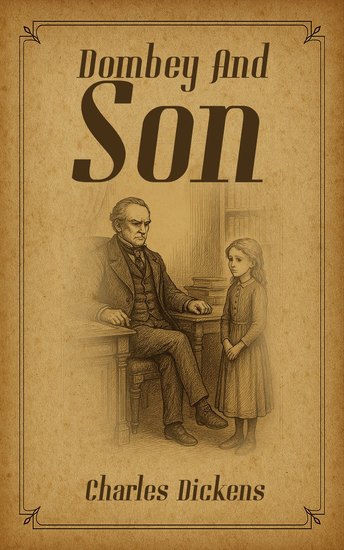
Dombey and Son - cover
LER

Dombey and Son

Charles Dickens

Editora: CLXBX

  • 0
  • 0
  • 0

Sinopse

Dombey and Son is a powerful and emotionally rich novel by Charles Dickens that explores pride, family, and the human cost of valuing wealth and status above love. Set in Victorian England, the story centers on Paul Dombey, a wealthy and rigid businessman who believes his commercial empire and family legacy are more important than human relationships.

From the moment his son is born, Mr. Dombey sees the child not as a source of affection, but as an heir—someone destined to carry on the prestigious firm of Dombey and Son. In contrast, he shows little regard for his daughter, Florence, whose deep love and loyalty are consistently ignored. As the novel unfolds, Dickens masterfully traces the consequences of this emotional coldness, revealing how pride and obsession with social standing fracture families and isolate individuals.

Through a wide cast of memorable characters—from the gentle and neglected Florence to the ambitious and manipulative figures drawn into Dombey's business world—the novel paints a vivid portrait of Victorian society. Themes of industrial progress, moral responsibility, parental duty, and redemption run throughout the narrative, balancing sharp social critique with deep compassion.

Ultimately, Dombey and Son is a story of loss and awakening. It asks whether success without love has any true value and whether a hardened heart can learn humility and compassion before it is too late. Rich in character development, emotional depth, and social insight, the novel remains one of Dickens's most enduring and thought-provoking works.
Disponível desde: 04/02/2026.
Comprimento de impressão: 1249 páginas.

Outros livros que poderiam interessá-lo

  • Daddy-Long-Legs - cover

    Daddy-Long-Legs

    Jean Webster

    • 0
    • 0
    • 0
    Jerusha Abbott, who much prefers to be called Judy, has received the offer of a lifetime: an anonymous benefactor has chosen to pay for her college education, in return for monthly letters. As a poor orphan with nothing of her own - even her name was chosen at random by the matron of the orphanage - this is the chance to choose her own future. Through heartfelt, witty, and honest correspondence, Judy discusses her friendships, classes, triumphs, and failures. Along the way, Judy also encounters a relationship that was entirely unexpected.This series, published by ONE Audiobooks, seeks to produce Classic titles read by handpicked audiobook narrators. ONE takes great care to cast these titles with readers who will provide an unmatched listening experience for these important works.
    Ver livro
  • The Wings of the Dove - cover

    The Wings of the Dove

    Henry James

    • 0
    • 0
    • 0
    "The Wings of the Dove" is a novel written by Henry James, first published in 1902. The novel is considered one of James's major works and is known for its intricate exploration of the complexities of human relationships and the moral dilemmas faced by its characters. It follows the story of an impoverished young woman named Milly Theale, who is suffering from a terminal illness. She becomes the object of the manipulative schemes of two friends, Kate Croy and Merton Densher, who seek to improve their own financial and social standing by exploiting Milly's vulnerability. The novel delves into themes of love, betrayal, and the moral consequences of one's actions.
    Ver livro
  • The Idiot - cover

    The Idiot

    Fyodor Dostoevsky

    • 0
    • 0
    • 0
    "Beauty will save the world."
    
    Prince Lev Nikolayevich Myshkin, a man of such pure honesty and childlike simplicity that he is mockingly dubbed "The Idiot," returns to the shark-infested waters of St. Petersburg society after years in a Swiss sanatorium. Seeking only to find the good in others, he is quickly ensnared in a volatile love triangle between the beautiful, traumatized "fallen woman" Nastasya Filippovna and the dark, obsessive merchant Rogozhin. As the Prince's saintly influence clashes with the vanity and greed of the Russian elite, Dostoevsky poses a devastating question: Can a truly good man survive in a world that is anything but?
    
    The Christ-Like Protagonist: Dostoevsky's goal was to depict a "perfectly beautiful" soul. Myshkin is a radical departure from the traditional literary hero; he is compassionate to a fault, lacks any ego, and suffers from epilepsy—a condition Dostoevsky shared and described with visceral, transcendent detail. The Prince is a mirror in which every other character sees their own failings and hidden virtues.
    
    A Tragedy of Modernity: The Idiot is a searing critique of a society obsessed with status, money, and intellectual posturing. Through the eccentric Epanchin family and the nihilistic youth of St. Petersburg, Dostoevsky captures a world on the brink of collapse, where genuine emotion is mistaken for madness and kindness is viewed as a fatal weakness. The novel's shocking conclusion remains one of the most powerful and debated endings in all of world literature.
    
    Experience the radiance and the darkness. Purchase "The Idiot" today and witness Dostoevsky's most heartbreaking achievement.
    Ver livro
  • The Snowstorm - Author of War & Peace Anna Karenina and countless other classics Russian realist Tolstoy brings a harsh look at life in Winter - cover

    The Snowstorm - Author of War &...

    Leo Tolstoy

    • 0
    • 0
    • 0
    Leo Tolstoy was born in 1828 in the Russian province of Tula to a wealthy noble family. As a child, he had private tutors but he showed little interest in any formal education. When he went to the University of Kazan in 1843 to study oriental languages and law, he left without completing his courses.  Life now was relaxed and idle but with some writing also taking place.  Gambling debts forced an abrupt change of path and he joined the army to fight in the Crimean War.  He was commended for his bravery and promoted but was appalled at the brutality and loss of life.  He recorded these and other earlier experiences in his diaries which formed the basis of several of his works. 
     
    In 1852 ‘Childhood’ was published to immediate success and was followed by ‘Boyhood’ and ‘Youth’. 
     
    His experience in the army and the horrors he witnessed resulted in ‘The Cossacks’ in 1862 and the trilogy ‘Sevastopol Tales’. After the war he travelled around Europe, visiting London and Paris and meeting such luminaries as Victor Hugo and Charles Darwin.  
     
    It was now that Tolstoy began his masterpiece, ‘War and Peace’. Published in 1869 it was an epic work that changed literature. He quickly followed this with ‘Anna Karenina’.  
     
    These successes made Tolstoy rich and helped him accomplish many of his dreams but also brought problems as he grappled with his faith and the lot of the oppressed poor. These revolutionary views became so popular that the authorities now kept him under surveillance.  
     
    He led a life of asceticism and vegetarianism and put his socialist ideals into practice by establishing numerous schools for the poor and food programmes. He also believed in giving away his wealth, which caused much discord with his wife.  
     
    His writing continued to bring forth classics such as ‘The Death of Ivan Ilyich’ and many brilliant and incisive short stories such as ‘How Much Land Does A Man Need’.  
     
    In 1901 Tolstoy was excommunicated from the Church and controversially deselected for the Nobel Prize for Literature. 
     
    Whilst undertaking a pilgrimage by train in October 1910 with his daughter Aleksandra he caught pneumonia in the nearby town of Astapovo.  Leo Tolstoy died on November 9th, 1910, he was 82. 
     
    In this much acclaimed short story Tolstoy’s characters are engulfed by a huge snowstorm which descends upon them and puts the successful conclusion of their journey into perilous doubt.
    Ver livro
  • A Dead Secret - From their pens to your ears genius in every story - cover

    A Dead Secret - From their pens...

    Lafcadio Hearn

    • 0
    • 0
    • 0
    Lafcadio Hearn was born on the 27th June 1850 on the Ionian isle of Levkás in Greece to a British Army officer and a Greek Mother. 
    His father, fearing for his career prospects at being married to a Greek Orthodox wife, sent them to Dublin whilst he continued to advance his career with further postings.  Life there was difficult for mother and son.  His father returned, wounded and traumatised, when Lafcadio was three.  He annulled the marriage and she remarried but had to give up care of Lafcadio to her sister-in law.   
    After brief periods for Catholic education in England and France he emigrated to Ohio in the United States when he was 19, taking on a series of casual jobs before embarking on a career as a journalist, publishing poems and essays in Cincinnati.  It was whilst here that he began a side-line in translating, starting with Gautier and Flaubert.  He married in 1874 to a 20 year old African-American woman in violation of Ohio's anti-miscegenation law.  The marriage soon failed. 
    In 1877 he relocated to New Orleans to write on a variety of themes before picking up a two year assignment from Harper’s to write in the West Indies, where he also wrote his first novel. 
    In 1890 Harper’s sent him to Japan.  Here he left journalism and took the remarkable decision to become a schoolteacher in the north of Japan.   Enraptured by the culture he was driven to explain it in various Western publications to those who had little, if any, knowledge of its culture.  Within the year he had fallen in love with, and married, a high-born Japanese lady, together they would have four children.   
    In 1895 he became a Japanese national and took the name Koizumi Yakumo, Koizumi being his wife’s family name. 
    The following few years, whilst a professor of Literature at the Imperial University of Japan, were his most creative and admired period.   
    Lafcadio Hearn died of heart failure on the 26th of September 1904, in Tokyo, Japan shortly before leaving to deliver a series of lectures at Cornell University in New York State.  He was 54.
    Ver livro
  • Other Gods The (Unabridged) - cover

    Other Gods The (Unabridged)

    H. P. Lovecraft

    • 0
    • 0
    • 0
    Barzai the Wise, a high priest and prophet greatly learned in the lore of the "gods of earth", or Great Ones, attempts to scale the mountain of Hatheg-Kla in order to look upon their faces, accompanied by his young disciple Atal. Upon reaching the peak, Barzai at first seems overjoyed until he finds that the "gods of the earth" are not there alone, but rather are overseen by the "other gods, the gods of the outer hells that guard the feeble gods of earth!" Atal flees, and Barzai is never seen again.
    Ver livro