¡Acompáñanos a viajar por el mundo de los libros!
Añadir este libro a la estantería
Grey
Escribe un nuevo comentario Default profile 50px
Grey
Suscríbete para leer el libro completo o lee las primeras páginas gratis.
All characters reduced
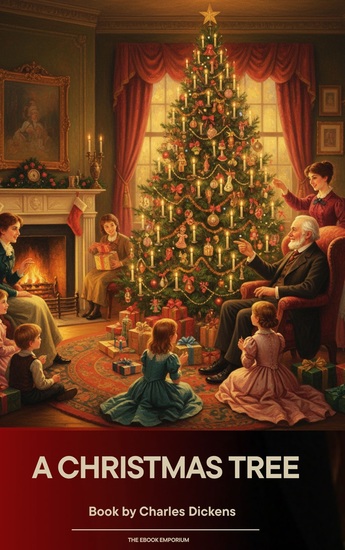
A Christmas Tree - cover

A Christmas Tree

Charles Dickens

Editorial: The Ebook Emporium

  • 0
  • 0
  • 0

Sinopsis

"I have been looking at a real Christmas tree, which stood in the middle of a great round table."

Before the world knew the full breadth of his holiday legacy, Charles Dickens penned this enchanting "meditation" on the centerpiece of the Victorian home. A Christmas Tree is not a traditional narrative, but a brilliant stream-of-consciousness exploration of memory. Looking upon the glittering branches of a tree, Dickens takes the reader on a nostalgic tour of the toys, the stories, and the spectral shadows that define our earliest holiday experiences.

A Toybox of the Imagination: Dickens vividly recreates the wonder of a child's world. He describes the "tumbling" dolls, the magic lanterns, and the leaden soldiers that once sparked his own imagination. Through his prose, we see the tree not just as a decoration, but as a living record of our growth—from the tangible excitement of childhood play to the more reflective, often haunting, memories of adulthood.

Ghosts of Christmas Past: In typical Dickensian fashion, the light of the tree is balanced by the shadows of the fire. The story delves into the "ghost stories" that were once an essential part of the midwinter tradition. Dickens reminds us that the holiday season is a time for remembering those who are no longer at the table, blending warmth with a poignant, Gothic sensibility that is uniquely his own.

Experience the heart of the holidays through the eyes of a master. Purchase "A Christmas Tree" today and rediscover the timeless magic of the season.
Disponible desde: 05/01/2026.
Longitud de impresión: 25 páginas.
Otros libros que te pueden interesar

  • The Wisdom of Uncle Podger - From their pens to your ears genius in every story - cover

    The Wisdom of Uncle Podger -...

    Jerome K. Jerome

    • 0
    • 0
    • 0
    Jerome Klapka Jerome was born on the 2nd May 1859 at Belsize House in Caldmore, Walsall, England. 
    His family were reduced to poverty whilst he was a toddler owning to failed investments in the local mining industry. 
    After several moves in declining circumstances Jerome became a pupil at St Marylebone Grammar School.  His aim then was to go into politics, or even become a man of letters, but with the death of his father, when he was thirteen, and his mother two years later, now meant that he had to support himself and leave all thoughts of education behind. 
    He spent four years working for the London and North Western Railway, initially collecting coal that fell along the railway lines.  Thereafter, using the name Harold Crichton, he tried his hand at acting but the repertory company he joined was stretched in its resources and, at times, relied on the actors to purchase their own props and costumes.  After three years he tried journalism, teaching and work as a solicitor’s clerk.  All came to nothing.  Finally, in 1885, he had some success with ‘On the Stage―and Off’, a comic memoir collection of his stage experiences and his early attempts at acting.  
    Shortly thereafter he married and his honeymoon on the Thames became the inspiration for ‘Three Men in a Boat’.  This of course was a wild success, both critically and commercially, but also his creative high point.  
    Although he was now able to write full time, he was never able to attain all the heights of that classic humorous novel.  He remained a prolific writer of novels, plays and short stories and its from those classic works that these stories have been mined. 
    Jerome K Jerome died in Northampton General Hospital on the 14th June 1927 two weeks after suffering a paralytic stroke and a cerebral haemorrhage on a motoring tour.  He was 68.
    Ver libro
  • Gooseberries - From their pens to your ears genius in every story - cover

    Gooseberries - From their pens...

    Anton Chekhov

    • 0
    • 0
    • 0
    Anton Pavlovich Chekhov was born on 29th January 1860 in Taganrog, on the south coast of Russia.  
    His family life was difficult; his father was strict and over-bearing but his mother was a passionate story-teller, a subject Chekhov warmed to. As he later said; ‘our talents we got from our father, but our soul from our mother’.  
    At school Chekhov was distinctly average. At 16 his father mis-managed his finances and was declared bankrupt. His family fled to Moscow. Chekhov remained and eked out a living by various means, including writing and selling short sketches to newspapers, to finish his schooling. That completed and with a scholarship to Moscow University obtained he rejoined his family. 
    He was able to help support them by selling satirical sketches and vignettes of Russian lifestyles and gradually obtained further commissions. In 1884, he qualified as a physician and, although it earned him little, he often treated the poor for free, he was fond of saying ‘Medicine is my lawful wife, and literature is my mistress.’ 
    His own health was now an issue as he began to cough up blood, a symptom of tuberculosis.  Despite this his writing success enabled him to move the family into more comfortable accommodation.  
    Chekhov wrote over 500 short stories which included many, many classics including ‘The Kiss’ and ‘The Lady with a Dog’.  His collection ‘At Dusk’ won him the coveted Pushkin Prize when was only 26.  
    He was also a major playwright beginning with the huge success of ‘Ivanov’ in 1887.   
    In 1892 Chekhov bought a country estate north of Moscow. Here his medical skills and money helped the peasants tackle outbreaks of cholera and bouts of famine. He also built three schools, a fire station and a clinic.  It left him with less time for writing but the interactions with real people gained him detailed knowledge about the peasantry and their living conditions for his stories.  
    His most famous work, ‘The Seagull’ was received disastrously at its premiere in St Petersburg. It was later restaged in Moscow to highlight its psychological aspects and was a huge success. It led to ‘Uncle Vanya’, ‘The Three Sisters’ and ‘The Cherry Orchard’.  
    Chekhov suffered a major lung hemorrhage in 1897 while visiting Moscow. A formal diagnosis confirmed tuberculosis and the doctors ordered changes to his lifestyle.  
    Despite a dread of weddings the elusive literary bachelor quietly married the actress Olga Knipper, whom he had met at rehearsals for ‘The Seagull’, on 25th May 1901. 
    By May 1904 with his tuberculosis worsening and death imminent he set off for the German town of Badenweiler writing cheerful, witty letters to his family and assuring them his health was improving.  
    On 15th July 1904 Anton Chekhov died at Badenweiler.  He was 44.
    Ver libro
  • The Emperor's New Clothes - cover

    The Emperor's New Clothes

    Hans Christian Andersen

    • 0
    • 0
    • 0
    A short tale by Hans Christian Andersen about two weavers who promise an Emperor a new suit of clothes that is invisible to those who are unfit for their positions, stupid, or incompetent.  The tale has been translated into over a hundred languages.
    Ver libro
  • The Money Box - From their pens to your ears genius in every story - cover

    The Money Box - From their pens...

    WW Jacobs

    • 0
    • 0
    • 0
    William Wymark Jacobs was born on 8th September 1863 in Wapping, East London.  
    He was educated at a private school and then Birkbeck Literary and Scientific Institution, now part of the University of London. 
    In 1879, Jacobs began work as a clerk in the civil service, in the Post Office Savings Bank.  In 1885 his first short story was published but it was not until almost the turn of the century that he would abandon his post office career to that as a full-time writer. By then he was a very popular author, his collections selling extremely well and with an excellent income. 
    His best-known work is the macabre ‘The Monkey's Paw’ and he is also highly regarded for his ghost stories although much of his remaining short story output is streaked with humour.  His characters are immediately identifiable and we all know that life will take chunks out of them in no time at all.  
    Jacobs married the noted suffragette Agnes Eleanor Williams in 1900 at West Ham, Essex. They went on to have two daughters and three sons as they settled down to life.  
    By the outbreak of the First World War his literary output had declined and he now mainly spent his time rewriting his earlier stories for the stage.  In all he wrote 18 plays. 
    W W Jacobs died on 1st September 1943 at Hornsey Lane, Islington in London. He was 79.
    Ver libro
  • The Moneychangers - cover

    The Moneychangers

    Upton Sinclair

    • 0
    • 0
    • 0
    In Upton Sinclair's "The Moneychangers," the ruthless world of high finance is laid bare as Wall Street titan Frank Cowperwood navigates a treacherous landscape of greed and power. Amidst banking scandals and corporate intrigue, Cowperwood's ambition knows no bounds, testing his morals and relationships. With a sharp critique of capitalism's darker facets, Sinclair weaves a compelling narrative of ambition, corruption, and the relentless pursuit of wealth.
    Ver libro
  • Immortal An - From their pens to your ears genius in every story - cover

    Immortal An - From their pens to...

    Sidney Benson Thorp

    • 0
    • 0
    • 0
    The bookshelves of British literature are incredible collections that have gathered together centuries of very talented authors.  From these Isles their fame spread and whilst among their number many are now forgotten or neglected their talents endure.  Among them is Sidney Benson Thorp.
    Ver libro