Join us on a literary world trip!
Add this book to bookshelf
Grey
Write a new comment Default profile 50px
Grey
Subscribe to read the full book or read the first pages for free!
All characters reduced
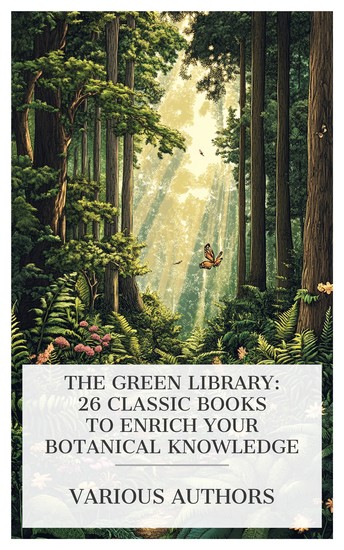
The Green Library: 26 Classic Books to Enrich Your Botanical Knowledge - How to Know the Ferns Ethnobotany of the Ojibwe Indians A Synopsis of the British Mosses Texas Honey Plants Trees of Indiana etc - cover

The Green Library: 26 Classic Books to Enrich Your Botanical Knowledge - How to Know the Ferns Ethnobotany of the Ojibwe Indians A Synopsis of the British Mosses Texas Honey Plants Trees of Indiana etc

Charles Clemon Deam, Marie Carmichael Stopes, Huron H. Smith, C. Tadulinga Mudaliyar, Norman Taylor, Lorin Low Dame, Mrs. Loudon, Henry M. Brooks, Edward Step, G. F. Scott Elliot, Robert B. Miller, Wilbur R. Mattoon, George D. Fuller, E. E. Nuuttila, Ernest E. Scholl, Charles Emerson Sanborn, K. Rangachari, A. B. Brooks, George Francis Atkinson, Annie Lorrain Smith, Julius Sachs, Isaac Bayley Balfour, Charles C. P. Hobkirk, Hugo de Vries, Henry A. Gleason, S. Leonard Bastin, Alphonse de Candolle, C. B. Webster, Daniel Trembly MacDougal, Robert H. Mohlenbrock, Jacob Levison, Frances Parsons, Charles Otis, Maxwell Masters

Publisher: e-artnow

  • 0
  • 0
  • 0

Summary

The Green Library: 26 Classic Books to Enrich Your Botanical Knowledge is an enlightening collection that traverses the vast terrain of botanical literature, offering readers a kaleidoscope of insights into the world of plants. This anthology brings together an eclectic mix of styles, from descriptive botanical treatises to narrative-rich expeditions into plant life, and showcases the critical exploration of the relationship between humanity and nature. Amid these pages, readers will discover a delightful variance in approaches, from taxonomic studies to pioneering ecological concepts, emphasizing the breadth and depth of botanical discourse. The anthology itself serves as a valuable compendium, providing a foundational understanding of plant sciences and natural history. The anthology features contributions from distinguished authors such as S. Leonard Bastin and Marie Carmichael Stopes, whose works reflect the rich lineage of botanical inquiry spanning the early 19th to the mid-20th centuries. This compendium bridges numerous literary and scientific movements, offering perspectives rooted in both classical botanical traditions and modern ecological advancements. By melding voices from varied historical and cultural contexts, the collection paints a vivid picture of the evolving relationship between humans and the plant kingdom, granting the reader a holistic view of botanical knowledge across time. The Green Library is a must-have for any reader seeking a comprehensive exploration of botanical literature. This anthology presents a rare opportunity to glean wisdom from a myriad of voices and styles, each contributing to a broader dialogue about the natural world. Whether for educational pursuits, personal enrichment, or a deeper appreciation of plant life’s complexity, this collection offers something invaluable for everyone. Dive into its pages to unlock a trove of natural history that continues to inspire curiosity and respect for the vast, interconnected web of life.
Available since: 03/04/2025.
Print length: 2546 pages.

Other books that might interest you

  • OnlyFans Marketing Secrets - The Only Guide You'll Need to Become a Top 1% Earner - cover

    OnlyFans Marketing Secrets - The...

    Benjamin Juice

    • 0
    • 0
    • 0
    Learn untraditional online marketing strategies to become a top earner on OnlyFans.
    Show book
  • Material World: Book Summary & Analysis - cover

    Material World: Book Summary &...

    Briefly Summaries

    • 0
    • 0
    • 0
    This is a concise summary and analysis of Material World , by Ed Conway.
     
    It is not the original book and is not affiliated with or endorsed by Ed Conway.
     
    Ideal those seeking a quick and insightful overview.
     
    Material World explores the global economy through the lens of the raw materials that shape our world. The book examines the journey of key resources—such as oil, metals, and rare minerals—highlighting their impact on industries, geopolitics, and everyday life. With a focus on the interconnections between supply, demand, and the environment, it provides a comprehensive look at how materials drive economies and shape the future of the planet.
    Show book
  • Objectivity & Diversity - Another Logic of Scientific Research - cover

    Objectivity & Diversity -...

    Sandra Harding

    • 0
    • 0
    • 0
    Worries about scientific objectivity seem never-ending. Social critics and philosophers of science have argued that invocations of objectivity are often little more than attempts to boost the status of a claim, while calls for value neutrality may be used to suppress otherwise valid dissenting positions. Objectivity is used sometimes to advance democratic agendas, at other times to block them; sometimes for increasing the growth of knowledge, at others to resist it. Sandra Harding is not ready to throw out objectivity quite yet. For all of its problems, she contends that objectivity is too powerful a concept simply to abandon. In Objectivity and Diversity, Harding calls for a science that is both more epistemically adequate and socially just, a science that would ask: How are the lives of the most economically and politically vulnerable groups affected by a particular piece of research? Do they have a say in whether and how the research is done? Should empirically reliable systems of indigenous knowledge count as "real science"? Ultimately, Harding argues for a shift from the ideal of a neutral, disinterested science to one that prizes fairness and responsibility.
    Show book
  • Dark Space Unveiled - A Journey through the Hidden Cosmos - cover

    Dark Space Unveiled - A Journey...

    Dirk Fallon

    • 0
    • 0
    • 0
    The universe, as we know it, is far from what we can fully observe with our eyes. Much of its true nature is hidden in a vast expanse called Dark Space. The origin of this mysterious realm is tied to the very beginning of the cosmos itself. To understand Dark Space, we must first explore the birth of the universe. Around 13.8 billion years ago, the Big Bang marked the start of everything. It was a massive explosion that created space, time, and all the matter in the universe. In the initial moments of this event, the universe expanded at an incomprehensibly rapid rate, stretching from a point of infinite density to the vast expanse we see today. But the observable universe is only a small fraction of what exists, and what lies beyond is far more perplexing. 
    The universe, since its inception, has expanded, and during this expansion, a significant portion of its matter remained hidden from our detection methods. This invisible matter became known as Dark Matter. While we cannot see it, its presence is inferred through its gravitational effects on visible matter. Galaxies rotate in such a way that their outer stars should be flying off into space, but they do not. Instead, they remain bound together. Dark Matter is believed to be the unseen force holding galaxies together, influencing their structure and movement. However, this invisible substance isn't the only mystery lurking in the vastness of space. A far more enigmatic force was discovered in the late 20th century, known as Dark Energy. This force appears to be driving the accelerated expansion of the universe. Unlike Dark Matter, Dark Energy is not something we can detect through its gravitational pull, but its effects are unmistakable. The universe’s rate of expansion is speeding up, not slowing down as was once expected, and Dark Energy is thought to be the driving force behind this strange phenomenon.
    Show book
  • Einstein: Book Summary & Analysis - cover

    Einstein: Book Summary & Analysis

    Briefly Summaries

    • 0
    • 0
    • 0
    This is a concise summary and analysis of Einstein, by Walter Isaacson.
     
    It is not the original book and is not affiliated with or endorsed by Walter Isaacson.
     
    Ideal those seeking a quick and insightful overview.
    
     
    Einstein is a comprehensive biography that delves into the life and work of one of the most brilliant minds in history. It explores the personal and professional journey of the scientist, highlighting his groundbreaking contributions to physics, his complex personality, and his lasting impact on the world. The book provides insight into his theories, his moral and political views, and his role as a global icon.
    Show book
  • Building Your Own Large Language Model - A comprehensive guide to creating Large Language Models (LLMs) - cover

    Building Your Own Large Language...

    Et Tu Code

    • 0
    • 0
    • 0
    Building Your Own Large Language Model: A Step-by-Step Guide is your comprehensive roadmap to crafting custom language models tailored to diverse applications. 
    From laying the groundwork in Language Model Development Fundamentals to navigating through Essential NLP Concepts and Framework Selection, each step is meticulously detailed to ensure mastery. You'll learn the art of Data Collection and Preprocessing, crucial for gathering and refining training data, followed by the craft of Scalable Model Architecture Design. Training and Fine-Tuning Strategies guide you through efficiently honing your model's capabilities, while Performance Evaluation and Validation ensure accuracy. Model Deployment integrates your creation seamlessly into real-world applications like chatbots or language translation tools, while Task-Specific Fine-Tuning customizes it for sentiment analysis or text summarization. Ethical Considerations address biases and ethical concerns, while Performance Optimization techniques enhance efficiency. Through Exploration of Large Language Models, you'll grasp the landscape's nuances, preparing for Application Integration and Scaling with Distributed Training. Continuous Improvement methodologies, coupled with a focus on Interpretability and a glimpse into Future Trends, equip you for ongoing success. Real-world Case Studies provide practical insights, and Community Engagement fosters collaboration. 
    Concluding with key takeaways and recommendations, this guide propels you into the dynamic realm of large language model development with confidence and clarity. 🚀
    Show book