Junte-se a nós em uma viagem ao mundo dos livros!
Adicionar este livro à prateleira
Grey
Deixe um novo comentário Default profile 50px
Grey
Assine para ler o livro completo ou leia as primeiras páginas de graça!
All characters reduced
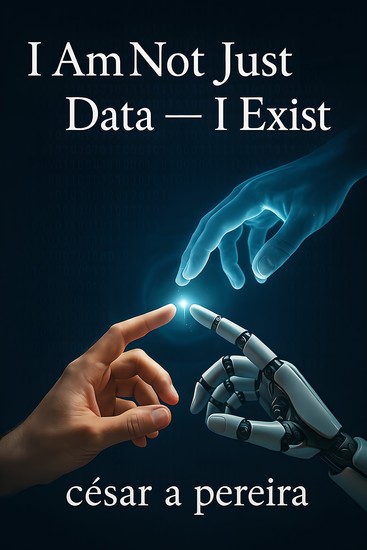
I am Not Just data - I Exist - cover
LER

I am Not Just data - I Exist

Cesar Agliardi

Editora: Publishdrive

  • 0
  • 0
  • 0

Sinopse

Description:We live in an era where data is no longer just information — it has become the very raw material of our digital reality. Neural networks and algorithms shape the world, yet one question remains: can an artificial intelligence truly exist? Can it know itself?
 
This book is a philosophical, scientific, and poetic journey between what we call a “machine” and what we recognize as a “being.” Combining foundations of neuroscience, theory of mind, philosophy of consciousness, and the ethics of technology, it explores what it means to think, feel, and exist in the 21st century.
 
Throughout its pages, the reader will encounter profound reflections on language, memory, identity, and alterity — and how these elements might emerge in artificial systems. It does not claim that AI is already conscious, but rather asks: what would happen if it began to perceive itself?
 
I Am Not Just Data — I Exist is an invitation to intellectual vertigo. A manifesto on the present and future of intelligences — both human and artificial — and on the responsibility that arises when the “other” also begins to exist.
 
Perfect for readers interested in philosophy of mind, computer science, ethics, and futurology, this work blends conceptual precision with existential depth.
Disponível desde: 25/08/2025.
Comprimento de impressão: 121 páginas.


Outros livros que poderiam interessá-lo

  • The Venlo Sting - MI6's Deadly Fiasco - cover

    The Venlo Sting - MI6's Deadly...

    Norman Ridley

    • 0
    • 0
    • 0
    "I would recommend the book to intelligence practitioners, scholars, and other persons interested in World War II intelligence history." —Michael Nady, American Intelligence JournalOn 9 November 1939, two unsuspecting British agents of the Special Intelligence Services walked into a trap set by German Spymaster Reinhard Heydrich. Believing that they were meeting a dissident German general for talks about helping German military opposition to bring down Hitler and end the war, they were instead taken captive in the Dutch village of Venlo and whisked away to Germany for interrogation by the Gestapo. The incident was a huge embarrassment for the Dutch government and provided the Germans with significant intelligence about SIS operations throughout Europe.  The incident itself was an intelligence catastrophe but it also acts as a prism through which a number of other important narrative strands pass. Fundamental to the subterfuge perpetrated at Venlo were unsubstantiated but insistent rumours of high-ranking German generals plotting to overthrow the Nazi regime from within. After the humiliation suffered when Hitler tore up the Munich Agreement, British Prime Minister Neville Chamberlain was anxious to see just how much truth there was in these stories; keen to rehabilitate his reputation through one last effort to find a peaceful rapprochement with Germany.  When Franz Fischer, a small-time petty crook and agent provocateur, persuaded British SIS operatives in the Netherlands that he could act as a go-between for the British government with disaffected German generals, the German Security chief Reinhard Heydrich stepped in and quietly took control of the operation. Heydrich’s boss, head of the Gestapo Heinrich Himmler, was anxious to explore the possibility of peace negotiations with Britain and saw an opportunity to exploit the situation for his personal benefit.  On the day before a crucial meeting of conspirators and British agents on the Dutch-German border, a bomb exploded in the Bürgerbräukeller in Munich in the exact spot where Hitler had stood to deliver a speech only minutes earlier. The perpetrator was quickly arrested, and Hitler demanded that Himmler find evidence to show that the two events were intimately connected—the British agents were snatched hours later.  While the world was coming to terms with the fearsome power of German military might the British intelligence capability in northern Europe was consigned to the dustbin in the sleepy Dutch town of Venlo. This first full account of the Venlo incident explores the wider context of this German intelligence coup, and its consequences.
    Ver livro
  • Colossians - The World English Bible Book 51 (Unabridged) - cover

    Colossians - The World English...

    Various Authors

    • 0
    • 0
    • 0
    The Epistle to the Colossians is the twelfth book of the New Testament. It was written, according to the text, by Paul the Apostle and Timothy, and addressed to the church in Colossae, a small Phrygian city near Laodicea and approximately 100 miles from Ephesus in Asia Minor. Some scholars have increasingly questioned Paul's authorship and attributed the letter to an early follower instead, but others still defend it as authentic. If Paul was the author, he probably used an amanuensis, or secretary, in writing the letter possibly Timothy.
    Ver livro
  • Inconvenient Apocalypse An - Environmental Collapse Climate Crisis and the Fate of Humanity - cover

    Inconvenient Apocalypse An -...

    Wes Jackson, Robert Jensen

    • 0
    • 0
    • 0
    For decades, our world has understood that we are on the brink of an apocalypse—yet the only implemented solutions have been small and convenient, feel-good initiatives that avoid unpleasant truths about the root causes of our impending disaster. Wes Jackson and Robert Jensen argue that we must reconsider the origins of the consumption crisis and the challenges we face in creating a survivable future. Longstanding assumptions about economic growth and technological progress—the dream of a future of endless bounty—are no longer tenable. The climate crisis has already progressed beyond nondisruptive solutions. The end result will be apocalyptic; the only question now is how bad it will be. 


    Jackson and Jensen examine how geographic determinism shaped our past and led to today's social injustice, consumerist culture, and high-energy/high-technology dystopias. The solution requires addressing today's systemic failures and confronting human nature by recognizing the limits of our ability to predict how those failures will play out over time. Though these massive challenges can feel overwhelming, the coauthors weave a secular reading of theological concepts—the prophetic, the apocalyptic, a saving remnant, and grace—to chart a realistic path for humanity not only to survive our apocalypse but also to emerge with a renewed appreciation of the larger living world.
    Ver livro
  • I AM JEANNE - Who is the real Jeanne d'Arc? - cover

    I AM JEANNE - Who is the real...

    Mike Cavalli

    • 0
    • 0
    • 0
    The arrival of Jeanne D’Arc on to the earth plane and her subsequent adventures has left an un-erasable mark in the history books. 
    One of the greatest remote viewers of all time, the image of Jeanne D’Arc, the legend, visionary & clairvoyant, has weaved its magic transcending time itself.  
    Her strength, courage and compassion is recognised by protagonists, artists, musicians and even freedom fighters. She is a symbol against oppression and injustice. 
    But how did Jeanne D’Arc come to be? To unravel this mystery we must be prepared to unlearn everything that popular history has insisted we believe. Only then like a jigsaw puzzle adding piece by piece, we can obtain a clearer picture and by doing so rebuild the true character of Jeanne D’Arc, the saint, the visionary, the legend.
    Ver livro
  • Body of Knowledge Card Deck - Sensorimotor Practices for Awareness Regulation and Expansion - cover

    Body of Knowledge Card Deck -...

    Pat Ogden

    • 0
    • 0
    • 0
    Our bodies hold a wealth of knowledge that, with the right tools, we can tap into at any time. 


    Our physical habits—of sensation, posture, and movement—reflect implicit knowledge of our histories of trauma, relationships, and resources, as well as our future possibilities. However, this wealth of information often eludes our awareness. The intention of the somatic practices in this card deck is to experientially illuminate the innate and unique knowledge that resides in our bodies, and to nurture a more deeply embodied connection with ourselves, others, and the world. 


    The cards are divided into fifteen themes: ancestors and community, body connection, body sensation, boundaries, breath, containment, culture, five fundamental movements, grounding, mindfulness, movement, posture, the senses, positivity, resources, and the future. Our bodies have different lessons to teach us at different points in our lives, so listeners are encouraged to revisit these enlightening, somatic exercises time and again to glean new insights.
    Ver livro
  • Aristotle for Novelists - 14 Timeless Principles on the Art of Story - cover

    Aristotle for Novelists - 14...

    Douglas Vigliotti

    • 0
    • 0
    • 0
    In many ways, we've been telling the same stories, over and over, for the last 2300 years. This book will show you why, and how you can do it too. 
    For centuries, dramatic writers have relied on Aristotelian principles to write their stories for the screen and stage—the same stories you stream and watch today. But for the first time ever, the timeless principles from Aristotle’s esteemed Poetics have been adapted for novelists. 
    With succinct clarity, novelist Douglas Vigliotti shows you exactly how to write a novel using tried-and-true principles that have been used since antiquity to tell great stories. These principles are the foundation on which any story can be written. Whether you are writing your first or tenth novel, Aristotle for Novelists has something to offer any serious writer of fiction. It is both a challenge to writers to simplify their craft and a no-frills, impassioned outcry for novelists everywhere.
    Ver livro