¡Acompáñanos a viajar por el mundo de los libros!
Añadir este libro a la estantería
Grey
Escribe un nuevo comentario Default profile 50px
Grey
Suscríbete para leer el libro completo o lee las primeras páginas gratis.
All characters reduced
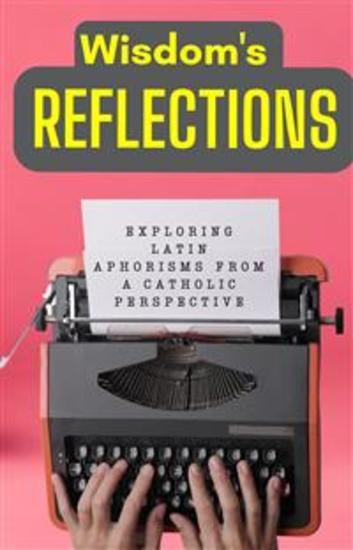
Wisdom's Reflections: Exploring Latin Aphorisms from a Catholic Perspective - cover

Wisdom's Reflections: Exploring Latin Aphorisms from a Catholic Perspective

Cervantes Digital

Editorial: Cervantes Digital

  • 0
  • 0
  • 0

Sinopsis

Embark on a profound journey of introspection with "Wisdom's Reflections: Exploring Latin Aphorisms from a Catholic Perspective." This captivating book extends an invitation to dive deep into the boundless wisdom encapsulated within Latin aphorisms, revealing their profound meanings through the lens of Catholic faith.

Structured with captivating intrigue, the "Table of Contents" unfolds like a pilgrimage through essential themes that encapsulate life's essence:

	Introduction: Immerse yourself in contemplating mortality as "Memento Mori" resonates powerfully, reminding us of life's impermanence.
	Carpe Diem: Reveal the divine essence of each day, guided by "Seizing the Divine Gift of Each Day," encouraging us to grasp life's fleeting moments.
	Amor Vincit Omnia: Witness the transformative power of love that transcends eras. Illuminated in "The Transformative Power of Love Throughout History," it reminds us of love's enduring influence.
	Mens Sana in Corpore Sano: Navigate the delicate equilibrium between mind and body. "The Transformative Balance Between Mind and Body" takes center stage, guiding us.
	Veritas Vos Liberabit: Venture into truth-seeking within the information age. "The Quest for Truth in the Information Age" resonates deeply, guiding us through modern complexities.
	Noli Foras Ire: Unearth authentic wisdom through self-discovery. "Discovering Authentic Knowledge Through Self-Knowledge" invites us on an inward journey.
	Dum Spiro, Spero: Experience the enduring strength of hope through Christian faith. "Hope Endures in Christian Faith" accompanies us through life's trials.
	Vivere Militare Est: Embrace life as an unending journey of perseverance. "Life as a Perpetual Struggle" empowers us to march forward.
	"In necessariis unitas, in dubiis libertas, in omnibus caritas": Embrace unity, freedom, and charity through a Christian lens. "A Call to Unity, Freedom, and Charity in the Christian Perspective" fosters a sense of community.
	Fides quaerens intellectum: Illuminate your path with faith seeking understanding. The pursuit of knowledge leads to enlightenment.
	Epilogue: Embark on a concluding reflection, a "Call to Action," compelling us to apply these insights to our lives.

As you immerse yourself in each chapter, a transformative odyssey unfolds, guided by faith, introspection, and the timeless wisdom of Latin aphorisms. "Wisdom's Reflections" transcends being just a book; it becomes a spiritual companion, beckoning you to plumb the depths of your soul and discover inspiration within age-old wisdom that remains profoundly relevant today.
Disponible desde: 27/08/2023.


Otros libros que te pueden interesar

  • Artificial Intelligence in the Primary Classroom - 101 ways to save time cut your workload and enhance your creativity - cover

    Artificial Intelligence in the...

    Emma Clarke

    • 0
    • 0
    • 0
    Artificial intelligence (AI) undoubtedly sparks debate among teachers. Questions arise about the trajectory of this new technology: where will it take us?; how will we differentiate between student-authored work and AI-generated content?; what impact will it have on the dynamics of learning and teaching within schools? These are all crucial topics for discussion, yet AI has already become an integral part of our reality, and Gemma Clark firmly believes that embracing its potential is in our best interests.
    In an era defined by technological advancements, Artificial Intelligence in the Primary Classroom stands as an indispensable resource that holds the key to transforming teaching and learning. For educators burdened by bureaucratic tasks that divert precious time from actual teaching, this book offers a lifeline. It showcases how AI-powered tools can alleviate administrative burdens, enabling teachers to focus more on crafting personalised and imaginative lessons that resonate with young minds. From automating report-writing processes to facilitating content creation, the book imparts tangible methods to streamline workflows and elevate teaching quality. Other examples include:
    
    - Spelling Lessons: Save time when planning your spelling lessons by using AI to automatically generate a comprehensive list of phonemes or 'sounds suitable for teaching young children.'
    - Mindfulness in the Classroom: If you are interested in incorporating mindfulness games and activities to assist children in relaxation and focus, AI can provide valuable suggestions for fostering pupil (and staff) wellbeing.
    - PE Lessons: You don't have to be an expert in sport to teach PE. Whether it's tennis, football, rugby or running, AI can offer suggestions for activities, warm-ups and cool-downs to use in your PE lessons.
    - Art Lessons: AI can be an excellent resource for planning art lessons, especially when seeking suggestions to emphasize one of the eight elements, such as line, shape, form, colour, value, texture, space, and value.
    - Maths Lessons: As with spelling, AI can significantly reduce the time spent on creating maths questions and simplify the process of differentiation.Artificial Intelligence in the Primary Classroom is filled with practical strategies, engaging activities and useful tips and tricks that will save teachers time and energy as well as transferrable lesson plans with step-by-step instructions. Backed up by real-world examples throughout, this book empowers teachers to embrace AI as a tool in fostering enhanced learning experiences, while also reclaiming invaluable time for pedagogical creativity.
    Suitable for primary school teachers of all levels of experience.
    Ver libro
  • Extended Summary - The Blood Of Olympus - Based On The Book By Rick Riordan - cover

    Extended Summary - The Blood Of...

    Quick Reading Library

    • 0
    • 0
    • 0
    EXTENDED SUMMARY 
      
    THE BLOOD OF OLYMPUS 
    BASED ON THE BOOK BY RICK RIORDAN 
      
    SUMMARY WRITTEN BY: QUICK READING LIBRARY 
      
    CONTENT 
    The Prophecy of the Blood of Olympus 
    Jason Grace's Struggle with His Identity 
    Reyna's Leadership and Loyalty 
    Leo Valdez and His Final Sacrifice 
    Piper McLean's Role in the Final Battle 
    Nico di Angelo's Hidden Power 
    The Army of Giants and the Battle for the Future 
    The Climax – The Fall of Gaia 
    The Aftermath and the Return to Camp Half-Blood 
    General Analysis of The Blood of Olympus 
      
    ABOUT THE ORIGINAL BOOK 
    The Blood of Olympus by Rick Riordan is the final book in the Heroes of Olympus series. It follows a group of seven demigods, each with unique powers, as they fight to prevent the Earth Mother, Gaia, from rising and destroying the gods of Olympus. As the demigods face powerful giants and the forces of nature, themes of sacrifice, loyalty, identity, and heroism dominate their journey. Throughout the story, the characters struggle with personal conflicts and difficult choices, while learning to work together despite their differences. The novel blends Greek and Roman mythology, delivering action, adventure, and emotional depth.
    Ver libro
  • Neuropsychology - cover

    Neuropsychology

    Miguel Vaquero

    • 0
    • 0
    • 0
    This book contains two topics, which are the following:1 - Memory Improvement: The ability for the brain to encode, store, and recall information is known as memory. Experience serves as a roadmap for future action.Memory includes both consciously recalled facts and experienced details as well as deeply embedded knowledge that pops up without thought or even awareness. It serves as both a temporary information storage space and a more lasting record of what has been learned.2 - The study of the anatomy and operation of the nervous system and the brain is known as neuroscience. To map the brain mechanistically, neuroscientists draw on cellular and molecular biology, anatomy and physiology, human behavior and cognition, and other fields.Each neuron, or brain cell, in an adult human has an estimated 100 billion connections to other neurons. The mapping of all the cell-to-cell communication networks—the brain circuits that process all ideas, feelings, and behaviors—remains one of the major difficulties of contemporary neuroscience. The resulting image that gradually forms is referred described as "the connectome." All learning is based on the brain's capacity to build new neural circuits and connections, or neuroplasticity.
    Ver libro
  • Teaching Primary Programming with Scratch Pupil Book Year 5 - cover

    Teaching Primary Programming...

    Phil Bagge

    • 0
    • 0
    • 0
    Scratch teaching and learning made easy thanks to up-to-date, classroom-tested methodologies. Draws on the expertise of Code-IT and HIAS.
    Ver libro
  • Law and Crime - Studying International Law and Criminal Justice (2 in 1) - cover

    Law and Crime - Studying...

    Kevin Thorley

    • 0
    • 0
    • 0
    This book consists of two titles, which are: 
    1 - International Law: International law is a complex system that governs relations between states and other international actors. It derives from several key sources, with treaties, customary international law, and general principles of law being the primary ones. Here's an overview of these sources: 
      
    Treaties are formal agreements between states or international organizations. They are the most explicit source of international law and are binding on the parties that have ratified them. Treaties can be bilateral (between two parties) or multilateral (involving multiple parties). Examples include the United Nations Charter, the Geneva Conventions, and various human rights treaties. The Vienna Convention on the Law of Treaties governs how treaties are made, interpreted, and terminated. 
    2 - Criminal Justice: The key processes in the criminal justice system are investigation, arrest, prosecution, pretrial, trial, sentencing, corrections, and reentry. Investigation involves law enforcement investigating a crime, gathering evidence, and identifying suspects. Arrest involves taking suspects into custody based on probable cause. Prosecution involves prosecutors reviewing evidence, deciding on charges, and filing them in court. Pretrial includes bail hearings, plea bargaining, and preliminary hearings. Trial is a court proceeding to determine the guilt or innocence of the accused, including opening statements, witness testimonies, and closing arguments. Sentencing involves a judge determining the sentence for a convicted offender. Corrections involve offenders serving their sentences in correctional facilities or through community-based programs. Reentry involves programs to help former inmates reintegrate into society, aiming to reduce recidivism.
    Ver libro
  • Summary - Silverview - Based On The Book By John Le Carre - cover

    Summary - Silverview - Based On...

    Fastbooks Publishing

    • 0
    • 0
    • 0
    SUMMARY 
      
    SILVERVIEW 
    BASED ON THE BOOK BY JOHN LE CARRÉ 
      
    SUMMARY WRITTEN BY: FASTBOOKS PUBLISHING 
      
    CONTENT 
    The Unexpected Connection 
    A New Beginning 
    Family Intrigue 
    Avon’s Enigmatic Charm 
    Secrets of Silverview 
    A Tangled Web 
    The Intelligence Puzzle 
    Unraveling Loyalties 
    The Final Reckoning 
    General Analysis of the Book 
      
    ABOUT THE ORIGINAL BOOK 
    “Silverview” by John le Carré follows Julian Lawndsley, a former financier turned bookseller, as he becomes entangled in a web of espionage and secrecy. After meeting the enigmatic Edward Avon, Julian uncovers a complex network of connections to the intelligence world. The novel explores themes of loyalty, betrayal, and the moral ambiguities of espionage, as Julian grapples with his growing fascination with Avon and the unsettling secrets he uncovers. Through a mix of personal and professional intrigue, le Carré critiques the ethical compromises within the intelligence community, leaving readers questioning the true cost of secrets and loyalty.
    Ver libro