Join us on a literary world trip!
Add this book to bookshelf
Grey
Write a new comment Default profile 50px
Grey
Subscribe to read the full book or read the first pages for free!
All characters reduced
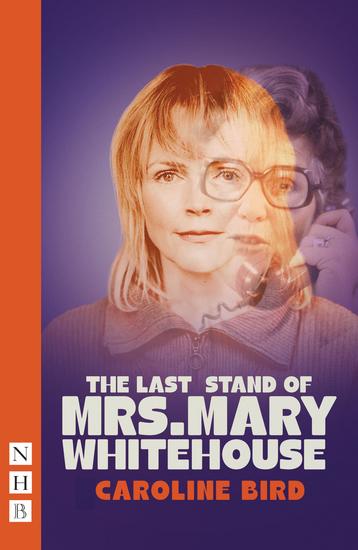
The Last Stand of Mrs Mary Whitehouse - cover

The Last Stand of Mrs Mary Whitehouse

Caroline Bird

Publisher: Nick Hern Books

  • 0
  • 0
  • 0

Summary

'And what happens when the pendulum swings too far? We push back.'
In the 1970s, one enigmatic old lady wielded extraordinary influence, fighting against what she believed was the UK's moral decline. Armed with only a typewriter, this seemingly harmless grandmother took on the BBC and the 'godless media' in a culture war that divided the nation.
Inspired by real events, Caroline Bird's wickedly funny play delves into Whitehouse's most explosive battle – her infamous blasphemy trial against Gay News – and explores her formidable resolve to push back the tide. Was she a pearl-clutching prude or 'the most dangerous woman in Britain'?
A fascinating investigation into freedom and censorship, The Last Stand of Mrs. Mary Whitehouse was co-commissioned by Nottingham Playhouse, Eleanor Lloyd Productions and Pakenham Projects. Premiering at Nottingham Playhouse in 2025, it was directed by Sarah Frankcom and starred Maxine Peake and Samuel Barnett. 
Available since: 09/18/2025.
Print length: 80 pages.

Other books that might interest you

  • Red Star Over Hebrides - cover

    Red Star Over Hebrides

    Donald S. Murray

    • 0
    • 0
    • 0
    Even as he grew up on the edge of Lewis, the vastness of Russia never felt too distant for Donald S Murray. Its great literary traditions were often discussed in his home village, while the political unrest and religious fervour that marked its past and present were occassionally reflected in his life on the island. Inspired by the Russian canon, the songs, verse and stories contained within these pages draw upon the experiences of his youth, shifting continually between myth and history, the absurd and moving, the satirical and everyday. Its extraordinary and diverse narratives underline the truth of its opening line: 'I can see these islands mirror Russia.'
    Show book
  • The Years - cover

    The Years

    Annie Ernaux

    • 0
    • 0
    • 0
    'Memory never stops. It pairs the dead with the living, real with imaginary beings, dreams with history.'
    She strikes a pose and the camera shutter clicks: a child playing in the debris of the Second World War. Click. A student discovering parties and men's bodies. Click. An activist fighting for the right to choose. Click. A wife picking out a velvet sofa. Click. A mother taking her eldest to judo. Click. A lover, seducing a younger man. Click. A grandmother presenting her granddaughter to the camera. Click.
    Les Années (The Years) is Annie Ernaux's critically acclaimed 'masterpiece' (Guardian), charting a woman's personal and political life against the backdrop of a rapidly changing post-war Europe.
    Eline Arbo's inventive stage adaptation was premiered as De Jaren by Het Nationale Theater in The Hague, Netherlands, in 2022, with a cast of five women collectively bringing to life an unapologetic portrait of one woman, and a whole continent. Arbo directed her adaptation at the Almeida Theatre, London, in 2024, in an English language version by Stephanie Bain – with reference to translations by Alison L. Strayer and Tanya Leslie. In 2025, The Years transferred to the Harold Pinter Theatre in London's West End, produced by Sonia Friedman Productions.
    Show book
  • The Four Ages of Man - The classic poem from the first Puritan figure in American literature - cover

    The Four Ages of Man - The...

    Anne Bradstreet

    • 0
    • 0
    • 0
    Born in England but emigrated to America this poet captures the hopes, fears and ambitions of living in a new country
    Show book
  • Circumtrauma - cover

    Circumtrauma

    Jumoke Verissimo

    • 0
    • 0
    • 0
    From one of Africa’s most acclaimed writers, poetry about the Nigeria-Biafra war 
    Everyone carries a piece of the war within them: what happens when we neglect to consider each individual’s story? The Nigeria-Biafra War (1967–70) erupted when the southeastern region of Nigeria, known as Biafra, declared independence. It was a major conflict; however, this war remains largely absent from official historical accounts. While victims have passed down their experiences across generations, the official silence and the dominance of narratives from larger ethnic groups have perpetuated stereotypes that diminish the suffering of some victims. The differing narratives that are absent from history books continue to divide and polarize social groups within Nigeria and beyond.  
    Weaving together cut-ups and redactions from personal narratives, historical accounts, and reflections on the enduring impact of war, and with raw language and searing imagery, the poems in Circumtrauma grapple with loss, resilience, and the search for healing amidst the fractures of deep-seated divisions.  
    This collection compels readers to confront the profound and often-silenced complexities of history, the intergenerational weight of inherited suffering, and the urgent need to acknowledge the diverse experiences and perspectives of all those impacted by the tragedy of war. It is a testament to the enduring power of art to bear witness to the human condition, offering a path towards healing and reconciliation.
    Show book
  • Meeting of Minds - Volume IX - cover

    Meeting of Minds - Volume IX

    Steve Allen

    • 0
    • 0
    • 0
    By " assembling" some of the most fascinating figures in world history, Meeting of Minds provided a groundbreaking opportunity for audiences to be exposed to ideas by way of a medium not normally known for its intellectual vigor. Portrayed by actors, panelists engage in stimulating round-table discussions that were conducted like any other talk show but featured prominent influencers from bygone generations— not just philosophers and politicians, but poets, playwrights, and presidents. From activists and artists to international leaders— both famous and infamous— these conversations are unfailingly witty, thought-provoking, and genuinely entertaining.
    An innovative series, Meeting of Minds remains one of the most delightful ways of gaining historical perspective ever devised, and these original soundtrack recordings capture the intellectual and spirited debates of the episodes hosted by Steve Allen.
    This installment breaks the pattern of other episodes by featuring playwright William Shakespeare surrounded not by other illustrious historical figures, but with the fruits of his own imagination. Following a brief discussion of his early life, Shakespeare is joined by the Dark Lady of the Sonnets, Hamlet, Romeo, Othello, and the Ghost of Hamlet's Father. Expounding on the theme of love, the most enigmatic and compelling of Shakespeare's characters challenge each other and their mutual creator to resolve long-standing controversies about their identities and inner conflicts.
    Show book
  • Duino Elegies - cover

    Duino Elegies

    Rainer Maria Rilke

    • 0
    • 0
    • 0
    We have a marvelous, almost legendary image of the circumstances in which the composition of this great poem began. Rainer Maria Rilke was staying at Duino Castle, on a rocky headland of the Adriatic Sea near Trieste. 
    One morning, he walked out onto the battlements and climbed down to where the cliffs dropped sharply to the sea. From out of the fierce wind, Rilke seemed to hear a voice: Wer, wenn ich schriee, horte mich denn aus der Engel Ordnungen? (If I cried out, who would hear me up there, among the angelic orders?). 
    He wrote these words, the opening of the first Duino Elegy, in his notebook, then went inside to continue what was to be his major opus—completely only after another ten, tormented years of effort—and one of the literary masterpieces of the century.  
    Duino Elegies speaks in a voice that is both intimate and majestic on the mysteries of human life and our attempt, in the words of the translator David Young, “to use our self-consciousness to some advantage: to transcend, through art and the imagination, our self-deception and our fear.”
    Show book