¡Acompáñanos a viajar por el mundo de los libros!
Añadir este libro a la estantería
Grey
Escribe un nuevo comentario Default profile 50px
Grey
Suscríbete para leer el libro completo o lee las primeras páginas gratis.
All characters reduced
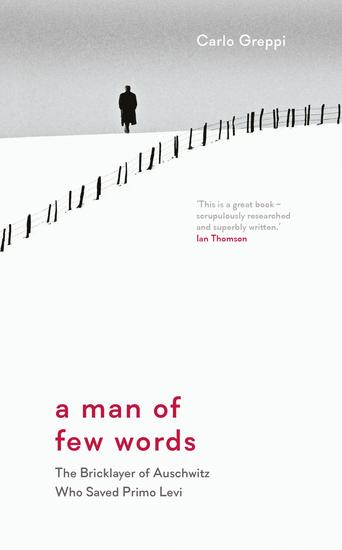
A Man of Few Words - The Bricklayer of Auschwitz Who Saved Primo Levi - cover

A Man of Few Words - The Bricklayer of Auschwitz Who Saved Primo Levi

Carlo Greppi

Traductor Howard Curtis

Editorial: The Westbourne Press

  • 0
  • 0
  • 0

Sinopsis

'Nobody knows how much I owe that man', Primo Levi said of his Italian compatriot Lorenzo Perrone, who saved his life at Auschwitz. 'I could never repay him'. Each day for a period of six months, Perrone, who worked beside Auschwitz in desperate conditions, risked his own life to smuggle part of his own soup ration to Levi, quietly leaving the mess tin by a half-constructed brick wall. Without those extra five hundred calories, Levi could not have survived, and would probably not have written If This Is a Man, the first published account by a Holocaust survivor.

In A Man of Few Words, Carlo Greppi pieces together the life of Lorenzo Perrone, a bricklayer from the Piedmontese town of Fossano, not far from Levi's native Turin. Near-destitute and with minimal formal education, Perrone left very few traces of himself. Yet despite their stark differences – Levi was a middle-class chemist – their friendship survived the Holocaust and continued until Perrone's tragic death. Levi never forgot Perrone. In every book he wrote, he mentions that he owes his life to a man named Lorenzo, and he returned persistently, in the last years of his life, to the man of few words who saved his life.

Compassionate, worldly and prescient, Greppi brings us a story that has much to say about the world we live in today, about an individual who kept hope alive in one of the darkest times and places known to humankind.
Disponible desde: 23/01/2025.
Longitud de impresión: 256 páginas.
Otros libros que te pueden interesar

  • My Russian Grandmother and Her American Vacuum Cleaner - A Family Memoir - cover

    My Russian Grandmother and Her...

    Meir Shalev

    • 0
    • 0
    • 0
    From the author of the acclaimed novel A Pigeon and a Boy comes a charming tale of family ties, over-the-top housekeeping, and the sport of storytelling in Nahalal, the village of Meir Shalev's birth. Here we meet Shalev's amazing Grandma Tonia, who arrived in Palestine by boat from Russia in 1923 and lived in a constant state of battle with what she viewed as the family's biggest enemy in their new land: dirt. 


    Hilarious and touching, Grandma Tonia and her regulations come richly to life in a narrative that circles around the arrival into the family's dusty agricultural midst of the big, shiny American sweeper sent as a gift by Great-uncle Yeshayahu. America, to little Meir and to his forebears, was a land of hedonism and enchanting progress. The sweeper, a stealth weapon from Grandpa Aharon's American brother meant to beguile the hardworking socialist household with a bit of American ease, was symbolic of the conflicts and visions of the family in every respect. 


    The fate of Tonia's "svieeperrr"—hidden away for decades in a spotless closed-off bathroom after its initial use—is a family mystery that Shalev determines to solve. The result is pure delight, as Shalev brings to life the obsessive but loving Tonia, the pioneers who gave his childhood its spirit of wonder, and the grit and humor of people building ever-new lives.
    Ver libro
  • Dad Brain - The New Science of Fatherhood and How It Shapes Men's Lives - cover

    Dad Brain - The New Science of...

    Darby Saxbe PhD

    • 0
    • 0
    • 0
    A groundbreaking scientific exploration of fatherhood that explains the biology of caregiving and redefines what it means to be a “good dad”Over the last decade, researchers have discovered that having a child profoundly transforms our brains, hormones, and sense of self. Most studies have (understandably) focused on mothers. Until recently, the transition to fatherhood has been overlooked.Now, in Dad Brain, University of Southern California Professor Darby Saxbe draws on her field-leading research on families to revolutionize our understanding of fatherhood. As Dr. Saxbe explains, across both animal and human societies, fathering behaviors vary widely. Male birds and fish are exemplary dads (Nemo’s father was no outlier; clownfish dads are particularly devoted), but involved fathers are rare among mammals. Human fatherhood is considered “facultative,” an optional but very useful adaptation. That’s where nonbiological factors such as love, obligation, culture, religion, and complex reproductive strategies come in, influencing the ways fathers respond to the needs of their children.In Dad Brain, Dr. Saxbe takes readers on a fatherhood world tour, from hunter-gatherers in the Congo to contemporary suburban dads, and into her lab at USC, where she investigates how caregiving alters men’s biology—including their brain architecture and hormone levels. Ultimately, she offers powerful evidence that great dads are made, not born. When men devote time and care to their children, their physiology adapts to set them up for success—and they can discover a richer and more connected life.In the tradition of bestselling books such as Hunt, Gather, Parent and The Anxious Generation, Dad Brain blends science, culture, and personal narrative to offer an illuminating, research-based understanding of fatherhood that will become a must-read for all parents.
    Ver libro
  • The Chinese Must Go - Violence Exclusion and the Making of the Alien in America - cover

    The Chinese Must Go - Violence...

    Beth Lew-Williams

    • 0
    • 0
    • 0
    In 1885, following the massacre of Chinese miners in Wyoming territory, communities throughout California and the Pacific Northwest harassed, assaulted, and expelled thousands of Chinese immigrants. The Chinese Must Go shows how American immigration policies incited this violence, and how this gave rise to the concept of the "alien" in America. 


    Our story begins in the 1850s, before federal border control established strict divisions between citizens and aliens—and long before Congress passed the Chinese Restriction Act, the nation's first attempt to bar immigration based on race and class. When this unprecedented experiment failed to slow Chinese migration, armed vigilante groups took the matter into their own hands. Fearing the spread of mob violence, policymakers redoubled their efforts to seal the borders, overhauling immigration law and transforming America's relationship with China in the process. By tracing the idea of the alien back to this violent era, Lew-Williams offers a troubling new origin story of today's racialized border.
    Ver libro
  • Know what you do not know - cover

    Know what you do not know

    Tara Brabazon

    • 0
    • 0
    • 0
    The University of Google. ChatGPT. Twitter pile-ons.  How do we manage chaos and crises, confusion and catastrophes? How do we understand the difference between the urgent and important, the trivial and significant?Information literacy is about as attractive as teeth extraction.  However, for PhD students and citizens more generally, information literacy enables us to sift and sort knowledge from opinion, and expertise from a vibe.  Know what you do not know:  Information literacy for PhD students provides a context around the folk devils of our time:  plagiarism, self-plagiarism, influencers and populists.  Most importantly, Know what you do not know demonstrates how to take notes, how to reference with clarity, and how to build an opinion into a referenced and considered argument.
    Ver libro
  • Darkest Christmas - December 1942 and a World at War - cover

    Darkest Christmas - December...

    Peter Harmsen

    • 0
    • 0
    • 0
    "This book is of interest to any scholar of World War II, particularly those focused on bridging culture and war. Highly readable, this text is suitable for undergraduate and popular audiences as well. Many should find its analysis to be a refreshing take on the well-trodden field of World War II histories." — Journal of Military HistoryDecember 1942 saw the bloodiest Christmas in the history of mankind. From the islands in the Pacific to the China front, from the trenches in Russia to the battle lines in North Africa, in the skies over Europe and in the depths of the Atlantic, men were killing each other in greater numbers than ever before. The Holocaust continued, and innocent civilians were murdered by the thousands throughout the evil Nazi empire, even as the perpetrators celebrated the birth of Christ.  Millions stationed in far-off lands amid the greatest conflict in human history feared this was their last Christmas in freedom, or their last Christmas alive. At the same time as the slaughter continued unabated, throughout the world there were random acts of kindness, born out of an instinctive feeling of the essential brotherhood of man. These gestures also straddled religious barriers and sometimes included those of non-Christian faiths. Even some Japanese, otherwise embarked on a self-declared crusade against the West, relented for a few precious hours in acknowledgment of the holiday.  At the same time, Christmas 1942 saw the injunction of ‘good will to man’ distorted in ugly and callous ways. At Auschwitz, SS guards played cruel games with their prisoners. In Berlin, the German heart of darkness, Propaganda Minister Joseph Goebbels spent time with his family while still buried in feverish fantasies about the Jewish world conspiracy.  Christmas 1942 saw the entire range of man’s conduct towards his fellow man, reflecting the extremes of behavior, good and bad, that World War II gave rise to. The way the holiday was marked around the world tells a deeper and more universal story of the human condition in extraordinary times.
    Ver libro
  • The Scientific Approach to Buddhism and The Appeal of Buddhism - Two Essays - cover

    The Scientific Approach to...

    Francis Story

    • 0
    • 0
    • 0
    This is an audiobook of Bodhi Leaves No. 55 by Francis Story (Anāgārika Sugatānanda), The Scientific Approach to Buddhism and The Appeal of Buddhism, two essays narrated by Christa Michel. The print edition can be found in the Pariyatti Edition of Collected Bodhi Leaves Vol. 2. The eBook of Bodhi Leaves No. 55 can be downloaded from the BPS website. 
    Excerpt from The Scientific Approach to Buddhism: 
    At present it may look as though man has only searched out the secrets of the universe in order to destroy himself with the power he has acquired; and of that there is certainly a danger. But I believe that a change in outlook is beginning to dawn, and that science itself, having destroyed the basis of much wrong thinking, is drawing us ever nearer to the realisation of the truth proclaimed by the Enlightened One. This is what I mean by “the scientific approach to Buddhism;” without being aware of it, the modern scientist and philosopher are being propelled irresistibly in the direction of Buddhism. Their uncertainties and doubts are spiritual “growing pains;” but a time will come quickly when they will realise that, although they have had to reject everything on which their ordinary religious and moral beliefs are founded, there is a higher religion—one based upon systematic investigation and the sincere search for truth—which will restore their lost faith in the universal principles of justice, truth and compassion. Those who now believe that man has come to the end of his tether will then see the opening up of vistas into the future that they only dimly suspect, and will recognise, beyond it all, the final goal of complete emancipation from the fetters of ignorance and delusion.
    Ver libro