¡Acompáñanos a viajar por el mundo de los libros!
Añadir este libro a la estantería
Grey
Escribe un nuevo comentario Default profile 50px
Grey
Suscríbete para leer el libro completo o lee las primeras páginas gratis.
All characters reduced
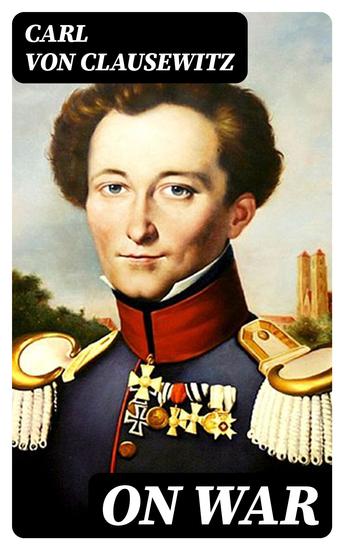
On War - Vom Kriege - cover

On War - Vom Kriege

Carl von Clausewitz

Traductor J. J. Graham

Editorial: DigiCat

  • 0
  • 0
  • 0

Sinopsis

In "On War," Carl von Clausewitz offers a profound examination of war's complex nature, blending philosophical inquiry with historical analysis. Written in the early 19th century, this seminal work articulates a comprehensive theory of warfare, emphasizing the interplay between political objectives and military strategy. Clausewitz's literary style is characterized by an analytical rigor and an engaging narrative that illuminates the often chaotic and unpredictable dynamics of conflict. His famous aphorism, "War is merely the continuation of politics by other means," encapsulates his belief that war cannot be understood in isolation from the social and political contexts from which it arises. Carl von Clausewitz was a Prussian general and military theorist whose experiences in the Napoleonic Wars profoundly shaped his understanding of warfare. His background in the military, combined with his extensive studies in philosophy and history, provided him with a unique perspective on the nature of conflict and its implications for society. Clausewitz's insights reflect a deep engagement with contemporary military thought and an unyielding commitment to uncovering the truths behind the phenomena of war. "On War" remains an essential text for anyone interested in military strategy, history, or political theory. Its relevance endures, as it addresses fundamental questions about the nature of human conflict, making it indispensable for scholars, military professionals, and informed readers alike.
Disponible desde: 17/05/2022.
Longitud de impresión: 796 páginas.

Otros libros que te pueden interesar

  • The Postmodern Predicament - Existential Challenges of the Twenty-First Century - cover

    The Postmodern Predicament -...

    Bruce Ackerman

    • 0
    • 0
    • 0
    Human beings have taken one thing for granted since our earliest days: we are bodily creatures dealing with one another on a face-to-face basis. The internet has shattered this fundamental feature of human existence. We are suddenly living our lives in two worlds at once—shifting endlessly from virtual to physical reality as we reach out to others. 


    Worse yet, we are developing different personal identities in our two worlds. We say and do things in virtual reality that flatly contradict our face-to-face commitments to family, friends, and fellow-workers—and vice versa. The Postmodern Predicament explores these dilemmas at each phase of the life cycle, beginning at the moment a young child picks up a cell phone. 


    The existentialist tradition of the twentieth century provides a precious perspective on our postmodern dilemmas. Thinkers and doers like Simone de Beauvoir and Jean-Paul Sartre considered the fragmentation of modern life as a central source of contemporary anxieties. Like them, Ackerman views the challenges of the internet age as a political, no less than personal, problem—and proposes concrete reforms that that could mobilize broad-based support for democracy against demagogic assaults on its very foundations.
    Ver libro
  • Imperialism - cover

    Imperialism

    Vladimir Lenin

    • 0
    • 0
    • 0
    Written in 1916 against the backdrop of the First World War, Imperialism: The Highest Stage of Capitalism explains the flaws and power of capitalism, which inevitably lead to monopolies, imperialism and colonialism. Lenin develops Marx’s theories of political economy, which had been put forward 50 years earlier in Das Kapital. He goes on to argue that imperialism is the most advanced state of capitalism, characterised by the domination of monopolies on an international scale, with the export of capital leading to the big imperialist powers carving up the world.More than a century later, Imperialism remains highly relevant in understanding the historical background to the strategies of many of today’s major nations.
    Ver libro
  • Unlikely Radicals - The Story of the Adams Mine Dump War - cover

    Unlikely Radicals - The Story of...

    Charlie Angus

    • 0
    • 0
    • 0
    For twenty-two years politicians and businessmen pushed for the Adams Mine landfill as a solution to Ontario’s garbage disposal crisis. This plan to dump millions of tonnes of waste into the fractured pits of the Adams Mine prompted five separate civil resistance campaigns by a rural region of 35,000 in Northern Ontario. Unlikely Radicals traces the compelling history of the First Nations people and farmers, environmentalists and miners, retirees and volunteers, Anglophones and Francophones who stood side by side to defend their community with mass demonstrations, blockades, and non-violent resistance.
    Ver libro
  • The Populist Temptation - Economic Grievance and Political Reaction in the Modern Era - cover

    The Populist Temptation -...

    Barry Eichengreen

    • 0
    • 0
    • 0
    In The Populist Temptation, the eminent economic historian Barry Eichengreen focuses on the global resurgence of populism today and places it in a deep context. Alternating between the present and earlier populist waves from modern history, he argues that populists tend to thrive most in the wake of economic downturns, when it is easy to convince the masses of elite malfeasance. Yet while there is more than a grain of truth that bankers, financiers, and "bought" politicians are responsible for the mess, populists' own solutions tend to be simplistic and economically counterproductive. There is no one solution to addressing the concerns that populists raise, but Eichengreen argues that there is an obvious place to start: shoring up and improving the welfare state so that it is better able to act as a buffer for those who suffer most during economic slumps. For example, America's patchwork welfare state was not well equipped to deal with the economic fallout that attended globalization and the decline of manufacturing in America, and that played no small part in Trump's victory. Lucidly explaining both the appeals and dangers of populism across history, this book is a must-listen for anyone seeking to understand not just the populist phenomenon, but more generally the lasting political fallout that follows in the wake of major economic crises.
    Ver libro
  • Communism VS Capitalism - A Comparative Analysis of Two Economic Systems - cover

    Communism VS Capitalism - A...

    Arlo Holders

    • 0
    • 0
    • 0
    An economic system refers to the structure and methods a society uses to produce, distribute, and consume goods and services. It defines how resources are allocated, how wealth is distributed, and how economic decisions are made. Different societies have developed various economic systems over time, influenced by their unique historical, cultural, and political contexts. Among these systems, capitalism and communism are two of the most prominent and contrasting economic ideologies that have shaped the global landscape. 
    Capitalism is an economic system that operates on the principles of private ownership and free markets. In capitalism, individuals or businesses own the means of production and are free to make decisions regarding what to produce, how to produce it, and at what price to sell it. The market is driven by competition, and prices are determined by supply and demand. Profit motives incentivize innovation and efficiency, leading to economic growth and technological advancements. However, capitalism can also lead to inequality, as wealth tends to be concentrated among those who own the most resources, while others may struggle to access basic necessities. While the role of government in capitalism is typically limited, debates about regulation, social welfare, and economic justice persist. 
    In contrast, communism is an economic system grounded in collective ownership and centralized control. In a communist society, the means of production are owned by the state or collectively by the people, and wealth is distributed based on need rather than profit. Communism seeks to eliminate class distinctions, advocating for equality and fairness in wealth and resource distribution. The government plays a central role in planning and directing economic activities, including determining production levels and distribution of goods.
    Ver libro
  • Cyborg - The MIT Press Essential Knowledge series) - cover

    Cyborg - The MIT Press Essential...

    Laura Forlano, Danya Glabau

    • 0
    • 0
    • 0
    This introduction to cyborg theory provides a critical vantage point for analyzing the claims around emerging technologies like automation, robots, and AI. Cyborg analyzes and reframes popular and scholarly conversations about cyborgs from the perspective of feminist cyborg theory. Drawing on their combined decades of training, teaching, and research in the social sciences, design, and engineering education, Laura Forlano and Danya Glabau introduce an approach called critical cyborg literacy. Critical cyborg literacy foregrounds power dynamics and pays attention to the ways that social and cultural factors such as gender, race, and disability shape how technology is imagined, developed, used, and resisted. 


    Forlano and Glabau offer critical cyborg literacy as a way of thinking through questions about the relationship between humanity and technology. Cyborg examines whether modern technologies make us all cyborgs—if we consider, for instance, the fact that we use daily technologies at work, have technologies embedded into our bodies in health care applications, or use technology to critically explore possibilities as artists, designers, activists, and creators. Lastly, Cyborg offers perspectives from critical race, feminist, and disability thinkers to help chart a path forward for cyborg theory in the twenty-first century.
    Ver libro