Junte-se a nós em uma viagem ao mundo dos livros!
Adicionar este livro à prateleira
Grey
Deixe um novo comentário Default profile 50px
Grey
Assine para ler o livro completo ou leia as primeiras páginas de graça!
All characters reduced
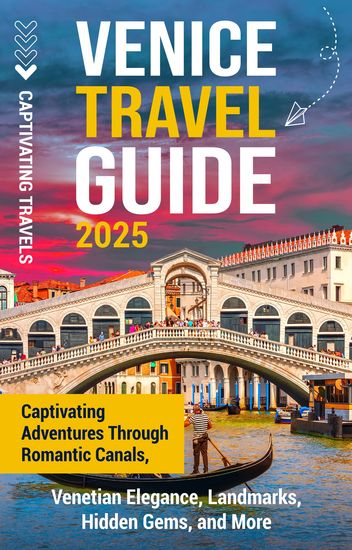
Venice Travel Guide - Captivating Adventures Through Romantic Canals Venetian Elegance Landmarks Hidden Gems and More - cover
LER

Venice Travel Guide - Captivating Adventures Through Romantic Canals Venetian Elegance Landmarks Hidden Gems and More

Captivating Travels

Editora: Captivating Travels

  • 0
  • 0
  • 0

Sinopse

Venice Travel Guide: Images, Interactive QR Codes & Detailed Maps for an Unforgettable Trip

Packed with  80+ images and maps and  40+ QR codes for easy access to key locations, this guide makes exploring Venice effortless. Whether it's your first visit or you're returning to uncover more, this book provides everything you need to experience the city's history, landmarks, and cultural treasures.

What You'll Discover Inside: 

- Famous Landmarks & Must-See Locations  – From  St. Mark's Square to the hidden corners of Venice's historic districts. 
- Easy-to-Use QR Codes  – Instantly access maps, directions, and additional travel resources. 
- High-Quality Images & Maps  – Visual guides to help you explore with confidence. 
- History & Culture  – Gain a deeper understanding of Venice's past, artistic heritage, and architectural wonders. 
- Day Trip Ideas & Ready-Made Itineraries  – Thoughtfully crafted routes to help you make the most of your visit. 
- Essential Italian Phrases  – A quick guide to help you communicate and navigate with ease. 
 
With detailed insights, interactive features, and carefully curated information, this guidebook makes planning and exploring Venice both simple and enjoyable.

Ready to Discover Venice? 

Add to cart now and start your journey today!
Disponível desde: 17/03/2025.
Comprimento de impressão: 190 páginas.

Outros livros que poderiam interessá-lo

  • From Prosperity to Peril - The Economic History of Argentina - cover

    From Prosperity to Peril - The...

    Anya Solace

    • 0
    • 0
    • 0
    The economic history of Argentina is deeply rooted in its colonial past, which shaped much of the country’s early economic structures and patterns. Argentina, as part of the Spanish Empire, was initially regarded as a peripheral region, with its economic activities largely shaped by the colonial powers’ interests. The Spanish imposed a rigid economic system in which the colony’s natural resources were exploited to benefit Spain, primarily through the export of silver, agricultural products, and other raw materials. This colonial legacy set the stage for Argentina’s agricultural-based economy and influenced the development of land ownership patterns and labor systems that would persist well into the 19th century. 
    During the colonial period, the region that would become Argentina was an important supplier of agricultural products, such as cattle and grains, to the Spanish Empire. Large estates, known as estancias, were established, and much of the labor force was provided by indigenous peoples and African slaves. The development of these estates led to the establishment of an agrarian economy that would remain a cornerstone of Argentina’s economic identity. The concentration of land and wealth in the hands of a few, however, created significant economic inequalities that would become a recurring theme in Argentina’s history. 
    Following Argentina’s independence from Spain in 1816, the young nation faced significant challenges in establishing its economic identity. The economic institutions that had been put in place by the colonial powers were largely centered around the needs of the empire, and there was little infrastructure to support an autonomous economy. The new republic was faced with the task of building a functional economy that could support its growing population while integrating itself into the global economy.
    Ver livro
  • The Passenger: Rome - cover

    The Passenger: Rome

    Passenger The

    • 0
    • 0
    • 0
    The best new writing, photography, art, and reportage from and about Rome—in the series that’s “like a literary vacation” (Publishers Weekly). 
     
    If you believe recent chatter about Rome—in the media and by its residents—the city is on the verge of collapse. Each year, it slips further down the ranking of the world’s most livable cities. To the problems faced by all large capitals—hit-and-run tourism, traffic, the divide between elegant, Airbnb-dominated city centers and run-down suburbs—in recent years Rome seems to have added a list of calamities of its own: a string of failing administrations, widespread corruption, the resurgence of fascist movements, rampant crime. A seemingly hopeless situation, perfectly symbolized by the fact that Rome currently leads the world in the number of self-combusting public buses. 
     
    One might expect mass migration in the face of problems like these—yet the vast majority of Romans don’t think for a second of “betraying” their hometown, and the many newcomers who’ve populated it in recent decades resemble the natives in the profound love that binds them to the city. 
     
    The largest metropolis in Europe is a place of contradictions and opposites. We think of it as ancient, but it is profoundly modern—it was founded almost three millennia ago, but 92 per cent of its buildings have been built after 1945. To understand Rome and fix its problems, we should start considering it a normal city, not unlike Chicago or Manchester . . . just incomparably more beautiful. This volume is filled with portraits of Rome and thoughts not just on its famous past but its present and future, including: 
     
    Rome doesn’t judge you by Nicola Lagioia · The soul of the city by Matteo Nucci · 39 memos for a book about Rome by Francesco Piccolo · Plus: a guide to the sounds of Rome by Letizia Muratori; the feigned unrest and real malaise of the suburbs; the influence of the Vatican; the excessive power of real estate speculators and the rule of gangs; disillusioned trappers; football fans of every age, and much more . . .  
     
    “A pleasure to read.” —La Repubblica
    Ver livro
  • Luxuriate in Onsen - cover

    Luxuriate in Onsen

    Jefferson Ng

    • 0
    • 0
    • 0
    This audiobook is about Japanese onsens which are one of the most popular destinations in Japan. They offer a range of benefits for locals and travellers across the world.In this mini-guide:An easy-to-understand overview on onsensHow to use onsens for beginnersBest tips on your stay at onsens
    Ver livro
  • The Minotaur at Calle Lanza - cover

    The Minotaur at Calle Lanza

    Zito Madu

    • 0
    • 0
    • 0
    A "hauntingly effective" surrealist travel memoir about the mysterious transformations that may lurk inside us all (Library Journal, starred review). 


    Venice, 2020. As a pandemic rages across the globe, Zito Madu finds himself in a nearly deserted city, its walls and basilicas humming with strange magic. As he wanders a haunted landscape, we see him twist further into his own past: his family's difficult immigration from Nigeria to Detroit, his troubled relationship with his father, the sporadic joys of daily life and solitude, his experiences with migration, poverty, foreignness, racism, and his own rage and regret. But as it is with all labyrinths, after finding its center, will he come away unscathed, or will he transform into the gripping, fantastical monstrousness that's out to consume him whole? 


    With nods to Italo Calvino and Jorge Luis Borges, this surrealist debut memoir takes us into the labyrinth of memory and the monsters lurking there.
    Ver livro
  • Mexico's Economic History - From Aztec Empire to Modern State - cover

    Mexico's Economic History - From...

    Anya Solace

    • 0
    • 0
    • 0
    Mexico’s economic history is a fascinating journey shaped by diverse influences, from the ancient Aztec empire to the complexities of the modern global economy. Over the centuries, Mexico has experienced dramatic transformations, driven by conquests, colonial rule, revolutions, and economic policies that have defined its growth and challenges. Understanding the evolution of Mexico’s economy requires examining its foundations, the role of geography and natural resources, and the early trade networks that set the stage for future economic systems.  
    The foundations of Mexico’s economy date back to the indigenous civilizations that thrived long before the Spanish conquest. The Aztecs, in particular, established a sophisticated economic system based on agriculture, trade, and tribute collection. Markets flourished in major cities like Tenochtitlán, where goods from across Mesoamerica were exchanged. The Aztec economy was not just a local system but a well-organized network that connected distant regions, allowing the movement of resources such as cacao, textiles, and obsidian. This structure provided a strong economic base, but it also made the region vulnerable to external forces, particularly the arrival of the Spanish.  
    Geography and natural resources have played a crucial role in shaping Mexico’s economic development. The country’s vast landscapes include fertile valleys, mineral-rich mountains, and long coastlines, all of which have influenced economic activities throughout history. The presence of silver, for example, turned Mexico into one of the most important centers of global trade during the colonial period. However, while natural resources have been a source of wealth, they have also led to economic dependency and external exploitation, shaping Mexico’s economic struggles even in modern times. 
    Ver livro
  • Ghosts of Boston - Haunts of the Hub - cover

    Ghosts of Boston - Haunts of the...

    Sam Baltrusis

    • 0
    • 0
    • 0
    It should come as no surprise that one of the nation's oldest cities brims with spirits of those who lived and died in its hundreds of years of tumultuous history. 


    Boston, Massachusetts, boasts countless stories of the supernatural. Many students at Boston College have encountered an unearthly hound that haunts O'Connell House to this day. Be on the watch for an actor who sits in on rehearsals at Huntington Theatre and restless spirits rumored to haunt Boston Common at night. From the Victorian brownstones of Back Bay to the shores of the Boston Harbor Islands, author Sam Baltrusis makes it clear that there is hardly a corner of the Hub where the paranormal cannot be experienced as he breathes new life into the tales of the long departed.
    Ver livro