Join us on a literary world trip!
Add this book to bookshelf
Grey
Write a new comment Default profile 50px
Grey
Subscribe to read the full book or read the first pages for free!
All characters reduced
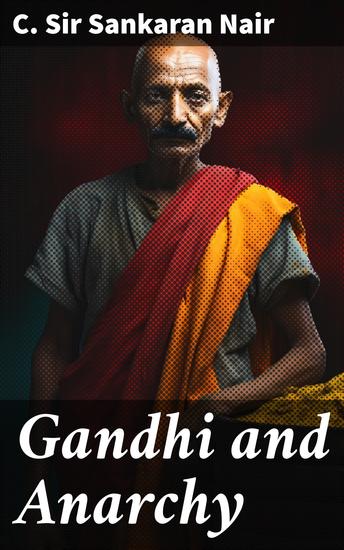
Gandhi and Anarchy - Unraveling Gandhi's Anarchist Philosophy - cover

Gandhi and Anarchy - Unraveling Gandhi's Anarchist Philosophy

C. Sankaran Nair

Publisher: Good Press

  • 0
  • 0
  • 0

Summary

In "Gandhi and Anarchy," C. Sir Sankaran Nair presents a profound examination of the philosophical dichotomy between Gandhian principles of non-violence and the chaotic forces of anarchy that challenge societal norms. Nair employs a critical lens, drawing from historical and contemporary sources, to dissect how Gandhi'Äôs approach to social and political justice stands in contrast to anarchist ideologies. With a blend of succinct prose and rigorous argumentation, the book situates Gandhi within the larger framework of political thought, exploring themes of resistance, moral ethics, and the role of civil disobedience in the quest for freedom. C. Sir Sankaran Nair was not only influenced by Gandhi's ideals but also lived through the tumultuous period of India's struggle for independence. His background as a lawyer, politician, and historian equipped him with the perspective necessary to critically analyze Gandhi's philosophies. Nair's experiences with colonial oppression and his engagement with various intellectual movements inspired him to explore the viability and implications of Gandhi's vision amidst the chaotic realities of societal upheaval. This work is a crucial text for readers interested in political theory, social justice, and the legacy of Gandhi. Nair's thoughtful discourse invites readers to reconsider the relationship between non-violence and the sometimes anarchic conditions of rebellion, making it an essential addition to any academic collection.
Available since: 10/29/2023.
Print length: 174 pages.

Other books that might interest you

  • Quantum God - cover

    Quantum God

    Philip Gardiner

    • 0
    • 0
    • 0
    This audiobook has been recorded using Text to speech (TTS). 
     
    Do you believe in God? If so, which one? Is it the Christian all-knowing, all-seeing father of Jesus? Is it Allah of Islam? The many deities of Hinduism? Or are you one of those that believes in God but not religion? 
     
    Whichever box you tick on the form, you have some kind of belief. Even if you're an atheist, you believe there is no God. That we all came from nothing. But there are massive questions that mankind has asked from the very beginning. Where did everything come from? Is there a meaning to our lives? Are we alone in the universe? 
     
    These questions and many more have fascinated mankind from the moment he could reason. And eventually we created a thing called science to discover the answers. To many, science eradicated the need for God to answer all the questions we could not answer. Delete faith and replace with scientific facts. The problem is that science has not yet answered all of the questions and many believe it never will. Or has it? 
     
    Today we are beginning to understand the complexities and even strangeness of the sub-atomic world. This new quantum realm is opening up new avenues of research and new inventions. All things are made of particles. The entire universe is formed from them. And now we are creating quantum computers that think at the quantum level. What answers will the union of artificial intelligence and this amazing quantum world bring? Will we now have the answers to the ultimate questions? 
     
    This is the story of the new scientific world of particle physics and the amazing unseen world it reveals.
    Show book
  • The Therapeutic School Approach - How to Embed Trauma-Informed Attachment-Aware Practices to Improve Outcomes for All Children - cover

    The Therapeutic School Approach...

    Shahana Knight

    • 0
    • 0
    • 0
    The Therapeutic School Approach offers teachers and school leaders a step-by-step guide to embedding a trauma-informed approach that is tangible, practical, and brings the underpinning science to life in a way that is relatable and relevant. Placing a keen focus on moving towards a more inclusive way of working, it advocates for a culture that puts wellbeing and mental health at the core of teaching and school life. 


    This whole school approach gives listeners the tools needed to support children when they are dysregulated by reframing 'difficult' behavior. The book evidences the 'why' behind the approach, exploring childhood trauma, attachment theory and stress, and explaining how these factors are impacting children today. It then introduces the 'how', looking in detail at trauma-informed responses, behavior policies, relationships, and the power of the environment. 


    With real life case studies and scenarios woven throughout, this empowering book challenges perspectives, raises awareness, and inspires the listener to reevaluate the norm to make a true difference to the children in their care. It will be an essential guide for primary school teachers, head teachers, SENCOs, and support staff who want to put children's wellbeing at the core of their practice.
    Show book
  • Edward Vernon-Harcourt - The Last Aristocratic Archbishop of York - cover

    Edward Vernon-Harcourt - The...

    Tony Vernon-Harcourt

    • 0
    • 0
    • 0
    Edward Vernon-Harcourt (1757–1847) was Archbishop of York from 1807 until his death at the age of 90.
    
     
    As a younger son of a wealthy land-owning family, Archbishop Harcourt depended on good family and political connections to make progress in the Church. He had to combine his responsibility for one of the largest dioceses in the Church of England with his duties in parliament and at court and with providing for his family of 16 children. More supportive of reform of both parliament and the church than most of his fellow bishops, Harcourt took steps to improve the training of ordinands in his diocese, encouraged the building of over 100 new churches to cope with population growth in the industrial towns of the West Riding and made some progress in tackling pluralism and non-residence. He was not afraid to stand up for a cause he believed to be right.
    
     
    In this biography, Tony Vernon-Harcourt examines the professional and family life of one of the last aristocratic bishops in the Church of England.
    Show book
  • The Golden Verses of Pythagoras - cover

    The Golden Verses of Pythagoras

    Florence Firth

    • 0
    • 0
    • 0
    In this small volume an attempt has been made to gather together the best and most reliable of the sets of Ethical Verses attributed to the Pythagoreans.Both Hall's translation from the Greek (1657), and Rowe's translation from the French of André Dacier (1707), have been used in reproducing the Golden Verses of Pythagoras, but Dacier's version has been almost exclusively followed, being clearer and more intelligible.The Golden Sentences of Democrates, the Similitudes of Demophilus, and Pythagorean Symbols are from Bridgman's translation, and are to be found in his little book, Translations from the Greek, published in 1804. The Pythagorean Sentences of Demophilus, translated by Taylor, are contained in that volume also.The remaining sets of verses, translated by Taylor, are appended by him to his Iamblichus' Life of Pythagoras, published in 1818.
    Show book
  • Leonardo da Vinci: A short biography - 5 Minutes: Short on time - long on info! - cover

    Leonardo da Vinci: A short...

    5 Minutes, 5 Minute Biographies,...

    • 0
    • 0
    • 0
    Leonardo da Vinci, painter and universal genius: Life and works in a short biography! Everything you need to know, brief and concise. Infotainment, education and entertainment at its best!
    Show book
  • Primary - Vertex One of The Prism - cover

    Primary - Vertex One of The Prism

    Alex Holland

    • 0
    • 0
    • 0
    On the brink of suicide on his 21st birthday, a young man's world is turned upside down when he encounters an elf and dwarf whose voices he can hear in his head. Thrust into a realistic video game, he must race against time to recover ancient artifacts that hold the key to his true origins before his high school bully kills him. As he uncovers the truth about himself, he discovers his reason for existing in this thrilling tale of self-discovery and adventure.
    Show book