Junte-se a nós em uma viagem ao mundo dos livros!
Adicionar este livro à prateleira
Grey
Deixe um novo comentário Default profile 50px
Grey
Assine para ler o livro completo ou leia as primeiras páginas de graça!
All characters reduced
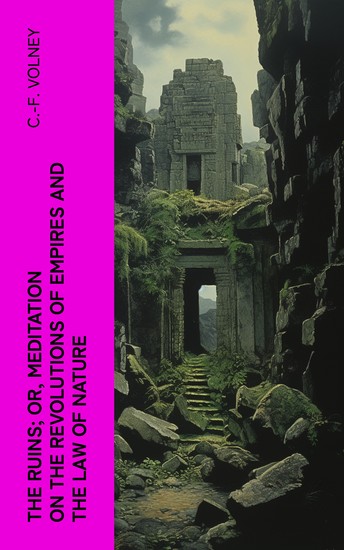
The Ruins; Or Meditation on the Revolutions of Empires and the Law of Nature - cover
LER

The Ruins; Or Meditation on the Revolutions of Empires and the Law of Nature

C.-F. Volney

Editora: e-artnow

  • 0
  • 0
  • 0

Sinopse

The Ruins of Empires (Les Ruines, 1791) is a classic work criticizing the political regimens of different countries pre and during the 18th century. The book was translated into English by the American president Thomas Jefferson, who thought it very important to build a strong political system in America. The author of the book criticizes Rousseau, demands the separation of church and state, and states that empires grow and stay stable only until the government allows the enlightened to grow and flourish.
Disponível desde: 20/11/2023.
Comprimento de impressão: 301 páginas.
Outros livros que poderiam interessá-lo

  • The Confessions of Fiona - Mythology and Folklore of the Faeries - cover

    The Confessions of Fiona -...

    Steve Blamires

    • 0
    • 0
    • 0
    The Confessions of Fiona by Steve Blamires details the beliefs, stories, and tenets of the Sidhe as revealed by one of the Sidhe, Fiona Macleod. For twelve years, this faery woman laid out the entire mythology, pantheon, and rituals of the faeries themselves. This volume reveals, expands, and explains what we can learn from her.  The Secrets of the Sidhe Revealed!  In 1893, the Scottish writer and mystic William Sharp (1855–1905) started writing under the name Fiona McLeod. The name Fiona did not exist before then, at least not in our world. For the following twelve years, Fiona wrote profusely of her own tradition; that is, the mythology and deities that the faeries recognize. None of these myths, legends, gods, or goddesses were known to humans prior to Fiona’s revelations.   Steve Blamires presents those concepts in his new book, The Confessions of Fiona. He has studied the esoteric faery tradition for thirty years. He presents a unique ritual system; previously unknown myths, legends, and gods and goddesses, offering insight to the modern researcher of this fascinating nonhuman magical body of work. Woven into the legends that the faeries share is a whole ritual magical tradition that humans can emulate with a basic knowledge of the Western magical tradition, the four festivals, the four magical tools, and what has come to be known as pathworking. But they are all significantly different from our human perspective.   Faeries are large, shockingly powerful, and, at times, cruel and dangerous. Steve shows how and when these mighty beings of ancient times were literally shrunken to become the Tinkerbells of popular imagery. Because of this important change of perspective, Steve includes in this book an in-depth look at the faery god Dalua—a truly dark, dangerous god but a necessary one.   To help readers access more of Fiona McLeod’s writings and teachings, Steve has included an appendix detailing all her essential works and scores of relevant direct quotations throughout the book.
    Ver livro
  • Huns and Mongols - Historical Facts about Genghis Khan and Attila the Hun - cover

    Huns and Mongols - Historical...

    Kelly Mass

    • 0
    • 0
    • 0
    This is a compilation of 2 different titles, which are about the following topics: 
    1: You may have heard about him: Attila the Hun. Let's discover who this individual actually was and why he has such a bad track record of being a callous, aggressive conqueror in the first millennium after Christ. Attila the Hun was the ruler of the Huns from the year 434 till his death in the month of March in the year 453. Also, he was the leader of a tribal realm which consisted mainly of Huns, Ostrogoths, Alans and Bulgars, to name a few, in Central Europe and in Eastern Europe. 
    In this guide, you will learn more about the wars, his enemies, the battles around Rome, his life, his death, and his legacy. Some of the information about his has been falsely attributed to certain details because of how much has been lost in historical records, but we can still get a slightly accurate image of who he was, what he did, and why he has become such an infamous figure. 
    2: Genghis Khan was the Mongol emperor who has expanded his region to the biggest empire on the face of the earth ever. His empire stretched from East Asia all the way to various European countries, the Middle East, and beyond. 
      
    What made Genghis Khan so successful? 
      
    Was he a brute, rapist, and pillaging dictator, or did he have a tolerant side as well? 
      
    How do the people in Mongolia see him, or the people in China? 
      
    All o these questions and more will be answered in this comprehensive overview of the history of Genghis Khan. You will learn more about his early life, his relationships, marriage, families and children, his attacks, his unification of the Mongolian Federations, his death, succession, and the continuing of the Mongolian Empire after his death.
    Ver livro
  • Crusades in Europe The: The History of the Catholic Crusaders’ Campaigns against the Ottomans and Christians across the Continent - cover

    Crusades in Europe The: The...

    Editors Charles River

    • 0
    • 0
    • 0
    Christianity was not a state religion for its first three centuries, and it was only when Emperor Constantine the Great declared it so in the early 4th century that the Church was faced with the thorny problem of state-sanctioned violence. The first major Christian authority to justify the use of arms in defense of Church and State was Augustine, Bishop of Hippo, who wrote in the 5th century, “They who have waged war in obedience to the divine command or in conformity with His laws, have represented in their persons the public justice or the wisdom of government, and in this capacity have put to death wicked men; such persons have by no means violated the commandment, ‘Thou shalt not kill.’”  
    	This opinion gained increasing influence in Western Christianity, though in the East, the attitude was (and continues to be) more nuanced. War was tolerated as a regrettable necessity in a world wounded by sin but never blessed. Canon law enacted in the Byzantine (Eastern Roman) Empire tended to treat soldiers who had killed as sinners needing to repent, and Bishop Basil of Caesarea (d. c. 330) believed that they needed to abstain from receiving communion for three years after battle. It was not that that the Eastern Roman Empire was a particularly peaceable state–far from it, in fact: it was engaged in almost continuous warfare for its entire existence. However, its conflicts were mostly defensive in character, fighting barbarians, Persians, or Muslims, and the idea of consecrating arms for the cause of Christianity was considered alien to its spirit.  
    At the Council of Clermont in July 1095, Pope Urban II canonized religious war by urging Western Europe's nobility to take up arms in defense of the Byzantine Empire against the Muslims, thus launching the Crusades, and religious military orders such as the Knights of Saint John, the Templars, and the Hospitallers arose.
    Ver livro
  • Routes - cover

    Routes

    Rhiya Pau

    • 0
    • 0
    • 0
    At the core of this debut collection is a question – what is worth holding onto?
    Through poetic experiments that blend the academic and the artistic, Rhiya Pau queries complex characters and tender landscapes. Routes journeys from Ba's kitchen in Sonia Gardens to Independence hour in Delhi, across the pink shores of Nakuru, to meet a painter on Lee High Road.
    Celebrating fifty years since her community arrived in the UK, Pau chronicles the migratory histories of her ancestors and simultaneously lays bare the conflicts of identity that arise from being a member of the East African-Indian diaspora. In this multilingual discourse exhibiting vast formal range, Pau wrestles with language, narrative and memory, daring to navigate their collective fallibilities to architect her own identity.
    '[Routes]...holds up to the light the wisdom of the past, and asks what else is passed down along with it...a work of humane intelligence, formal experiment and linguistic verve' - Sarah Howe, Judge of Eric Gregory Awards 2022
    Ver livro
  • Brief History of the Antarctic Exploration - cover

    Brief History of the Antarctic...

    Gerardo Bartolome

    • 0
    • 0
    • 0
    Antarctica, a continent like no other. Not only because of its beauty but also because of its unique history, without wars, kings or indigenous cultures. This book delves into its exploration, offering key insights into events and motivations. A concise overview, it's designed for those preparing for an Antarctic journey or seeking quick insights into its history. With over 150 images, it captures the essence of this exceptional place. For more in-depth explorations, additional resources are suggested in the final appendix. Explore Antarctica's history through a succinct and enjoyable reading experience.
    Ver livro
  • The Power of your subconscious mind - cover

    The Power of your subconscious mind

    Joseph Murphy

    • 0
    • 0
    • 0
    The Power of Your Subconscious Mind is one of the most beloved and inspirational self-help guides of all time. Having sold millions of copies, this bestselling book, complete and with the original text will show you how changing your thought patterns can produce dramatic improvements in all aspects of your life, from money, to relationships, to jobs, to success and happiness. 
    With easy-to-understand practical techniques and actual case studies, Dr. Murphy teaches you to apply and direct its awesome power to achieve all your goals and dreams. 
    Since its first publication in 1963, The Power of Your Subconscious Mind has inspired millions of readers to unlock the unseen forces and invisible power within them.
    Ver livro