Junte-se a nós em uma viagem ao mundo dos livros!
Adicionar este livro à prateleira
Grey
Deixe um novo comentário Default profile 50px
Grey
Assine para ler o livro completo ou leia as primeiras páginas de graça!
All characters reduced
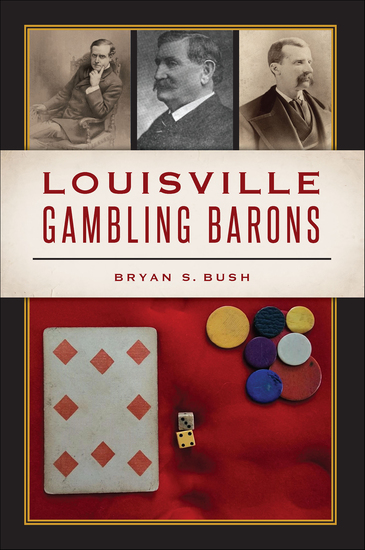
Louisville Gambling Barons - cover
LER

Louisville Gambling Barons

Bryan S. Bush

Editora: The History Press

  • 0
  • 0
  • 0

Sinopse

The Golden Age of Gambling in Louisville Louisville experienced a golden age of gambling between 1860 and 1885, thanks to the arrival of hundreds of thousands of Union soldiers by steamboat and foot. They played faro, keno, roulette and other games of chance, such as chuck-a-luck. Entire city blocks were devoted to betting. Horse racing and lotteries emerged. Gaming houses became grand palaces, with names such as the Crockford, the Crawford and the Turf Exchange, frequented by famous gamblers like Richard Watts, Colonel "Black" Chinn and actor Nat Goodwin. Author Bryan Bush offers up these stories and more about "The City of Gamblers."
Disponível desde: 03/04/2023.
Comprimento de impressão: 242 páginas.

Outros livros que poderiam interessá-lo

  • Doorknob Bombshells in Therapy - The Deadline the Brain and Why It Is Important to End on Time - cover

    Doorknob Bombshells in Therapy -...

    Daniela V. Gitlin

    • 0
    • 0
    • 0
    What should a therapist do when a patient reveals critical information at the end of a session? 


    It's a near-universal experience among mental health practitioners: a patient drops a bombshell—a critical disclosure that moves the treatment forward—on their way out, with a hand on the doorknob. This "doorknob moment" creates a stressful dilemma for clinicians, especially when the patient is distraught. Should the clinician end the session on time, or run over and be late for the next patient? 


    Here, seasoned psychiatrist Daniela V. Gitlin provides clinicians with a clear, evidence-based answer. By conceptualizing the functional differences between patient and therapist in the treatment relationship as a metaphor for the functional differences between right and left cerebral hemispheres, Gitlin's argument yields a comprehensive explanation for why doorknob moments occur, why they are necessary to prevent treatment stagnation, and why ending on time makes patients feel safer to deliver them.
    Ver livro
  • Biggest Tank Battles of the World Wars The: Tank Warfare in History’s Deadliest Conflicts - cover

    Biggest Tank Battles of the...

    Charles River Editors

    • 0
    • 0
    • 0
    World War I was the first truly industrial war, and it created a paradigm which reached its zenith with World War II and towards which virtually all equipment, innovation and training were dedicated throughout the Cold War and the remainder of the 20th century. To this day, modern warfare remains synonymous with tanks and mass infantry battles, although a confrontation of this nature has not occurred (except briefly during Operation Desert Storm) since World War II.  
    	One of the most important breakthroughs in military technology associated with World War I, and certainly the one that continues to capture the public imagination, was the introduction of a war machine that came to dominate the face of land battles throughout most of the 20th century: the tank. As a concept, it was not revolutionary; in fact, it harkened back to classical antiquity and to the Middle Ages, such as the covered battering rams and testudos which had made frequent appearances on ancient battlefields. In essence, it was designed to solve the age-old problem of protecting infantry from enemy projectiles while remaining mobile.  
    	The development of both modern artillery and machine guns, as well as the stalemate engendered by heavy fortifications and entrenchments, had hamstrung the mobility of infantry and cavalry and also left them both utterly vulnerable to defensive firepower. Since they were incapable of replying in kind, the tank was designed to bridge that gap. The tank’s armor, thick enough to withstand lateral fragmentation from exploding shells (although not direct hits) also made it virtually invulnerable to enemy rifle and machine gun fire, and its large tread meant that it could bridge trenches which would, at the very least, have delayed infantry substantially. As for the barbed wire entanglements and obstacles that severely delayed infantry and exposed them to enemy fire, tanks could simply drive right through it. 
    Ver livro
  • In the Penal Colony - cover

    In the Penal Colony

    Franz Kafka

    • 0
    • 0
    • 0
    "In the Penal Colony" is a short story by Franz Kafka written in German in October 1914, revised in November 1918, and first published in October 1919. As in some of Kafka's other writings, the narrator in this story seems detached from, or perhaps numbed by, events that one would normally expect to be registered with horror. Internal clues and the setting on an island suggest Octave Mirbeau's The Torture Garden as an influence. The story is set in an unnamed penal colony and describes the last use of an elaborate torture and execution device that carves the commandment that the condemned prisoner has transgressed on his skin as he slowly dies over the course of twelve hours. As the plot unfolds, the reader learns more and more about the machine, including its origin and original justification.
    Ver livro
  • The Ashtray - (Or the Man Who Denied Reality) - cover

    The Ashtray - (Or the Man Who...

    Errol Morris

    • 0
    • 0
    • 0
    In 1972, philosopher of science Thomas Kuhn threw an ashtray at Errol Morris. This book is the result. At the time, Morris was a graduate student. Now we know him as one of the most celebrated and restlessly probing filmmakers of our time, the creator of such classics of documentary investigation as The Thin Blue Line. Kuhn was—and, posthumously, remains—a star in his field and author of The Structure of Scientific Revolutions, a landmark book that introduced the concept of "paradigm shifts" to the larger culture. And Morris thought the idea was bunk. 


    The Ashtray tells why—and in doing so, it makes a powerful case for Morris's way of viewing the world, and the centrality to that view of a fundamental conception of the necessity of truth. "For me," Morris writes, "truth is about the relationship between language and the world: a correspondence idea of truth." He has no patience for philosophical systems that aim for internal coherence and disdain the world itself. Morris wants to establish as clearly as possible what we know and can say about the world, reality, history, our actions, and interactions. It's the fundamental desire that animates his filmmaking. Truth may be slippery, but that doesn't mean we have to grease its path of escape through philosophical evasions. Rather, Morris argues, it is our duty to do everything we can to establish and support it.
    Ver livro
  • The Story Economy - How Sharing Your Truth Can Be Your Most Valuable Asset - cover

    The Story Economy - How Sharing...

    William Welser

    • 0
    • 0
    • 0
    How do you value your private data? What about your job? The truth is someone is selling your data, and your job may be among the countless others being lost to AI at record rates. Because of this abuse of technology among many others, most people have lost all agency over their technology, devices, and information. But technologist William Welser IV has a plan to help us regain control.Enter The Story Economy, a guide that provides fresh purchasing power in a world where opportunity feels harder and harder to grasp. Within, Welser outlines the need for an alternative economy where stories can become solutions to overwhelming new problems. His entirely new marketplace allows us to use our stories as currency, putting the data we've voluntarily given to good use—allowing us to purchase goods and services and giving us the power to see exactly where our data is going and to whom.In this exciting and sometimes scary world of AI, Big Tech is using all of its tools against us to create a society in which we're lonely, broke, and lost. We must take back our power and make the technology work for us to close the healthcare, education, and wealth divide—and in the process, foster self-awareness to help us become astute decision-makers and stay ahead of technology. The Story Economy provides the innovative blueprint to get started.
    Ver livro
  • 1000 Motivational Statements - Learn German While Transforming Your Life - cover

    1000 Motivational Statements -...

    Science-Based Language Learning Lab

    • 0
    • 0
    • 0
    Unlock the power of dual-language learning with "1000 Motivational Statements: Learn German While Transforming Your Life." This innovative book combines language mastery with self-improvement, offering 1000 motivational statements in German, followed by English translations. By reading and repeating these phrases, you'll effortlessly integrate language learning into your daily routine, making it both enjoyable and inspiring. 
     
    Why Choose This Book? 
     
    - Dual Benefit: Improve your German while boosting your motivation. 
     
    - Complete Self-Improvement: Beyond clichés, find advice on communication, relationships, fitness, and more. 
     
    - Inspirational Growth: Each statement is crafted to uplift and guide you on your personal development journey. 
     
    - Easy to Follow: Side-by-side translations make understanding and pronunciation simple. 
     
    - Cultural Insight: Delve into German language and culture through meaningful expressions. 
     
    Ideal for beginners or those reinforcing their skills, this book offers a refreshing way to stay motivated while achieving your language goals. Transform your life and broaden your horizons with every page. Start your bilingual journey today and discover the empowerment of learning German while enhancing your life!
    Ver livro