Junte-se a nós em uma viagem ao mundo dos livros!
Adicionar este livro à prateleira
Grey
Deixe um novo comentário Default profile 50px
Grey
Assine para ler o livro completo ou leia as primeiras páginas de graça!
All characters reduced
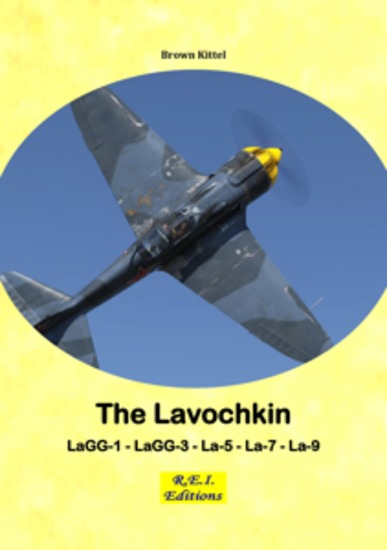
The Lavochkin - cover
LER

The Lavochkin

Brown Kittel

Editora: R.E.I. Editions

  • 0
  • 0
  • 0

Sinopse

The first Lavochkin fighter was designated I-22 and was also the first of the triad of new Soviet interceptors (Lavochkin, Yakovlev and Ilyushin) to take flight, on March 30, 1939.Lavochkin, together with Gorbunov and Gudkov, had created a simple and robust fighter, relatively good-looking, but which had the problem of choosing strategic materials, or rather, the choice not to use them.It was, in fact, the only one of the three that was built entirely of wood, except, of course, for the fundamental elements such as the landing gear, weapons, engine, ailerons (metal and covered in fabric).The retractable landing gear and the M-105P engine were signs of relative modernity, and certainly worthy of note was its maximum speed of 605 km/h.The weapons were high rate of fire, two ShKAS cannons and a ShVAK cannon.Despite its heavy structure, the real problem was the tendency to enter a spin in tight turns, which certainly did not encourage to make the most of its flight characteristics, already not very exciting.However, it was successful as a tactical support fighter, especially used on the Finnish front, and within the limits of its autonomy, also valid for escorting bombers.It was capable of flying in cold climates and often had skis, which, however, worsened its performance in flight.The first LaGG-1 model was followed by subsequent models, the LaGG-3, the La-5, the La-7 and, finally, the La-9, but by then at the end of the war. 
Disponível desde: 08/02/2025.
Comprimento de impressão: 120 páginas.

Outros livros que poderiam interessá-lo

  • Four Dissertations - A Natural History of Religion Of the Passions Of Tragedy Of the Standard of Taste - cover

    Four Dissertations - A Natural...

    David Hume

    • 0
    • 0
    • 0
    David Hume (1711-1776) remains one of the most stimulating and entertaining writers in the English essay tradition. Though primarily known for long-form writings, he was adept at taking one subject and looking at it in a more concise but accessible manner. 
    Hume devoted his life to study – across a wide range of his personal interests, reflecting his background in philosophy, history, economics, and many other subjects. This can be clearly seen in Four Dissertations (1757) and the topics he chose to consider. 
     
    Of these, The Natural History of Religion is the most well-known and widely quoted. Hume’s views, shaped by empiricism and scepticism, enables him to offer a perspective unusual for his age, though naturally it is embedded in the prevailing view ‘The whole frame of nature bespeaks an intelligent author’. Nevertheless, this does not restrict his thinking as he examines the psychological and sociological factors that shape religious sentiment. 
     
    The other three Dissertations are no less fascinating. Fittingly, in Of The Passions, Hume delves into the complex realm of human emotions. Investigating the nature of desire, love, fear, and more, he presents a wide-ranging study of how passions influence our actions and shape our experiences. 
     
    Of Tragedy, explores the aesthetics of dramatic art. Hume looks into the power of tragedy to elicit a passionate response and provoke contemplation. He examines the mechanisms by which tragedies captivate audiences and evoke a range of sentiments, shedding light on the profound impact of art on human consciousness. 
     
    In Of the Standard of Taste, Hume takes the viewpoint of the beholder, rather than the object. Declaring ‘We are apt to call barbarous whatever departs widely from our own taste and apprehension,’ he proposes that two elements, sentiment and critical faculty form a major part in decisions on taste. For “Beauty is no quality in things themselves: It exists merely in the mind which contemplates them; and each mind perceives a different beauty.” But such a subjective view cannot deny a certain consensus on beauty, which leads Hume to examine the matter of aesthetics in the light of judgements of established critics. 
     
    This recording concludes with Hume’s two short autobiographies, written at different times in his life and with differing characteristics. The first, A Kind of Life (1734) is a letter written to a doctor and the second, My Own Life (1776) was written shortly before his death.
    Ver livro
  • Sumerian Gods and Heroes - Exploring the Birth of Mythology - cover

    Sumerian Gods and Heroes -...

    Odessa Nightshade

    • 0
    • 0
    • 0
    The mythology of the Sumerians stands as one of the earliest recorded religious traditions, shaping the beliefs of later civilizations in Mesopotamia and beyond. As one of the first urban societies, the Sumerians established a complex pantheon of gods and heroes that explained the forces of nature, human existence, and the divine order of the universe. Their myths, inscribed on clay tablets in cuneiform script, offer a glimpse into a world where deities governed every aspect of life, from the rising sun to the floods of the Tigris and Euphrates rivers. These stories, rich with symbolism and allegory, not only influenced later cultures but also laid the foundation for many of the myths and legends still told today.  
    Sumerian civilization thrived in southern Mesopotamia, in what is now modern-day Iraq, around 3100 BCE. The Sumerians built city-states such as Uruk, Ur, and Nippur, each with its own patron deity. Religion was deeply intertwined with governance, as rulers were seen as intermediaries between the gods and the people. The belief that divine favor determined a city’s prosperity reinforced the importance of rituals, offerings, and temple constructions, particularly the iconic ziggurats that served as sacred centers of worship. The Sumerian gods were not distant, benevolent figures but rather powerful beings with human emotions and rivalries, shaping the world through both harmony and conflict.  
    The primary sources of Sumerian mythology come from cuneiform texts, including the Enuma Elish, various temple hymns, and the Epic of Gilgamesh. These texts preserve tales of creation, divine wars, and the struggles of mortal heroes. The myths of Anu, Enlil, and Enki explain the structure of the cosmos and the forces that govern it, while legends of Inanna and Dumuzi reveal the themes of love, fertility, and the cycle of life and death.
    Ver livro
  • A Rare Recording of Alexander Fleming - cover

    A Rare Recording of Alexander...

    Alexander Fleming

    • 0
    • 0
    • 0
    Sir Alexander Fleming (August 6, 1881 – March 11, 1955) was a Scottish biologist, pharmacologist and botanist. He wrote many articles on bacteriology, immunology, and chemotherapy. His best-known discoveries are the enzyme lysozyme in 1923 and the antibiotic substance penicillin from the mold Penicillium notatum in 1928, for which he shared the Nobel Prize in Physiology or Medicine in 1945 with Howard Florey and Ernst Boris Chain. The following is from a 1950 talk he gave on the development of antibiotics.
    Ver livro
  • Howard Carter: A short biography - 5 Minutes: Short on time – long on info! - cover

    Howard Carter: A short biography...

    5 Minutes, 5 Minute Biographies,...

    • 0
    • 0
    • 0
    Howard Carter, discoverer of the grave of Pharaoh Tutankhamon: Life and work in a short biography! Everything you need to know, brief and concise. Infotainment, education and entertainment at its best!
    Ver livro
  • A Grotesque Animal - cover

    A Grotesque Animal

    Amy Lee Lillard

    • 0
    • 0
    • 0
    At the age of forty-three, Amy Lee Lillard learned she was autistic. She learned she was part of a community of unseen women who fell through the gaps due to medical bias and social stereotypes. 


    A Grotesque Animal explores the making, unmaking, and making again of a woman with an undiagnosed disorder. How did a working-­class background and a deep-rooted Midwest culture of silence lead to hiding in plain sight for decades? How did sexuality and anger hide the roots of trauma among the women in her family? And what does it mean to be a queer, disabled, aging woman, a descendant of wild but tamed mothers and a survivor of the things patriarchy inflicts? 


    Through wide-ranging styles and a combination of personal storytelling and cultural analysis, Lillard dissects anger, sexuality, autistic masking, bodies, punk, and female annihilation to create a new picture of modern women.
    Ver livro
  • Cornelius Vanderbilt: A short biography - 5 Minutes: Short on time - long on info! - cover

    Cornelius Vanderbilt: A short...

    5 Minutes, 5 Minute Biographies,...

    • 0
    • 0
    • 0
    Cornelius Vanderbilt, industrial tycoon: Life and work in a short biography! Everything you need to know, brief and concise. Infotainment, education and entertainment at its best!
    Ver livro