¡Acompáñanos a viajar por el mundo de los libros!
Añadir este libro a la estantería
Grey
Escribe un nuevo comentario Default profile 50px
Grey
Suscríbete para leer el libro completo o lee las primeras páginas gratis.
All characters reduced
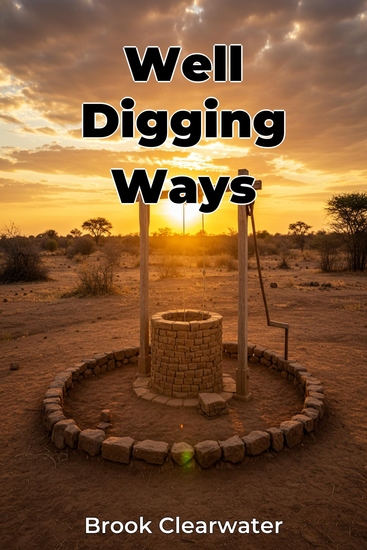
Well Digging Ways - cover

Well Digging Ways

Brook Clearwater

Traductor A AI

Editorial: Publifye

  • 0
  • 0
  • 0

Sinopsis

Well Digging Ways offers a unique perspective on tackling water scarcity by focusing on family-led well construction. This approach empowers communities in dry regions to secure sustainable water solutions. The book blends environmental science, earth sciences, and geography to provide a comprehensive guide. It highlights how understanding the hydrogeology of dry regions, including groundwater systems and aquifer dynamics, is crucial for successful well placement. It also details how family-led projects can reduce reliance on external aid and foster community resilience.

 
The book explores accessible methods for well construction using local materials and techniques, emphasizing community involvement and ecological sustainability. For example, it discusses hand-dug wells and driven wells. It also examines the social and economic dimensions, such as land ownership and water rights, and presents guidelines for sustainable well management.

 
The book progresses from fundamental hydrogeological concepts to practical well construction techniques and finally to sustainable management strategies. Well Digging Ways stands out by combining technical guidance with an examination of political and economic factors influencing water access. It challenges conventional reliance on large-scale projects, showcasing the potential of community-driven initiatives. Case studies and field research support the argument that family-led well construction can be a sustainable and empowering solution to water scarcity.
Disponible desde: 27/02/2025.
Longitud de impresión: 127 páginas.

Otros libros que te pueden interesar

  • America’s Most Notorious Natural Disasters - cover

    America’s Most Notorious Natural...

    Charles River Editors

    • 0
    • 0
    • 0
    It had taken about 40 years for Chicago to grow from a small settlement of about 300 people into a thriving metropolis with a population of 300,000, but in just two days in 1871, much of that progress was burned to the ground. In arguably the most famous fire in American history, a blaze in the southwestern section of Chicago began to burn out of control on the night of October 8, 1871.  
    In 2005, the world watched in horror as Hurricane Katrina decimated New Orleans, and the calamity seemed all the worse because many felt that technology had advanced far enough to prevent such tragedies, whether through advanced warning or engineering. However, the failure of human engineering like that seen in New Orleans was nothing new, and it had previously had even deadlier consequences in Johnstown, Pennsylvania. Although floods rarely get as much coverage as other kinds of natural disasters like volcanic explosions, the Johnstown Flood of 1889 has remained an exception due to the sheer destruction and magnitude of the disaster.  
    As bad as Hurricane Katrina was, the hurricane that struck Galveston, Texas on September 8, 1900 killed several times more people, with an estimated death toll between 6,000-12,000 people. Prior to advanced communications, few people knew about impending hurricanes except those closest to the site, and in the days before television, or even radio, catastrophic descriptions were merely recorded on paper, limiting an understanding of the immediate impact.   
    	On April 18, 1906, most of the residents of the city of San Francisco were sound asleep when the ground started to shake around 5:15 a.m., but what started as fairly soft tremors turned into a violent shaking in all directions. The earthquake lasted about a minute, but it had enough destructive force to divert the course of entire rivers and level much of the 9th largest city in America at the time. 
    Ver libro
  • Microbiology - A Very Short Introduction - cover

    Microbiology - A Very Short...

    Nicholas P. Money

    • 0
    • 0
    • 0
    In recent decades we have come to realize that the microbial world is hugely diverse, and can be found in the most extreme environments. Fungi, single-celled protists, bacteria, archaea, and the vast array of viruses and sub-viral particles far outnumber plants and animals. Microbes, we now know, play a critical role in ecosystems, in the chemistry of atmosphere and oceans, and within our bodies. The field of microbiology, armed with new techniques from molecular biology, is now one of the most vibrant in the life sciences. 
     
    In this Very Short Introduction Nicholas P. Money explores not only the traditional methods of microscopy and laboratory culture but also the modern techniques of genetic detection and DNA sequencing, genomic analysis, and genetic manipulation. In turn he demonstrates how advances in microbiology have had a tremendous impact on the areas of medicine, agriculture, and biotechnology.
    Ver libro
  • Race for Nuclear Weapons during World War II The: The History and Legacy of Both Sides’ Efforts to Build an Atomic Bomb - cover

    Race for Nuclear Weapons during...

    Editors Charles River

    • 0
    • 0
    • 0
    Before the Second World War, military conflicts were fought under orthodox conditions, usually termed “conventional warfare,” but several innovations had significantly changed combat, leading inextricably to the race for a nuclear weapon in the 1930s and 1940s. Conflicts had been fought by armies on horseback with guns of varying sophistication since the 16th century, but mechanized warfare and machine guns changed this calculus and set the stage for future combat by the end of World War I. Other sinister changes entered the fray during this conflict, such as chemical weapons like chlorine and mustard gas. The total warfare brought about by World War I and ensuing wars like the Spanish Civil War made the quest for the most powerful weapons somewhat necessary. 
    The Manhattan Project would ultimately yield the “Little Boy” and “Fat Man” bombs that released more than 100 Terajoules of energy at Hiroshima and Nagasaki, but as it turned out, the Axis were not far behind with their own nuclear weapons program. When the Nazis’ quest for a nuclear weapon began in earnest in 1939, no one really had a handle on how important nuclear weapons would prove to war and geopolitics. The attacks on Hiroshima and Nagasaki in August 1945, along with the Cold War-era tests and their accompanying mushroom clouds, would demonstrate the true power and terror of nuclear weapons, but in the late 1930s these bombs were only vaguely being thought through, particularly after the successful first experiment to split the atom by a German scientist. The nuclear age itself was in its infancy, barely 35 years old, but within a few short years the advent of nuclear war loomed over the world and the prospect of the enemy winning the nuclear race kept Allied leaders awake at night.
    Ver libro
  • Firefighter - Ignite your Firefighter Exam Prep! Dive into engaging audio lessons for peak test performance - cover

    Firefighter - Ignite your...

    Caleb Thornfield

    • 0
    • 0
    • 0
    Firefighter: The Ultimate Guide to Mastering the Firefighter Exam 2024-2025 
    ⭐⭐ Simplified Guide & Explanations Included ⭐⭐ 
    Are you aiming to advance in your career and solidify your knowledge by successfully passing the Firefighter Exam 2024-2025? 
    In need of a comprehensive resource that provides all the necessary elements to ace the Firefighter Exam 2024-2025? 
    Your search ends here! 
    This guide serves as your definitive companion for deepening your understanding, applying your skills, and engaging in hands-on exercises. With this, you're geared for success. 
    Updated for the Firefighter Exam Structure 2024-2025  
    Key features of this enriched guide: 
    - Profound insights about the Firefighter Exam 2024-2025 Certification 
    - Detailed explanation of the Firefighter Certification Process 
    - Fruitful strategies for exam preparation and tackling 
    Our guide distinguishes itself through comprehensive coverage, which is essential for your exam victory. Concepts aren't merely skimmed; they are delved into with precision. 
    Please note that this guide is not affiliated with any official firefighter entity and is purely an independent resource for your benefit. 
    Designed with a clear structure and easy-to-understand language, our Firefighter Exam Guide 2024-2025 ensures smooth transitions between topics. Say goodbye to dense jargon and welcome clear, precise, and technically accurate content. 
    So, why wait? Click the BUY NOW button, secure your guide, and begin your journey to Firefighter Exam 2024-2025 success!
    Ver libro
  • Software Engineering for Data Scientists - From Notebooks to Scalable Systems - cover

    Software Engineering for Data...

    Catherine Nelson

    • 0
    • 0
    • 0
    Data science happens in code. The ability to write reproducible, robust, scaleable code is key to a data science project's success—and is absolutely essential for those working with production code. This practical book bridges the gap between data science and software engineering, and clearly explains how to apply the best practices from software engineering to data science. 


    Examples are provided in Python, drawn from popular packages such as NumPy and pandas. If you want to write better data science code, this guide covers the essential topics that are often missing from introductory data science or coding classes, including how to understand data structures and object-oriented programming; clearly and skillfully document your code; package and share your code; integrate data science code with a larger code base; learn how to write APIs; create secure code; apply best practices to common tasks such as testing, error handling, and logging; work more effectively with software engineers; write more efficient, maintainable, and robust code in Python; put your data science projects into production; and more.
    Ver libro
  • US Army 1960s Polygraph Training - cover

    US Army 1960s Polygraph Training

    US Army

    • 0
    • 0
    • 0
    The primary mission of military intelligence in the United States Army is to provide timely, relevant, accurate, and synchronized intelligence and electronic warfare support to tactical, operational and strategic-level commanders. The Army’s intelligence components produce intelligence both for Army use and for sharing across the national intelligence community. The military will subject someone to a polygraph for several reasons: If that person needs to access confidential files; if they are accused of leaking government secrets; if they are accused of terrorism or of being a spy; if they are a foreign national who needs access to classified material, and several other reasons. The following is a 1960s Army training recording with information on administering a lie detector test.
    Ver libro