Junte-se a nós em uma viagem ao mundo dos livros!
Adicionar este livro à prateleira
Grey
Deixe um novo comentário Default profile 50px
Grey
Assine para ler o livro completo ou leia as primeiras páginas de graça!
All characters reduced
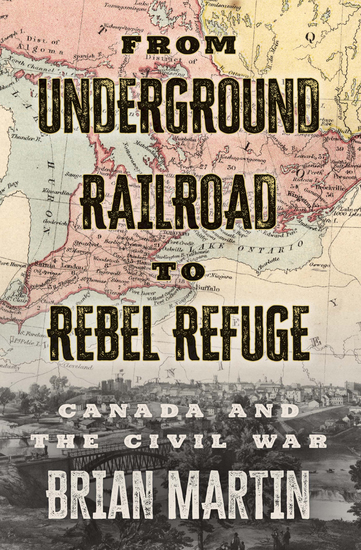
From Underground Railroad to Rebel Refuge - Canada and the Civil War - cover
LER

From Underground Railroad to Rebel Refuge - Canada and the Civil War

Brian Martin

Editora: ECW Press

  • 0
  • 0
  • 0

Sinopse

Filled with engaging stories and astonishing facts, From Underground Railroad to Rebel Refuge examines the role of Canadians in the American Civil War
		 
Despite all we know about the Civil War, its causes, battles, characters, issues, impacts, and legacy, few books have explored Canada’s role in the bloody conflict that claimed more than 600,000 lives.
		 
A surprising 20,000 Canadians went south to take up arms on both sides of the conflict, while thousands of enslaved people, draft dodgers, deserters, recruiters, plotters, and spies fled northward to take shelter in the attic that is Canada. Though many escaped slavery and found safety through the Underground Railroad, they were later joined by KKK members wanted for murder. Confederate President Jefferson Davis along with several of his emissaries and generals found refuge on Canadian soil, and many plantation owners moved north of the border.
		 
Award-winning journalist Brian Martin will open eyes in both Canada and the United States to how the two countries and their citizens interacted during the Civil War and the troubled times that surrounded it.
Disponível desde: 25/10/2022.
Comprimento de impressão: 352 páginas.

Outros livros que poderiam interessá-lo

  • Frontier Wars and the New Zealand Wars The: The History of the British Empire’s Conflicts against Indigenous Groups in Australia and New Zealand - cover

    Frontier Wars and the New...

    Editors Charles River

    • 0
    • 0
    • 0
    Inevitably, as the British settled in Australia and New Zealand, they entered into conflicts with the indigenous people, and they would learn quite quickly that the Māori were quite bellicose. As such, the New Zealand Wars would last over 30 years.  
    	The history of the indigenous inhabitants of Australia, known in contemporary anthropology as the “Aboriginal and Torres Strait Islander people of Australia,” is a complex and continually evolving field of study, and it has been colored by politics. For generations after the arrival of whites in Australia, the Aboriginal people were disregarded and marginalized, largely because they offered little in the way of a labor resource, and they occupied land required for European settlement.  
    	At the same time, it is a misconception that indigenous Australians meekly accepted the invasion of their country by the British, for they did not. They certainly resisted, but as far as colonial wars during that era went, the frontier conflicts of Australia did not warrant a great deal of attention. Indigenous Australians were hardly a warlike people, and without central organization, or political cohesion beyond scattered family groups, they succumbed to the orchestrated advance of white settlement with passionate, but futile resistance. In many instances, aggressive clashes between the two groups simply gave the white colonists reasonable cause to inflict a style of genocide on the Aborigines that stood in the way of progress. In any case, their fate had largely been sealed by the first European sneeze in the Terra Australis, which preceded the importation of the two signature mediums of social destruction. The first was a collection of alien diseases, chief among smallpox, but also cholera, influenza, measles, tuberculosis, syphilis and the common cold. 
    Ver livro
  • Healing the Adult Children of Narcissists - Essays on The Invisible War Zone and Exercises for Recovery and Reflection - cover

    Healing the Adult Children of...

    Shahida Arabi

    • 0
    • 0
    • 0
    Those who have had a narcissistic parent can testify to how damaging it can be to one's psyche. Narcissistic parents lack empathy, show a severe sense of entitlement to micromanage the lives of their children, and often subject their children to neglect, as well as emotional, psychological, and physical abuse. From the unique challenges daughters of narcissistic fathers face to the ways in which adverse childhood experiences affect our brains, Shahida Arabi's insightful essays resonate deeply with those who have been raised by narcissistic parents. In this new essay collection, Arabi explores how narcissistic abuse in childhood can set us up for trauma repetition in adulthood, affecting how we navigate relationships, the self, and the world. She pinpoints the toxic traits and behaviors of narcissistic mothers and fathers, exposing how covert abuse insidiously plays out in these specific dynamics. She offers the essential tools, skill sets, and healing modalities for survivors who have undergone a lifetime's worth of abuse, helping them to break the cycle once and for all for future generations.
    Ver livro
  • Dream Psychology - Psychoanalysis for Beginners - cover

    Dream Psychology -...

    Sigmund Freud

    • 0
    • 0
    • 0
    In his book Dream Psychology, Sigmund Freud argues that dreams are a manifestation of our unconscious desires. He believes that they are a way for our mind to process and make sense of the events of the day. Dreams can also be a way for us to work through our fears and anxieties. Freud believes that understanding the symbolism in our dreams can help us to better understand ourselves and our subconscious minds. Read in English, unabridged.
    Ver livro
  • Jewish Space Lasers - The Rothschilds and 200 Years of Conspiracy Theories - cover

    Jewish Space Lasers - The...

    Mike Rothschild

    • 0
    • 0
    • 0
    The strange tale of how one Jewish family—the Rothschilds—became a lightning rod for conspiracy theories over the course of the last two centuries . . .  


    In 2018 Congresswoman Marjorie Taylor Greene took to social media to share her suspicions that the California wildfires were started by 'space solar generators' which were funded by powerful, mysterious backers. Instantly, thousands of people rallied around her, blaming the fires on "Jewish space lasers" and, ultimately, the Rothschild family. 


    For more than 200 years, the name "Rothschild" has been synonymous with two things: great wealth, and conspiracy theories about what they're "really doing" with it. Almost from the moment Mayer Amschel Rothschild and his sons emerged from the Jewish ghetto of Frankfurt to revolutionize the banking world, the Rothschild family has been the target of myths, hoaxes, bizarre accusations, and constant, virulent antisemitism. Over the years, they have been blamed for everything from the sinking of the Titanic, to causing the Great Depression, and even creating the COVID-19 pandemic. 


    Jewish Space Lasers is a deeply researched dive into the history of the conspiracy industry around the Rothschild family.
    Ver livro
  • Hedonism - The Pursuit and Philosophy of Pleasure as a Way of Life - cover

    Hedonism - The Pursuit and...

    Hector Davidson

    • 0
    • 0
    • 0
    Hedonism, at its core, is the philosophy that pleasure is the highest good and the ultimate goal of human life. Its allure lies in the simplicity of its premise: that the pursuit of pleasure, whether physical, emotional, or intellectual, is essential to living a fulfilling life. This view is not just a modern indulgence but has deep roots in the history of philosophy, tracing back to the ancient Greeks, who were the first to systematically explore the nature of pleasure and its role in human existence. 
    The term “hedonism” derives from the Greek word hēdonē, meaning pleasure, and throughout history, philosophers have debated whether this pursuit is inherently selfish or whether it can contribute to the greater good. The Greek philosopher Aristippus of Cyrene is often credited with being one of the first to advocate for a form of hedonism, suggesting that the ability to master one’s pleasures was the key to happiness. On the other hand, Epicurus, another Greek philosopher, argued that the pursuit of simple pleasures, rather than indulgence in excess, leads to the greatest happiness. These foundational ideas have sparked ongoing discussions about the nature of pleasure and how it fits into the human quest for meaning. 
    In the centuries that followed, hedonism evolved in different directions. During the Enlightenment, thinkers like Jeremy Bentham and John Stuart Mill reinterpreted hedonism through the lens of utilitarianism, positing that the greatest happiness of the greatest number should be the guiding principle of ethical decision-making. Today, hedonism is often understood not only as a personal pursuit of pleasure but also as a cultural phenomenon that shapes modern consumerism, self-care movements, and even digital experiences.
    Ver livro
  • Index A History of the - A Bookish Adventure from Medieval Manuscripts to the Digital Age - cover

    Index A History of the - A...

    Dennis Duncan

    • 0
    • 0
    • 0
    Most of us give little thought to the back of the book—it's just where you go to look things up. But as Dennis Duncan reveals in this delightful and witty history, hiding in plain sight is an unlikely realm of ambition and obsession, sparring and politicking, pleasure and play. In the pages of the index, we might find Butchers, to be avoided, or Cows that sh-te Fire, or even catch Calvin in his chamber with a Nonne. Here, for the first time, is the secret world of the index: an unsung but extraordinary everyday tool, with an illustrious but little-known past. 


    Charting its curious path from the monasteries and universities of thirteenth-century Europe to Silicon Valley in the twenty-first, Duncan uncovers how it has saved heretics from the stake, kept politicians from high office, and made us all into the readers we are today. We follow it through German print shops and Enlightenment coffee houses, novelists' living rooms and university laboratories, encountering emperors and popes, philosophers and prime ministers, poets, librarians and—of course—indexers along the way. Revealing its vast role in our evolving literary and intellectual culture, Duncan shows that, for all our anxieties about the Age of Search, we are all index-rakers at heart—and we have been for eight hundred years.
    Ver livro