¡Acompáñanos a viajar por el mundo de los libros!
Añadir este libro a la estantería
Grey
Escribe un nuevo comentario Default profile 50px
Grey
Suscríbete para leer el libro completo o lee las primeras páginas gratis.
All characters reduced
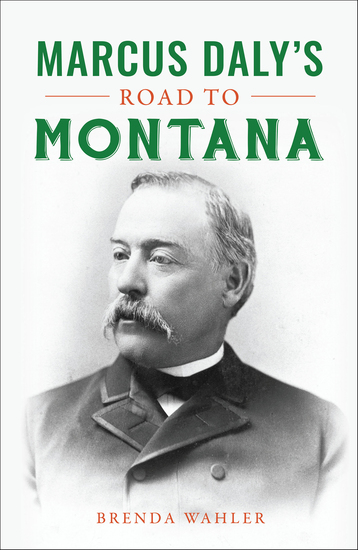
Marcus Daly's Road to Montana - cover

Marcus Daly's Road to Montana

Brenda Wahler

Editorial: The History Press

  • 0
  • 0
  • 0

Sinopsis

The Making of a Copper King!Born in 1841 to tenant farmers, Marcus Daly came from ruralIreland to New York as a boy. Having learned the big city’s harsh lessons, he traveled west to the gold and silver mining camps ofCalifornia, Nevada, Utah and Montana. Then, a spectacular discovery in the Anaconda mine him one of Montana’s famed Copper Kings. Yet, his early life remained shrouded in myth. Famed for his machinations in state politics and shaping Butte into the “Richest Hill on Earth,” his path from farm boy to mining king has been overlooked. For the first time, author Brenda Wahler brings his secretive and formative early years to life.
Disponible desde: 06/03/2023.
Longitud de impresión: 264 páginas.


Otros libros que te pueden interesar

  • Train General Knowledge Skillful Small Talk - How to Improve Your General Knowledge and Radiate More Intelligence and Self-Confidence - cover

    Train General Knowledge Skillful...

    Martin Grapengeter

    • 0
    • 0
    • 0
    Has it ever happened to you that you suddenly couldn't keep up with an interesting conversation? Did you have the impression that everyone else around you was taking part in an exciting debate that you could only understand? That's not a nice feeling and can lead to embarrassing situations in which you appear uninformed and clueless. If you hardly know anything about the world, you are quickly left behind in conversations and find it difficult to form an opinion on socially relevant topics. In a fast-paced and increasingly hectic world, it is often difficult to distinguish between important and unimportant knowledge and to find the right words. But it's not that difficult to acquire important general knowledge in a very short space of time!
    That's exactly what I want to help you with this book. You don't have time to wade through huge encyclopaedias or spend hours researching topics on the Internet? Are you often unsure whether your sources really reflect the facts correctly and how you can actually apply your knowledge? Then reading this compact guide to general knowledge is the right thing for you! Instead of complicated explanations and pages and pages of figures and data, you can expect easy-to-understand, informative sections on relevant topics from a wide range of areas.
    Ver libro
  • Norse Myths Unveiled - The Gods Giants and Heroes of Scandinavia - cover

    Norse Myths Unveiled - The Gods...

    Julia Blacksmith

    • 0
    • 0
    • 0
    Norse mythology is a vast and intricate belief system that shaped the spiritual and cultural identity of the Scandinavian people. Rooted in oral traditions and later recorded in texts such as the *Poetic Edda* and *Prose Edda*, these myths offer a glimpse into a world filled with powerful gods, fearsome giants, and legendary heroes. Unlike many other mythologies, Norse myths do not present a perfect and orderly universe but rather one marked by struggle, chaos, and an inevitable end.  
      
    At the heart of Norse cosmology are the Nine Realms, each interconnected through Yggdrasil, the great World Tree. These realms include Asgard, the home of the gods; Midgard, the realm of humans; and Jotunheim, the land of giants, among others. The Norse viewed the universe as a place of constant conflict and transformation, where even the gods were not immune to fate. This belief in destiny was central to their worldview, with figures like the Norns weaving the threads of fate for gods and mortals alike.  
      
    Prophecy played a significant role in Norse mythology, shaping the actions of both gods and mortals. One of the most well-known prophecies is that of Ragnarok, the great battle that would bring about the end of the world. Unlike many other religious traditions that offer eternal salvation, Norse myths emphasize the inevitability of destruction and rebirth. Even Odin, the Allfather, seeks wisdom not to change fate but to prepare for its arrival. 
    Ver libro
  • How is One to Be Entirely Free of Fear? - Malibu 1970 - Small Group Discussion 8 - cover

    How is One to Be Entirely Free...

    Jiddu Krishnamurti

    • 0
    • 0
    • 0
    What do we mean by fear? Fear of what? There are various types of fear and we need not analyse every type. But we can see that fear comes into being when our comprehension of relationship is not complete. Relationship is not only between people but between ourselves and nature, between ourselves and property, between ourselves and ideas; as long as that relationship is not fully understood, there must be fear. Life is relationship. To be is to be related and without relationship there is no life. Nothing can exist in isolation; so long as the mind is seeking isolation, there must be fear. Fear is not an abstraction; it exists only in relation to something.
    Ver libro
  • The Ancient Wisdom of Baseball - The Ancient Wisdom of Baseball: Lessons for Life from Homer's ODYSSEY to the World Series - cover

    The Ancient Wisdom of Baseball -...

    Christian Sheppard

    • 0
    • 0
    • 0
    “For those who love baseball, the game holds deep personal meaning and echoes to the past that are undeniable but often hard to articulate. Christian Sheppard’s The Ancient Wisdom of Baseball is a love letter to baseball that explains its connections to our inner lives and to classical lore in a way that makes one pine for Opening Day.”  —THEO EPSTEIN
     
    Who are you, how are you supposed to live, and what about happiness? Answers to age-old questions are offered in classic myths about heroes, gods, and monsters, and at the ballgame.
     
    In The Ancient Wisdom of Baseball, author Christian Sheppard interweaves Homer’s epics with glorious stories from the green fields of America’s pastime, celebrating Achilles’ courage and Odysseus’ cunning along with the virtues of Hall of Fame
        players such as Jackie Robinson and Babe Ruth and of great teams such as the 2004 Red Sox and the 2016 Cubs. Along the way, Sheppard humorously recollects trying to raise his baby daughter true to the teachings of ancient myth and his beloved game.
        The result is an endearing, insightful, and inspiring guide to cultivating virtue and becoming the hero of your own life’s odyssey.
    Ver libro
  • Obsolescence - An Architectural History - cover

    Obsolescence - An Architectural...

    Daniel M. Abramson

    • 0
    • 0
    • 0
    In our architectural pursuits, we often seem to be in search of something newer, grander, or more efficient—and this phenomenon is not novel. In the spring of 1910 hundreds of workers labored day and night to demolish the Gillender Building in New York, once the loftiest office tower in the world, in order to make way for a taller skyscraper. The New York Times puzzled over those who would sacrifice the thirteen-year-old structure, “as ruthlessly as though it were some ancient shack.” In New York alone, the Gillender joined the original Grand Central Terminal, the Plaza Hotel, the Western Union Building, and the Tower Building on the list of just one generation’s razed metropolitan monuments. In the innovative and wide-ranging Obsolescence, Daniel M. Abramson investigates this notion of architectural expendability and the logic by which buildings lose their value and utility. The idea that the new necessarily outperforms and makes superfluous the old, Abramson argues, helps people come to terms with modernity and capitalism’s fast-paced change. Obsolescence, then, gives an unsettling experience purpose and meaning. Belief in obsolescence, as Abramson shows, also profoundly affects architectural design. In the 1960s, many architects worldwide accepted the inevitability of obsolescence, experimenting with flexible, modular designs, from open-plan schools, offices, labs, and museums to vast megastructural frames and indeterminate building complexes. Some architects went so far as to embrace obsolescence’s liberating promise to cast aside convention and habit, envisioning expendable short-life buildings that embodied human choice and freedom. Others, we learn, were horrified by the implications of this ephemerality and waste, and their resistance eventually set the stage for our turn to sustainability—the conservation rather than disposal of resources. Abramson’s fascinating tour of our idea of obsolescence culminates in an assessment of recent manifestations of sustainability, from adaptive reuse and historic preservation to postmodernism and green design, which all struggle to comprehend and manage the changes that challenge us on all sides.
    Ver libro
  • The Notorious Edward Low - Pursuing the Last Great Villain of Piracy's Golden Age - cover

    The Notorious Edward Low -...

    Len Travers

    • 0
    • 0
    • 0
    Following the War of the Spanish Succession (1702–1713) a decade-long wave of sea-robbery plagued the Atlantic rim—often glamorized as the "Golden Age of Piracy". Boston-based laborer, Edward Low, left his mark on pirate history as the most vicious and sadistic raider of them all. Low's reputation, and those of other pirates, was crafted through newspapers and literature. Romanticized as anti-heroes and egalitarians in a monarchical world who had liberated themselves from the constraints of law and society ashore, these marauders came to enjoy an immortality bestowed upon them by generations of historians, novelists, and movie makers. That persistent gloss masks a more sordid reality. 


    Travers demonstrates that, feared as they certainly were, pirates were largely ordinary seamen trapped in desperate circumstances who, in the end, had little to show for their efforts. Contrary to popular portrayals, for pirates it was a time of radically diminishing returns, scant treasure, and increasingly successful suppression by state authorities. The Notorious Edward Low puts individual actors, from colonial governors to captains to common seamen, at center stage, and reveals how British authorities used new anti-piracy laws to reclaim authority over their fractious North American colonies—a compelling story with its own brand of true-life swashbuckling on the high seas.
    Ver libro