¡Acompáñanos a viajar por el mundo de los libros!
Añadir este libro a la estantería
Grey
Escribe un nuevo comentario Default profile 50px
Grey
Suscríbete para leer el libro completo o lee las primeras páginas gratis.
All characters reduced
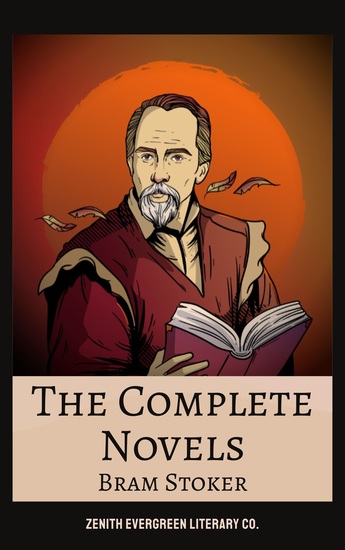
The Complete Novels of Bram Stoker - Gothic Horror Dark Romance and Classic Suspense - cover

The Complete Novels of Bram Stoker - Gothic Horror Dark Romance and Classic Suspense

Bram Stoker, Zenith Evergreen Literary Co.

Editorial: Zenith Evergreen Literary Co.

  • 0
  • 0
  • 0

Sinopsis

Where the darkness whispers and the monsters live.

The Complete Novels of Bram Stoker brings together the masterworks of gothic horror's greatest author. From the immortal Dracula to The Jewel of Seven Stars, The Lair of the White Worm, and beyond, these novels explore the supernatural, the macabre, and the limits of fear.

Stoker's writing blends atmospheric dread, psychological intrigue, and Victorian sensibility, influencing generations of horror fiction and cementing his place alongside Edgar Allan Poe and Mary Shelley as one of the great architects of terror.

💬 "Bram Stoker doesn't just tell ghost stories—he creates worlds you fear to enter and cannot leave."

🦇 Why Readers Still Crave Bram Stoker:
Includes all major gothic novels, including Dracula, The Jewel of Seven Stars, The Mystery of the Sea, and more

Perfect for fans of Mary Shelley, Shirley Jackson, and Stephen King

Essential reading for lovers of horror, supernatural thrillers, and Victorian literature

📣 Dare to Open the Door. Dare to Read the Darkness. Dare to Discover Stoker.
Buy The Complete Novels of Bram Stoker today and step into the world of shadows that still chills the soul.
Disponible desde: 28/04/2025.
Longitud de impresión: 3150 páginas.

Otros libros que te pueden interesar

  • The Raven - cover

    The Raven

    Edgar Allan Poe

    • 0
    • 0
    • 0
    The Raven by Edgar Allan Poe is one of literature's most iconic poems, weaving a haunting narrative of loss, despair, and the supernatural. In this mesmerizing and atmospheric tale, a grieving man, tormented by the memory of his lost love Lenore, finds himself visited by a mysterious raven late at night. As the raven perches above his chamber door, it speaks a single word: "Nevermore." 
    Poe's use of vivid imagery and melodic language captures the narrator’s descent into madness as he desperately seeks meaning in the raven’s cryptic response. Is it a messenger from beyond, or merely a cruel reminder of his sorrow? The poem masterfully explores themes of death, mourning, and the futility of seeking solace in the face of overwhelming grief. 
    This audiobook version of The Raven brings Poe's dark and melancholic vision to life, enveloping listeners in its eerie, gothic ambiance. With its rhythmic cadence and poignant storytelling, the poem remains a timeless work that resonates with anyone who has ever experienced the haunting echoes of lost love. 
    Perfect for fans of gothic poetry and classic literature, this rendition captures the essence of Poe’s masterful storytelling, making it an unforgettable listening experience. 
    Start Listening to The Raven today and immerse yourself in the chilling and poetic world of Edgar Allan Poe!
    Ver libro
  • The Criminal From Lost Honour - cover

    The Criminal From Lost Honour

    Frederick Schiller

    • 0
    • 0
    • 0
    Johann Christoph Friedrich Schiller was born on 10th November 1759, in Marbach, Württemberg, the sole son of six children, into a very religious family. 
     
    During his childhood his father was away, engaged in the Seven Years War and contact was sporadic until with the War’s end in 1763. His father became a recruiting officer and the family moved to Lorch. 
     
    It was here that Schiller received his early education, the quality of which was poor, not helped by the child’s frequent truancy.  His parents sought a clerical career for him and a local priest was engaged to teach him Latin and Greek. As a boy, Schiller was excited by the idea of becoming a cleric and often wore black robes and pretended to preach. 
     
    In 1766, the family left Lorch. Schiller's father had not been paid for three years, and the family’s savings were depleted, so his father Kaspar, joined the garrison in Ludwigsburg for the Duke of Württemberg. 
     
    There the boy Schiller came to the attention of the Duke. He entered the elite military academy, the Karlsschule Stuttgart, in 1773, and eventually studied medicine, which led him to frequently attempt cures for his various illnesses. 
     
    At the academy, he wrote his first play, ‘The Robbers’, which dramatizes the conflict between two aristocratic brothers. The play's themes of social corruption and proto-revolutionary republican ideals astounded its original audience. Schiller became an overnight sensation.  
     
    In 1780, he obtained a post as regimental doctor in Stuttgart. In order to attend the first performance of ‘The Robbers’ in Mannheim, Schiller left his regiment without permission. As a result, he was arrested, sentenced to 14 days imprisonment, and forbidden from publishing any further works. 
     
    He fled Stuttgart in 1782, going via Frankfurt, Mannheim, Leipzig, and Dresden to Weimar. Along this journey he had an affair with an army officer's wife, Charlotte von Kalb. She was at the centre of an intellectual circle and known for her cleverness and instability.  
     
    Schiller settled in Weimar in 1787. Two years later he was appointed professor of History and Philosophy in Jena, where he wrote only historical works. 
     
    On 22nd February 1790, he married Charlotte von Lengefeld who bore him two sons and two daughters. 
     
    Schiller returned with his family to Weimar from Jena in 1799. There Johann Wolfgang von Goethe convinced him to return to playwriting and together they founded the Weimar Theater, which led to a renaissance of drama now referred to as Weimar Classicism. They also worked together on Xenien, a collection of short satirical poems in which they challenged opponents of their philosophical vision. 
     
    For his achievements, Schiller was ennobled in 1802 by the Duke of Saxe-Weimar, adding the nobiliary particle ‘von’ to his name.  
     
    Schiller died on 9th May 1805, at age 45, from tuberculosis, at Weimar. 


    Although primarily admired for his plays Schiller also wrote histories, poetry and some notable translations.   
     
    In his short story ‘The Criminal from Lost Honour’ the layers of a man’s life are examined as perhaps only Schiller and his literary genius can.
    Ver libro
  • Running Wolf - Set in the Canadian wilderness this is a gripping supernatural tale with Native American elements - cover

    Running Wolf - Set in the...

    Algernon Blackwood

    • 0
    • 0
    • 0
    Algernon Blackwood was born on 14th March 1869 in Shooter’s Hill, South East London, to a religious middle-class family. His mother was a widowed Duchess and his father was a Post Office administrator.  
     
    Blackwood was interested in the paranormal and the supernatural at an early age, and had a thirst for anything on Buddhism, other Oriental philosophies, mysticism and occultism.  In his writings the weaving of the supernatural into his various works, from ghost stories and children’s stories to plays and long novels is clearly seen, his writings beautifully enriched by his long and diversified life experience.  
     
    After leaving university and visiting parts of Europe, mainly Switzerland, the young writer went to Canada and the United States where he took on jobs including work as a farmer, a bartender, a secretary, a journalist, a reporter, running a hotel and teaching the violin.  He was voracious in meeting new people and absorbing new ideas.  
     
    In his late thirties, he returned to England where he published two of his supernatural stories in Pall Mall Magazine. As more of his highly entertaining stories were published so did his reputation and his bank balance.  All those years of curiosity and experiences were starting to emerge from his writing. 
     
    In 1906, ‘The Empty House & Other Ghost Stories’ was published with tremendous success.  Further volumes of short stories followed and with it a larger audience and bigger paydays. He also published children’s stories. 
     
    Blackwood also had ideas for novels and to explore on a larger canvas the paranormal world and the relationship between man and metaphysical powers including, in 1911, ‘The Centaur’.  
     
    With the outbreak of the First World War, Blackwood was assigned to British intelligence to write propaganda to support the war effort. 
     
    He was a prolific author with a quite staggering output which was also to include many plays. The exact number of his works is unknown as he would frequently write a story for a newspaper or periodical at very short notice.  
     
    In 1949, Blackwood was made a Commander of the Order of the British Empire in recognition of his literary talents and his services during the First World War.  
     
    Algernon Blackwood died on 10th December 1951 after a series of strokes.  
     
    The mysteries of the natural world are enhanced by those of the Native American spirit world in this wonderfully descriptive short story of a man’s fishing expedition to Medicine Lake.
    Ver libro
  • Oliver Twist - cover

    Oliver Twist

    Charles Dickens

    • 0
    • 0
    • 0
    "Oliver Twist; or, The Parish Boy's Progress" is a novel by Charles Dickens, first published as a serialized work between 1837 and 1839. The story follows Oliver Twist, an orphan who escapes from a workhouse to seek his fortune in London. Oliver is naive and innocent, contrasting sharply with the corrupt and exploitative adults he encounters. He becomes involved with a group of juvenile criminals led by the cunning Fagin. The book explores social inequality and is an early example of the social-protest novel.
    Ver libro
  • Collected Works of F Scott Fitzgerald - cover

    Collected Works of F Scott...

    F Scott itzgerald

    • 0
    • 0
    • 0
    The Collected Works of F. Scott Fitzgerald includes the short stories: 
    The Great Gatsby
    The Curious Case of Benjamin Button
    The Camel's Back
    The Jelly-Bean 
    May Day
    Porcelain and Pink
    Tarquin of Cheapside
    Oh Russet Witch! 
    The Lees of Happiness 
    Mr. Icky
    Jemina, The Mountain Girl
    Ver libro
  • Fading Voices - From their pens to your ears genius in every story - cover

    Fading Voices - From their pens...

    Boleslaw Prus

    • 0
    • 0
    • 0
    Aleksander Głowacki who wrote under the nom de plume Boleslaw Prus was born on 20th August 1847 at Hrubieszów in the Kingdom of Poland, at that time, controlled by the Russian Empire. 
    At three his mother died and then at nine his father.  Female relatives helped raise him but at 15 he joined the Polish uprising against the might of Imperial Russia.  Wounded on the battlefield, arrested and imprisoned, he was later released into the care of a relative and resumed secondary school and then Warsaw University but poverty forced him to leave after two years.  At some point he developed agoraphobia which often caused problems. 
    In 1869, he enrolled in the Forestry Department at Puławy but was soon sacked and so he began a system of self-education that led to work as a newspaper columnist on a wide-ranging series of topics that eventually became the ‘Weekly Chronicles’ and spanned 40 years. 
    With his finances now stabilized he married and then adopted his late brother-in-law’s son.  
    It seems he had doubts as to the scale of his talents and early on adopted the name ‘Boleslaw Prus’ for both his journalistic and literary offerings. 
    His work as a short-story writer met with much acclaim. He wrote several dozen of them, originally published in newspapers and ranging in length from micro-story to novella. His keen observation of everyday life and sense of humor are evident in them.  
    During his career he also wrote novels. After ‘Pharoah’, in 1895, he embarked on a four-month journey taking in Berlin, Dresden, Nuremberg, Rapperswil in Switzerland, where he stayed for two months, and his final destination, Paris.  Here his agoraphobia was so bad he couldn’t cross the Seine.  
    However, his writing continued and in 1911 his novel ‘Changes’, though uncompleted, began to be serialised.  It was never finished. 
    Boleslaw Prus died on 19th May 1912, at his Warsaw apartment.  He was 64.  A National Hero, thousands attended both his funeral service and interment.
    Ver libro