¡Acompáñanos a viajar por el mundo de los libros!
Añadir este libro a la estantería
Grey
Escribe un nuevo comentario Default profile 50px
Grey
Suscríbete para leer el libro completo o lee las primeras páginas gratis.
All characters reduced
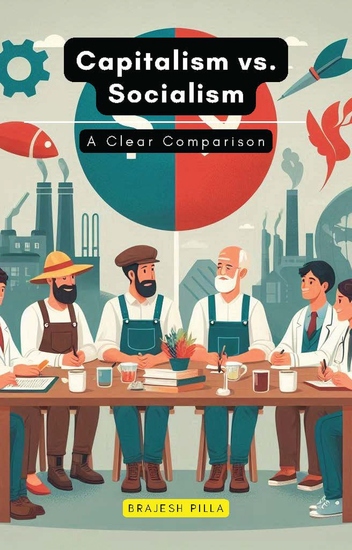
Capitalism vs Socialism - A Clear Comparison - cover

Capitalism vs Socialism - A Clear Comparison

Brajesh Pilla

Editorial: Educohack Press

  • 0
  • 0
  • 0

Sinopsis

"Capitalism vs. Socialism: A Clear Comparison" provides an insightful look into two prominent economic systems. We explore the development of capitalism, which evolved gradually since the late Middle Ages, and how industrialization transformed societal and market structures. Readers will gain a comprehensive understanding of the capitalist market system.
The second half of the book delves into socialism, a political, social, and economic philosophy characterized by social ownership of the means of production. We discuss various forms of social ownership, including public, collective, and cooperative ownership, and the political theories and movements associated with socialism.
This book offers a thorough comparison of capitalism and socialism, making it an invaluable resource for understanding these economic systems. We present the information in a clear and accessible manner, ensuring readers can learn about these topics without complexity.
Disponible desde: 03/01/2025.
Longitud de impresión: 290 páginas.

Otros libros que te pueden interesar

  • Liberal White Supremacy - How Progressives Silence Racial and Class Oppression - cover

    Liberal White Supremacy - How...

    Angie Beeman

    • 0
    • 0
    • 0
    In Liberal White Supremacy, Angie Beeman argues that white supremacy is maintained not only by right-wing conservatives or stereotypically uneducated working-class racial bigots but also by progressives who operate from a liberal ideology of color-blindness, racism-evasiveness, and class elitism. This distinction provides insight on divisions among progressives at the local level, in community organizations, and at the national level, in the Democratic Party. By distinguishing between liberal and radical approaches to racism, class oppression, capitalism, and social movement tactics, Beeman shows how progressives continue to be limited by liberal ideology and perpetuate rather than dismantle white supremacy, all while claiming to be antiracist. 


    She conceptualizes this self-serving process as "liberal white supremacy," the tendency for liberal European Americans to constantly place themselves in the superior moral position in a way that reinforces inequality. Beeman advances what she calls action-oriented and racism-centered intersectional approaches as alternatives to progressive organizational strategies that either downplay racism in favor of a class-centered approach or take a talk-centered approach to racism without developing explicit actions to challenge it.
    Ver libro
  • How to Think Like a Lawyer--and Why - A Common-Sense Guide to Everyday Dilemmas - cover

    How to Think Like a Lawyer--and...

    Kim Wehle

    • 0
    • 0
    • 0
    A law professor and author teaches non-attorneys how to think like a lawyer to gain advantage in their lives—whether buying a house, negotiating a salary, or choosing the right healthcare.   
    Lawyers aren’t like other people. They often argue points that are best left alone or look for mistakes in menus “just because.” While their scrupulous attention to detail may be annoying, it can also be a valuable skill.  
    Do you need to make health care decisions for an aging parent but are unsure where to start? Are you at crossroads in your career and don’t know how to move forward? Have you ever been on a jury trying to understand confusing legal instructions? How to Think Like a Lawyer has the answers to help you cut through the confusion and gain an advantage in your everyday life. Kim Wehle identifies the details you need to pay attention to, the questions you should ask, the responses you should anticipate, and the pitfalls you can avoid. Topics include: Selling and buying a homeUnderstanding employment termsCreating a will and health care proxyNavigating health concernsApplying for financial aidNegotiating a divorce 
     
    Wehle shows you how to break complex issues down into digestible, easier-to-understand pieces that will enable you to make better decisions in all areas of your life. 
    Supplemental enhancement PDF accompanies the audiobook.
    Ver libro
  • Power without Victory - Woodrow Wilson and the American Internationalist Experiment - cover

    Power without Victory - Woodrow...

    Trygve Throntveit

    • 0
    • 0
    • 0
    For decades, Woodrow Wilson has been remembered as either a paternalistic liberal or reactionary conservative at home and as a naïve idealist or cynical imperialist abroad. Historians’ harsh judgments of Wilson are understandable. He won two elections by promising a deliberative democratic process that would ensure justice and political empowerment for all. Yet under Wilson, Jim Crow persisted, interventions in Latin America increased, and a humiliating peace settlement was forced upon Germany. A generation after Wilson, stark inequalities and injustices still plagued the nation, myopic nationalism hindered its responsible engagement in world affairs, and a second vastly destructive global conflict threatened the survival of democracy worldwide—leaving some Americans today to wonder what, exactly, the buildings and programs bearing his name are commemorating. In Power without Victory, Trygve Throntveit argues that there is more to the story of Wilson than these sad truths. Throntveit makes the case that Wilson was not a “Wilsonian,” as that term has come to be understood, but a principled pragmatist in the tradition of William James. He did not seek to stamp American-style democracy on other peoples, but to enable the gradual development of a genuinely global system of governance that would maintain justice and facilitate peaceful change—a goal that, contrary to historical tradition, the American people embraced. In this brilliant intellectual, cultural, and political history, Throntveit gives us a new vision of Wilson, as well as a model of how to think about the complex relationship between the world of ideas and the worlds of policy and diplomacy.
    Ver libro
  • Corporations Are Not People - Reclaiming Democracy from Big Money and Global Corporations (2nd Edition) - cover

    Corporations Are Not People -...

    Jeffrey D. Clements, Bill Myers

    • 0
    • 0
    • 0
    A revised and updated edition of the definitive guide to overturning Citizens United. 


    Since the Supreme Court's Citizens United ruling that the rights of things—money and corporations—matter more than the rights of people, America has faced a crisis of democracy. In this timely and thoroughly updated second edition, Jeff Clements describes the strange history of this bizarre ruling, its ongoing destructive effects, and the growing movement to reverse it. 


    He includes a new chapter, "Do Something!," showing how—state by state and community by community—Americans are using creative strategies and tools to renew democracy and curb unbalanced corporate power. Since the first edition, sixteen states, one-hundred-sixty members of Congress, and five hundred cities and towns have called for a constitutional amendment to overturn Citizens United, and the list is growing. This is a fight we can win! 


    "More relevant than ever, this updated edition of Corporations Are Not People chronicles the remarkably vibrant, nationwide grassroots movement to 'get money out and voters in.' " —Katrina vanden Heuvel, Editor and Publisher, The Nation
    Ver libro
  • American Epic - Reading the US Constitution - cover

    American Epic - Reading the US...

    Garrett Epps

    • 0
    • 0
    • 0
    In 1987, E. L. Doctorow celebrated the Constitution's bicentennial by reading it. "It is five thousand words long but reads like fifty thousand," he said. Distinguished legal scholar Garrett Epps disagrees. It's about 7,500 words. And Doctorow "missed a good deal of high rhetoric, many literary tropes, and even a trace of, if not wit, at least irony," he writes. 


    In American Epic, Epps takes us through a complete reading of the Constitution to achieve an appreciation of its power and a holistic understanding of what it says. In this book he seeks not to provide a definitive interpretation, but to listen to the language and ponder its meaning. He draws on four modes of reading: scriptural, legal, lyric, and epic. The Constitution's first three words, for example, sound spiritual—but Epps finds them to be more aspirational than prayer-like. He turns the Second Amendment into a poem to illuminate its ambiguity. He notices oddities and omissions. The Constitution lays out rules for presidential appointment of officers, for example, but not removal. Should the Senate approve each firing? Can it withdraw its "advice and consent" and force a resignation? And he challenges himself, as seen in his surprising discussion of the Defense of Marriage Act (DOMA) in light of Article 4, which orders states to give "full faith and credit" to the acts of other states.
    Ver libro
  • No One Knows Their Destiny - The Eckfeld Records: Inside the Dunera Story - cover

    No One Knows Their Destiny - The...

    Tonia Eckfeld

    • 0
    • 0
    • 0
    A moving portrait of two Dunera Boys, from Kristallnacht in Vienna to VE Day in Melbourne, that complicates the traditional story of the Dunera. 
    Popular culture has mythologised the Dunera Boys – but who were the real men who sailed on the infamous ship, and how did the voyage transform their lives? 
    Art historian Tonia Eckfeld draws on a deeply personal history to tell the story of her father and her uncle, Jewish refugees whose lives were shaped indelibly by their wartime experiences and internment – each to very different outcomes. 
    In 1939, Reinhold and Waldemar Eckfeld fled Hitler’s Austria to Churchill’s United Kingdom. There they were unjustly arrested and transported on the Dunera to Tatura prison camp, where it took many months to gain their freedom. Their experiences of internment were often harrowing, riven with violence, deprivation and frustration. Waldemar, who was beaten by British guards aboard the Dunera, found himself entangled in court martial proceedings – the records of which were reportedly destroyed by the British government to hush up a human-rights scandal. Reinhold, classified as an ‘enemy alien’, joined the Australian Army after release and served the country that would not legally recognise him for so long. 
    Drawing on a trove of historical artefacts – including previously unseen artworks, photographs and official documents – Tonia Eckfeld takes the reader inside these events as they unfold. Gripping and illuminating, this book asks us to reconsider the conventional narrative of the Dunera Boys, unearthing new perspectives on the impact of war, trauma and legacy on family relationships.
    Ver libro