¡Acompáñanos a viajar por el mundo de los libros!
Añadir este libro a la estantería
Grey
Escribe un nuevo comentario Default profile 50px
Grey
Suscríbete para leer el libro completo o lee las primeras páginas gratis.
All characters reduced
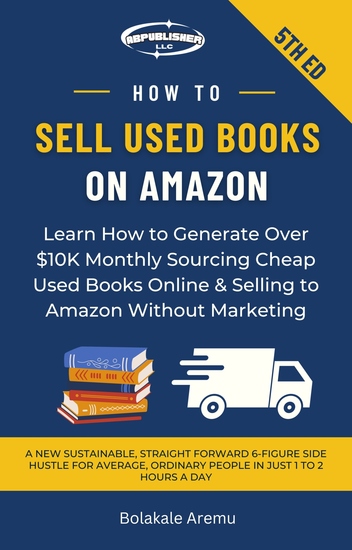
How to Sell Used Books on Amazon - Learn How to Generate Over $10K Monthly Sourcing Cheap Used Books Online & Selling to Amazon Without Marketing - cover

How to Sell Used Books on Amazon - Learn How to Generate Over $10K Monthly Sourcing Cheap Used Books Online & Selling to Amazon Without Marketing

Bolakale Aremu

Editorial: Publishdrive

  • 0
  • 0
  • 0

Sinopsis

In this edition I reveal more proofs of people making a lot of money with the same techniques we've been using since 2019. It's a kind of online book arbitrage can never be saturated. It's something that still works and is creating fortune for many folks, especially absolute beginners. This is because it really doesn't have to do with having technical or previous knowledge.
 
As long as you have internet and a computer, you can do this alone if you follow this guide, or you can join us and start selling inside our community. So, wherever you are in the world, I just want to let you know you can do this strategy.
Disponible desde: 04/12/2023.
Longitud de impresión: 52 páginas.

Otros libros que te pueden interesar

  • Metaverse Simplified - Simplified guide for understanding Future Economy - Metaverse Blockchain Cryptocurrency NFT Gaming Art Digital Assets - cover

    Metaverse Simplified -...

    Gaurav Duggal, Medha Agrawal

    • 0
    • 0
    • 0
    Metaverse is everywhere. Large conglomerates are betting billions of dollars on it. Concepts like Web 3.0, Blockchain, and NFTs have become the reality of digital life. Entrepreneurs have made millions by investing in Metaverse. Many have become millionaires just by trading virtual land or NFTs on Metaverse. 
    Why do you think only a few were able to earn millions? Should the Metaverse concepts, knowledge, and information be easily accessible to all? 
    A considerable amount of research was done for this book to democratize the knowledge about the Metaverse. This book is an honest attempt to answer some of these questions:What is the Metaverse?Why is it getting so much attention?How could it evolve over the next 5–10 years?What should you watch for as the market matures? 
    Metaverse Simplified contains all the essential elements to make you understand Metaverse in an easy-to-read language and a concise manner. 
    Metaverse Simplified is a must-read to get ahead and succeed in the realm of Metaverse. Without further ado, get yourself a copy and usher in a new era for your life timely. 
    An audiobook produced by e-Audio Productions
    Ver libro
  • The Apple II Age - How the Computer Became Personal - cover

    The Apple II Age - How the...

    Laine Nooney

    • 0
    • 0
    • 0
    Skip the iPhone, the iPod, and the Macintosh. If you want to understand how Apple Inc. became an industry behemoth, look no further than the 1977 Apple II. Designed by the engineer Steve Wozniak and hustled into the marketplace by his Apple cofounder Steve Jobs, the Apple II became one of the most prominent personal computers of this dawning industry. 


    The Apple II was a versatile piece of hardware, but its most compelling story isn't found in the feat of its engineering, the personalities of Apple's founders, or the way it set the stage for the company's multibillion-dollar future. Instead, historian Laine Nooney shows, what made the Apple II iconic was its software. In software, we discover the material reasons people bought computers. The story of personal computing in the United States is not about the evolution of hackers—it's about the rise of everyday users. 


    Recounting a constellation of software creation stories, Nooney offers a new understanding of how the hobbyists' microcomputers of the 1970s became the personal computer we know today. The Apple II Age offers an unprecedented look at the people, the industry, and the money that built the microcomputing milieu—and why so much of it converged around the pioneering Apple II.
    Ver libro
  • Kickstart Python Programming Fundamentals - Real-World Projects and Hands-on Exercises to Cement Every Python Programming Concept - cover

    Kickstart Python Programming...

    Jit Sinha

    • 0
    • 0
    • 0
    Keep Calm and Let Us Tame the Python.
    Book Description
    Python is more than a programming language—it’s a career catalyst. Whether you're aiming to future-proof your skills, automate everyday tasks, or break into tech, Python is the gateway.
    Kickstart Python Programming Fundamentals is your launchpad, built specifically for absolute beginners, freshers, students, and professionals with no coding background. With crystal-clear explanations, real-world examples, and zero jargon, this book makes programming accessible, engaging, and fun.
    You’ll start by writing your first Python program and gradually master essential concepts like variables, loops, functions, and data structures. From there, you'll progress to object-oriented programming, file handling, working with databases, and even get a taste of AI and data analysis.
    Each chapter includes hands-on exercises and mini-projects to solidify your learning. By the end, you'll not only understand Python—you’ll be building real-world solutions, building a project portfolio, and ready to take on academic, personal, or professional challenges.
    The future is coded—start your journey today and don’t get left behind.
    Table of Contents
    1. Beginning with Python
    2. Introduction to Algorithms and Flowcharts
    3. Basic Python
    4. Making Choices and Repeating Actions
    5. Creating Functions
    6. Organizing Data
    7. Understanding OOP in Python
    8. Using Modules and Packages
    9. Error Handling
    10. File Handling and String Manipulation
    11. Dates and Times
    12. Working with JSON and XML
    13. Math in Python
    14. Managing Packages with PIP
    15. Building Web Apps
    16. Python and Databases
    17. Analyzing Data
    18. Python in Artificial Intelligence
    19. Conclusion and Next Steps
    20. Real-World Project       
    
    Index
    Ver libro
  • See Yourself in Cyber - Security Careers Beyond Hacking - cover

    See Yourself in Cyber - Security...

    Ed Adams

    • 0
    • 0
    • 0
    In See Yourself in Cyber: Security Careers Beyond Hacking, information security strategist and educator Ed Adams delivers a unique and insightful discussion of the many different ways the people in your organization—inhabiting a variety of roles not traditionally associated with cybersecurity—can contribute to improving its cybersecurity backbone. You'll discover how developers, DevOps professionals, managers, and others can strengthen your cybersecurity. You'll also find out how improving your firm's diversity and inclusion can have dramatically positive effects on your team's talent. 


    Using the familiar analogy of the color wheel, the author explains the modern roles and responsibilities of practitioners who operate within each "slice." He also includes: real-world examples and case studies that demonstrate the application of the ideas discussed; interviews with established industry leaders in a variety of disciplines explaining what non-security professionals can do to improve cybersecurity; and actionable strategies and specific methodologies for professionals working in several different fields interested in meeting their cybersecurity obligations. Perfect for managers, directors, executives, and other business leaders, See Yourself in Cyber: Security Careers Beyond Hacking is also ideal for policymakers, regulators, and compliance professionals.
    Ver libro
  • Butterfly Safari - cover

    Butterfly Safari

    Andrew Fusek Peters

    • 0
    • 1
    • 0
    Andrew Fusek Peters has spent five years travelling around the UK to document and celebrate British butterflies. In Butterfly Safari, he shows butterflies in a new light, capturing close-ups of wing scales and the delicate structure of eggs, eyes and antennae. He has also pioneered never-before-seen flight shots and astonishing aerial sequences. Many of these photos have already appeared in the national papers and magazines. 
     
    'With so many of our butterflies in decline, this is a very timely book by one of the country's best photographers. It's a must-have for the bookshelves!' Iolo Williams 
     
    'This book captures the glorious beauty and heart-lifting spirit of butterflies better than any other.' Patrick Barkham, author of The Butterfly Isles 
     
    'This book acptures the beauty and movement of butterflies like no other. The flight sequences are sublime - they are pure poetry in motion.' Dr Martin Warren, former Chief Executive of Butterfly Conservation
    Ver libro
  • Neurology - Understanding Brain and Nerve Disorders - cover

    Neurology - Understanding Brain...

    Ava Westwood

    • 0
    • 0
    • 0
    The human brain is often described as the most intricate and remarkable organ in the known universe. It serves as the control center for every thought, emotion, movement, and sensation we experience, seamlessly integrating billions of neural connections to create the essence of who we are. Despite centuries of scientific inquiry, the brain remains a profound mystery—an organ that not only governs our basic survival but also fuels creativity, innovation, and the very consciousness that allows us to ponder its complexity. 
    What makes the brain so fascinating is its duality: it is both fragile and resilient, capable of extraordinary feats yet vulnerable to a wide range of disorders. Its 86 billion neurons form networks that enable everything from the rhythmic beating of the heart to the abstract contemplation of art, philosophy, and science. This complexity has driven countless researchers to explore its depths, seeking to understand how such a compact structure can hold the vastness of human thought, memory, and emotion. 
    Throughout history, our understanding of the brain has evolved dramatically. Early civilizations believed that the heart was the seat of intelligence, while the brain was considered secondary. It wasn’t until the work of ancient scholars like Hippocrates and later neurologists such as Thomas Willis and Santiago Ramón y Cajal that the brain was recognized as the epicenter of human experience. Today, advanced imaging technologies allow us to observe the brain in action, mapping areas responsible for speech, movement, and even complex emotions. Yet, for all our progress, we have only begun to scratch the surface of its potential.
    Ver libro