¡Acompáñanos a viajar por el mundo de los libros!
Añadir este libro a la estantería
Grey
Escribe un nuevo comentario Default profile 50px
Grey
Suscríbete para leer el libro completo o lee las primeras páginas gratis.
All characters reduced
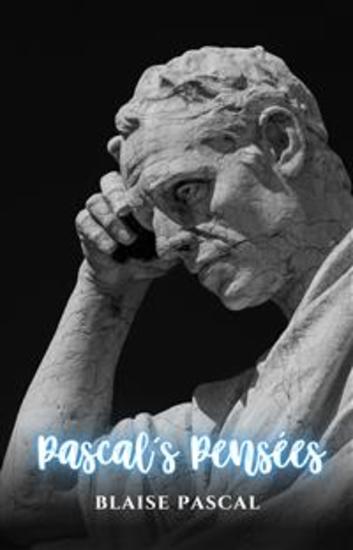
Pascal's Pensées - cover

Pascal's Pensées

Blaise Pascal

Editorial: Cervantes Digital

  • 0
  • 0
  • 0

Sinopsis

Step into the intellectual world of Blaise Pascal with "Pascal's Pensées," a collection of profound and thought-provoking reflections that transcends the boundaries of time. Within the pages of this literary masterpiece, Pascal, a brilliant mathematician and philosopher of the 17th century, invites readers on a journey of contemplation and introspection.

In "Pascal's Pensées," one encounters a tapestry of ideas exploring the human condition, faith, and the enigmatic nature of existence. Pascal's razor-sharp intellect delves into the complexities of belief, offering a nuanced perspective on religion and reason. From musings on the fragility of human life to profound reflections on the vastness of the cosmos, each entry in this collection is a gem that sparkles with intellectual brilliance.

As you navigate through Pascal's labyrinth of thoughts, you'll find yourself captivated by the elegance of his prose and the depth of his insights. This timeless work not only unveils the philosophical musings of a great mind but also serves as an invitation to engage in a dialogue with the fundamental questions that have intrigued humanity for centuries. "Pascal's Pensées" is not just a book; it's an intellectual odyssey that continues to resonate with readers, inviting them to explore the intricate tapestry of human existence.
Disponible desde: 03/01/2024.

Otros libros que te pueden interesar

  • Cryptography in World War I: The History of the Efforts to Make and Break Secret Codes during the Great War - cover

    Cryptography in World War I: The...

    Editors Charles River

    • 0
    • 0
    • 0
    World War I was the first major conflict in which new electronic means of transmitting and receiving messages became a major factor in political and military operations. The electric telegraph was developed in the first half of the 19th century, and by 1850, there were several telegraph companies around the world providing a service that allowed virtually instantaneous communication over long distances. This was a major breakthrough, but the telegraph depended on the availability of wires to transmit messages between stations, meaning that if these wires were broken or damaged, communications were cut off. 
    	Late in the 19th century, there was another new development, the telephone, though this too relied on wires to transmit and receive information. At the same time, there was a new invention that provided instant voice and Morse code communication over long distances that did not require wires. Initially called wireless, radio was quickly adopted by armies around the world as a way of providing rapid communication between military units. By the time World War I began in 1914, all the major nations involved had provided their forces with some form of radio equipment. 
    	Of course, this came with a fundamental problem: radio, telephone, and telegraph messages could be intercepted by the enemy, potentially giving them notice of impending operations. To protect these electronic messages from being read by the enemy, armies began to use codes and ciphers to disguise the meaning of messages. Teams were created to devise effective codes and ciphers, and these were quickly followed by other teams whose role was to attempt to break the codes and ciphers used by the other side. As a result, a secret war began, almost completely hidden from public view, as the belligerents devised complex ways of hiding the real meaning of their own messages while simultaneously attempting to understand those of the enemy. 
    Ver libro
  • Queering the Runes - Reclaiming Ancestral Wisdom in Rune Magic and Mythology - cover

    Queering the Runes - Reclaiming...

    Siri Vincent Plouff

    • 0
    • 0
    • 0
    Queering the Runes is a contemporary, inclusive, and forward-thinking approach to the runes that focuses on finding queer experience, life, and joy in the Elder Futhark. Siri comes to the runes as a queer, nonbinary reader, and presents a path for reclaiming the ancestral wisdom and mystery of the runes in a way that can provide insight and understanding of their sacred nature for masculine, feminine, and nongendered aspects of self. Written as a love letter to the runes, the gods, and the people who follow the Nordic path, Queering the Runes presents an alternative approach to the runes—one that creates a gentle container for those who want to follow this heathen path. Based on the author’s personal gnosis, as well as deep academic research on runes and Nordic culture, this book explores the root culture of the runes, both in terms of myth and of lived, real folkloric experience, and paves the way for understanding how to work with runes disencumbered from patriarchy and white supremacy.   Siri Vincent Plouff presents the traditional meanings of the runes, then helps the reader to queer the runes in their own way. Included are the lore associated with each rune, exercises to apply them to modern life, activities to engage with the runes (layouts, castings, and galdr), and advice on how to use the runes for divination. Throughout, the author provides journal prompts meant to help the reader channel the energy of specific runes, to get to know their energy, as well as to use the runes to help them move forward in a journey of self-discovery.  Queering the Runes seeks to blow open perceptions of the runes, exploring them as active, living symbols available to all, as well as the inherent connection with ancestral magic that comes with rune work.
    Ver libro
  • ADHD Money - cover

    ADHD Money

    Tina Mathams

    • 0
    • 0
    • 0
    Eliminate the overwhelm and stay on track with your money goals. 
     
    If you struggle with the time and energy needed to manage your money, you’re not alone. So much financial advice is geared toward neurotypical brains. From checking your bank account to impulse spending and budgets that just don’t work out … It’s time to find the strategies that will help you manage your money in a way that suits your brain. 
     
    ADHD Money is an empowering personal finance guide. In this book, you’ll learn how and why those with ADHD (and other neurodivergent conditions) often feel frustrated by finances. You’ll discover tips that work for your interest-based nervous system by using key motivation factors. And you’ll get practical, psychology-based tools and worksheets to help you keep going and achieve your money goals. 
     
    Full of engaging, step-by-step exercises, this book will help you: 
     
    identify your money values and refresh your money mindset 
     
    create an ADHD-friendly spending plan and approach budgeting in a way that works for you 
     
    try new methods for paying off debts and saving money 
     
    combine money tasks with strategies like body doubling, gamifying and habit stacking 
     
    achieve your long-term plans 
     
    The reality is that money and budgeting isn’t always easy. But with ADHD Money, you’ll discover how to take control, keep the spark alive and follow through on your financial dreams. Author Tina Mathams of @theadhdaccountant shares the hacks that will help you keep going and create your own money success.
    Ver libro
  • The Prince - cover

    The Prince

    Niccolò Machiavelli

    • 0
    • 0
    • 0
    The Prince (Italian: Il Principe [il ˈprintʃipe]; Latin: De Principatibus) is a 16th-century political treatise written by the Italian diplomat, philosopher, and political theorist Niccolò Machiavelli in the form of a realistic instruction guide for new princes. As a remarkable general theme, The Prince appears to take it for granted that immoral acts are justified if they can help achieve political glory. 
    From Machiavelli's correspondence, a version was apparently being written in 1513, using a Latin title, De Principatibus (Of Principalities). However, the printed version was not published until 1532, five years after Machiavelli's death. This was carried out with the permission of the Medici pope Clement VII, but "long before then, in fact since the first appearance of The Prince in manuscript, controversy had swirled about his writings". 
    Although The Prince was written as if it were a traditional work in the mirrors for princes style, it was generally agreed as being especially innovative. This is partly because it was written in the vernacular Italian rather than Latin, a practice that had become increasingly popular since the publication of Dante's Divine Comedy and other works of Renaissance literature.  Machiavelli illustrates his reasoning using remarkable comparisons of classical, biblical, and medieval events, including many seemingly positive references to the murderous career of Cesare Borgia, which occurred during Machiavelli's own diplomatic career.
    Ver libro
  • Northumberland - A guide - cover

    Northumberland - A guide

    Stephen Platten

    • 0
    • 0
    • 0
    Northumberland, one of the most sparsely-populated counties in England, with unique features like the Holy Island of Lindisfarne and Hadrian’s Wall, was also a crucible of European civilization and remains a treasury of culture. Giving birth to railways worldwide through George Stephenson, it saw the beginnings of hydraulics, hydro-electricity and turbines and, with Joseph Swan, witnessed the earliest light from electric incandescent lamps; it was a laboratory of invention.
    
     
    Northumberland has, however, changed dramatically over the course of the last century: deep coal-mining, shipbuilding and much heavy engineering have gone, but new industries have flowered. So, the largest man-made lake in northwest Europe, lying within the largest man-made forest is set within the north west of the county, bringing water in abundance and supporting entirely new leisure and tourist activities. The lower Tyne has been transformed both architecturally, and culturally.
    
     
    This unique guide to England’s most northern county explores the land, the people, the flora and fauna alongside its architecture and history. A gazetteer takes readers to Northumberland’s towns and cities – Newcastle, Hexham, and Berwick-upon-Tweed, but also to villages, hamlets, castles, beaches, churchyards, great houses, ruined abbeys, and vast wild open countryside. Among the places visited are the castles at Warkworth, Bamburgh, Dunstanburgh and Alnwick, the Farne Islands and the remote valleys of Allendale and the South Tyne, battle sites at Heavenfield, Otterburn and Flodden, alongside Vanbrugh’s final triumphant Palladian mansion at Seaton Delaval.
    
     
    Fully illustrated with more than 240 photographs, this guidebook invites travellers and locals alike to explore the unique features and the true character of Northumberland.
    Ver libro
  • The Voting Rights Act of 1965 - cover

    The Voting Rights Act of 1965

    Various

    • 0
    • 0
    • 0
    This program is read by an AI-based synthesized voice.
    Ver libro