Junte-se a nós em uma viagem ao mundo dos livros!
Adicionar este livro à prateleira
Grey
Deixe um novo comentário Default profile 50px
Grey
Assine para ler o livro completo ou leia as primeiras páginas de graça!
All characters reduced
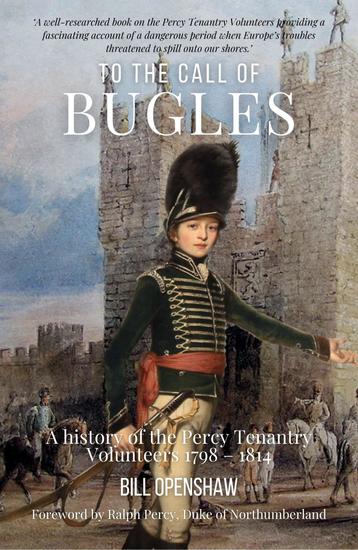
To The Call of Bugles - A History of the Percy Tenantry Volunteers 1798–1814 - cover
LER

To The Call of Bugles - A History of the Percy Tenantry Volunteers 1798–1814

Bill Openshaw

Editora: McNidder and Grace

  • 0
  • 0
  • 0

Sinopse

This highly readable illustrated biography on the Percy Tenantry Volunteers has been written with exclusive access to the current Duke of Northumberland's treasure trove of archive records. This book is for anyone interested in military history, especially Revolutionary and the Napoleonic war period, and for those looking at the local history of Northumberland, and especially Alnwick Castle.
The history of Britain's conflict with France between 1793 and 1815 is well documented. Nevertheless, one aspect that has scant coverage, is that of the role of Volunteers.  In 1798, afraid of impending invasion by France's all-conquering armies the British desperately needed to defend their shores. To The Call of Bugles reveals, for the first time, how among those who stood forward in Home Guard style military bodies, there was no finer example than that of the valiant Percy Tenantry Volunteers, created by the 2nd Duke of Northumberland, General Hugh Percy. This amateur body of men, 1,500 strong, consisting of cavalry, artillery and riflemen, was put together, trained, armed, dressed and operated by General Hugh Percy. This book provides stories from the original volunteers, an in-depth understanding of how such a corps was organised and reveals how they were fashioned into an elite and innovative fighting force.
Disponível desde: 03/08/2023.
Comprimento de impressão: 272 páginas.

Outros livros que poderiam interessá-lo

  • The Representativeness Heuristic - Judging Likelihood on Similarity - cover

    The Representativeness Heuristic...

    William Rands

    • 0
    • 0
    • 0
    The representativeness heuristic is one of the most influential concepts in cognitive psychology, profoundly shaping the way individuals make judgments and decisions. First introduced by psychologists Amos Tversky and Daniel Kahneman, this heuristic explains how people often assess probabilities and likelihoods based on how closely an event or object resembles a prototype or existing mental model. While this cognitive shortcut can be useful in navigating a complex world, it also introduces biases that distort reasoning and lead to systematic errors. 
    At its core, the representativeness heuristic simplifies decision-making by allowing individuals to rely on surface-level similarities rather than delving into deeper, more complex analyses. For example, if someone observes a well-dressed, articulate individual discussing financial markets, they might assume the person is a financial expert, even without any concrete evidence. This judgment stems from the resemblance of the observed traits to the prototype of a financial expert. However, such assumptions often overlook critical information, such as actual expertise or experience. 
    The origins of the heuristic lie in the evolutionary need for humans to make rapid decisions in uncertain environments. In situations where time and resources are limited, relying on similarity and pattern recognition can provide a survival advantage. While these mechanisms were effective in ancestral contexts, their application to modern, complex scenarios often leads to cognitive pitfalls. In many cases, the representativeness heuristic prompts individuals to ignore statistical data, base rates, and other relevant information in favor of intuitive judgments.
    Ver livro
  • Survival 101: The Essential Guide to Surviving Disasters and Other Natural Disasters Learn Everything You Need to Know On How You Can Prepare and Survive Disasters - cover

    Survival 101: The Essential...

    Gordon Barr

    • 0
    • 0
    • 0
    Survival 101: The Essential Guide to Surviving Disasters and Other Natural Disasters, Learn Everything You Need to Know On How You Can Prepare and Survive DisastersWe all have no idea when a disaster will strike. It can happen any time, anywhere and no one will be able to foresee it. That's why it is crucial that you be prepared when it strikes. There are places that are more prone to disasters or other natural calamities but the truth is, with all the climate changes and other man-made disasters, nothing and nowhere is safe anymore. Places that didn't use to experience flooding are suddenly finding themselves underwater when there's a deluge of rain.This audiobook will teach you all about disaster preparedness so you and your family will be able to survive in case it happens. You will know the things you need to prepare, the skills you need to learn and what to do in case you have to evacuate. In this audiobook, you will learn about the following topics:-What is a Disaster?-Creating a Disaster Plan For Your Family-A Disaster Kit-Helping Your Children in a Crises-Watch or Warning-Disasters and People with Disabilities-How to Create a Support System-What If You Must Evacuate-First Aid for First Response-Food Stores-What About Your Pets in an Emergency-Medical Emergencies-Safety Proofing Your Home-Disaster Insurance -What You Should Carry In Your CarIf you have not experienced any type of disaster, consider yourself lucky because every year, nearly 200 million people are impacted by natural disasters and other 99,000 are killed. But there is no telling when a disaster will strike so it is better to be prepared at all times. If you want to learn all the vital information in order to survive disasters, scroll up and click "add to cart" now.
    Ver livro
  • Clashing Minds: The Battle for the Soul of Western Thought - "Elevate your journey with captivating audio insights on the battle for Western thought’s essence!" - cover

    Clashing Minds: The Battle for...

    Merrick Ashcombe

    • 0
    • 0
    • 0
    Clashing Minds: The Battle for the Soul of Western Thought 
    ⭐⭐ Simplified Guide & Explanations Included ⭐⭐ 
    Are you eager to advance your understanding of Western philosophy and successfully navigate the complexities of 'Clashing Minds: The Battle for the Soul of Western Thought'?  
    In search of a thorough guide that offers all the insights needed to grasp the concepts within 'Clashing Minds'? 
    Your quest ends here! 
    This guide is your essential companion for deepening comprehension, applying critical thinking skills, and engaging in insightful discussions. With this resource, you are set for intellectual triumph. 
    Updated for the latest insights surrounding 'Clashing Minds: The Battle for the Soul of Western Thought'. 
    Key features of this comprehensive guide: 
    - In-depth analysis of the themes explored in 'Clashing Minds: The Battle for the Soul of Western Thought' 
    - Detailed explanations of the underlying concepts 
    - Effective strategies for engaging with the material and critical thinking 
    Our guide stands out due to its extensive coverage, which is crucial for your success in understanding the book's themes. Concepts are not just glossed over but explored thoughtfully and in detail. 
    Crafted with a straightforward structure and accessible language, our guide for 'Clashing Minds' ensures seamless transitions between topics. Leave behind complex jargon and embrace clear, precise, and intellectually rich content. 
    So, why hesitate? Click the BUY NOW button, secure your guide, and embark on your journey to mastery of 'Clashing Minds: The Battle for the Soul of Western Thought'! 
    Ver livro
  • Famine Affluence and Morality - cover

    Famine Affluence and Morality

    Peter Singer

    • 0
    • 0
    • 0
    In 1972, the young philosopher Peter Singer published "Famine, Affluence and Morality," which rapidly became one of the most widely discussed essays in applied ethics. Through this article, Singer presents his view that we have the same moral obligations to those far away as we do to those close to us. He argued that choosing not to send life-saving money to starving people on the other side of the earth is the moral equivalent of neglecting to save drowning children because we prefer not to muddy our shoes. If we can help, we must—and any excuse is hypocrisy. Singer's extreme stand on our moral obligations to others became a powerful call to arms and continues to challenge people's attitudes towards extreme poverty. Today, it remains a central touchstone for those who argue we should all help others more than we do. 


    As Bill and Melinda Gates observe in their foreword, in the age of today's global philanthropy, Singer's essay is as relevant now as it ever was. This concise edition collects the original article, two of Singer's more recent popular writings on our obligations to others around the world, and a new introduction by Singer that discusses his current thinking.
    Ver livro
  • Empire of Ife - The Cradle of Yoruba Culture and the Kingdom of Sculptors - cover

    Empire of Ife - The Cradle of...

    Rolf Hedger

    • 0
    • 0
    • 0
    The origins of Ife are deeply rooted in mythology, oral traditions, and historical accounts, making it one of the most revered ancient cities in West Africa. Ife is often referred to as the cradle of the Yoruba civilization, a place where culture, religion, and governance took form. The story of its beginning is intertwined with Yoruba cosmology, particularly the legend of Oduduwa, who is considered the progenitor of the Yoruba people. 
    According to Yoruba mythology, Olodumare, the Supreme Being, entrusted Oduduwa with the sacred task of creating the earth. He descended from the heavens with a chain, a handful of earth, and a rooster. Upon reaching the watery expanse that covered the world, he spread the earth on the surface, and the rooster scattered it, forming the first landmass. This sacred land became known as Ile-Ife, meaning “The Land of Expansion.” Over time, Oduduwa and his followers established a kingdom that became the center of Yoruba civilization, laying the foundation for its political, spiritual, and artistic traditions. 
    Beyond mythology, historical and archaeological evidence suggests that Ife was already a flourishing city-state by the 9th century, possibly earlier. It grew as a hub of trade, attracting merchants and artisans from different parts of West Africa. Its strategic location allowed for the exchange of goods, ideas, and cultural practices, contributing to the city’s rapid development. The city’s early rulers, often referred to as the Oonis, played a crucial role in consolidating power and maintaining the harmony between religious and political institutions. The Ooni of Ife, regarded as both a king and a divine figure, acted as the intermediary between the people and the gods, reinforcing Ife’s status as a sacred city.
    Ver livro
  • Big Questions of Philosophy The: Book Summary & Analysis - cover

    Big Questions of Philosophy The:...

    Briefly Summaries

    • 0
    • 0
    • 0
    This is a concise summary and analysis of ,The Big Questions of Philosophy by 
    David Edmonds.
     
    It is not the original book and is not affiliated with or endorsed by David Edmonds.
    Ideal those seeking a quick and insightful overview.
     
    Delve into life's most profound questions with clarity and wit in The Big Questions of Philosophy. This thought-provoking exploration tackles timeless issues such as morality, free will, the nature of consciousness, and the existence of God. Blending ancient wisdom with contemporary insights, the book provides accessible explanations of complex philosophical ideas, inviting readers to engage with the fundamental questions that shape human understanding and experience.
    Ver livro