Join us on a literary world trip!
Add this book to bookshelf
Grey
Write a new comment Default profile 50px
Grey
Subscribe to read the full book or read the first pages for free!
All characters reduced
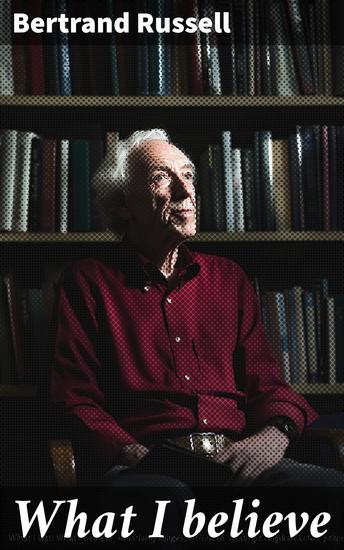
What I believe - cover

What I believe

Bertrand Russell

Publisher: Good Press

  • 0
  • 0
  • 0

Summary

In "What I Believe," Bertrand Russell presents a profound exploration of his philosophical convictions and personal beliefs, articulating a worldview shaped by reason, humanism, and skepticism. Written in a concise and engaging style, this work reflects Russell's commitment to clarity and rational discourse, emerging from the context of early 20th-century intellectual thought. It addresses essential themes such as morality, religion, and the quest for meaning, as Russell confronts the complexities of modern existence through his distinctive blend of analytic rigor and poetic expression. Bertrand Russell, a towering figure in philosophy, mathematics, and social activism, wrote this work in an era marked by rapid scientific advancements and existential crises. His inclusive approach to philosophy was influenced by his upbringing in a prominent intellectual family, as well as his extensive engagement with political and social issues. Russell's lifelong pursuit of knowledge and truth is palpable in this book, as he strives to demystify life's fundamental questions for both himself and his readers. I highly recommend "What I Believe" for anyone seeking a thoughtful and accessible introduction to Russell's philosophical ethos. This book not only enriches our understanding of the interplay between belief and skepticism but also serves as an invitation to reflect on our own convictions in a world fraught with uncertainty.
Available since: 03/02/2025.
Print length: 90 pages.

Other books that might interest you

  • Israel - What Went Wrong? - cover

    Israel - What Went Wrong?

    Omer Bartov

    • 0
    • 0
    • 0
    A leading Israeli American scholar of the Holocaust explores and explains his native country's intensifying turn toward violence and exclusion.The distinguished historian Omer Bartov was born on a kibbutz, grew up in Tel Aviv, and served in the Israel Defense Forces during the Yom Kippur War. He went on to become a leading scholar of the German army and the Holocaust, before turning his attention to his native country.In Israel: What Went Wrong?, Bartov sketches the tragic transformation of Zionism, a movement that sought to emancipate European Jewry from oppression, into a state ideology of ethno-nationalism. How is it possible, he asks, that a state founded in the immediate aftermath of the Holocaust, an event that gave legitimacy to a national home for the Jews, stands credibly accused of perpetrating large-scale war crimes? How do we come to terms with the fact that Israel’s war of destruction is being conducted with the support, laced with denial and indifference, of so many of its Jewish citizens?Tracing the roots of the violent events currently unfolding in Israel and the occupied territories, Bartov tracks his country's moral tribulations and considers the origins of Zionism, the intertwining of Israel’s independence with Palestinian displacement, the politics of the Holocaust, controversies over the term "genocide," and the uncertain future. The result is a searing and urgent critique that addresses today’s debates over Zionism and the future of Israel with rigor and depth.
    Show book
  • Putin's Russia - Life in a Failing Democracy - cover

    Putin's Russia - Life in a...

    Anna Politkovskaya

    • 0
    • 1
    • 0
    A searing portrait of a country in disarray and of the man at its helm, from "the bravest of Russian journalists" (The New York Times)Hailed as "a lone voice crying out in a moral wilderness" (New Statesman), Anna Politkovskaya made her name with her fearless reporting on the war in Chechnya. Here, she turned her steely gaze on the multiple threats to Russian stability, among them Vladimir Putin himself.Rich with characters and poignant accounts, Putin's Russia depicts a far-reaching state of decay. Politkovskaya describes an army in which soldiers die from malnutrition, parents must pay bribes to recover their dead sons' bodies, and conscripts are even hired out as slaves. She exposes rampant corruption in business, government, and the judiciary, where everything from store permits to bus routes to court appointments is for sale. And she offers a scathing condemnation of the war in Chechnya, where kidnappings, extra-judicial killings, rape, and torture beget terrorism rather than fighting it. Finally, Politkovskaya denounces both Putin, for stifling civil liberties as he pushes the country back to a Soviet-style dictatorship, and the West, for its unqualified embrace of the Russian leader.Sounding an urgent alarm, Putin's Russia is a gripping portrayal of a country in crisis and the testament of a great and intrepid reporter, who received death threats and survived assassination attempts for her scathing criticism of the Kremlin. Tragically, on October 7, 2006, Politkovskaya was shot and found dead in an elevator in her Moscow apartment building. After several years of investigations, five men were imprisoned for her murder.
    Show book
  • A History of the Middle Ages - World Events from 400 CE to 1500 CE - cover

    A History of the Middle Ages -...

    Phyllis G. Jestice

    • 0
    • 0
    • 0
    This fascinating guide examines of one of the most important eras in history, the Middle Ages, spanning the breadth of the globe. 
    Often misconceived as a dark 'between-time' between the ancient and modern eras, the Middle Ages was in fact a period of radical transformation. Professor of Medieval History Phyllis G. Jestice gives a fascinating overview of this incredible period across the world, bringing to life the personalities, the technologies, the politics and the culture that defined this period in the development of the world we know today. 
    Includes: 
    The rise of ChristianityThe astounding advances in the sciences and the arts in the Islamic worldHow economic powerhouses developed in Africa and powerful states arose in the AmericasHow trade flourished throughout central Asia and China in the form of the Silk RoadsThe terrifying depredations of the Mongol invasionsThe crusades and other conflicts of Europe that marked a so-called era of 'chivalry'.
    Show book
  • Faith's Answers to America's Political Crisis - How Religion Can Help Us Out of the Mess We're In - cover

    Faith's Answers to America's...

    Senator Joe Lieberman

    • 0
    • 0
    • 0
    Can the faith in God that most Americans share help us out of the political mess we're in? 


    As both a religiously observant person and a veteran of forty years in elective office, Senator Joe Lieberman is uniquely prepared to answer this question. In fact, he is the first person with political experience to pose and answer such a question in response to the current crisis of political division and governmental dysfunction in America. 


    Lieberman breaks down the causes of our political problems—including partisanship, incivility, and refusal to compromise—and then describes what the monotheistic faith that Christians, Jews, and Muslims share calls on us to do to overcome those problems. 


    He directs this appeal to members of Congress and the White House; leaders of the news and entertainment industry, who have such a large influence on our values and political behavior; and members of the clergy, who need to be leaders of a new Religious Awakening in America. 


    This book will provide a totally different way to look at American politics and government. It will open your mind and heart and give you hope for a better, more united future for our country.
    Show book
  • Bringing Up Race - How to Raise a Kind Child in a Prejudiced World - cover

    Bringing Up Race - How to Raise...

    Uju Asika

    • 0
    • 0
    • 0
    You can't avoid it, because it's everywhere. In the looks Black kids get in certain spaces, the manner in which some people speak to them, the stuff that goes over their heads. Stuff that makes them cry even when they don't know why. How do you bring up your kids to be kind and happy when there is so much out there trying to break them down? 
     
    Bringing Up Race is an important book, for all families whatever their race or ethnicity. It's for everyone who wants to instill a sense of open-minded inclusivity in their kids, and those who want to discuss difference instead of shying away from tough questions. Uju Asika draws on often shocking personal stories of prejudice along with opinions of experts, influencers, and fellow parents to give advice in this guide. 
     
    Bringing Up Race explores: when children start noticing ethnic differences; what to do if your child says something racist; how to have open, honest, age-appropriate conversations; how children and parents can handle racial bullying; and how to recognize and challenge everyday racism. 
     
    Bringing Up Race is a call to arms for all parents as our society works to combat white supremacy and dismantle systemic racism.
    Show book
  • Sioux - History of Its Causes and Consequences - cover

    Sioux - History of Its Causes...

    Kelly Mass

    • 0
    • 0
    • 0
    The Sioux, also called the Oceti Sakowin are a North American people of Native American tribe and First Countries tribes. The contemporary Sioux are split into 2 significant groups based upon language: Dakota and Lakota; they're called together as the Ohéthi akówi ("7 Council Fires"). The term "Sioux" is an exonym stemmed from a French transliteration of the Ojibwe term "Nadouessioux," and can apply to any ethnic group or language dialect within the Great Sioux Country. 
    The Dakota War of 1862 came from the United States' failure to make agreement payments on time, and also an absence of food supply. The Dakota were banished from Minnesota to many bookings in Nebraska, North and South Dakota, and Canada. After 1870, the Dakota people started to return to Minnesota, developing the state's existing reserves. Before relinquishing their terrain and transferring to South Dakota in 1858, the Yankton and Yanktonai Dakota (Iháktuwa and Iháktuwana; "Village-at-the-End" and "Little village-at-the-End") resided in the Minnesota River area. 
    If any of this sounds fascinating to you, then go ahead and start reading or listening to the audiobook.
    Show book