
¡Acompáñanos a viajar por el mundo de los libros!
Añadir este libro a la estantería
Grey
Escribe un nuevo comentario Default profile 50px
Grey
Suscríbete para leer el libro completo o lee las primeras páginas gratis.
All characters reduced
The Fable of the Bees (Philosophy Study) - Enriched edition - cover

The Fable of the Bees (Philosophy Study) - Enriched edition

Bernard Mandeville

Editorial: Musaicum Books

  • 0
  • 0
  • 0

Sinopsis

In Bernard Mandeville's controversial and thought-provoking work, 'The Fable of the Bees', the author uses a collection of fables to present a critique of society and human nature. Mandeville's groundbreaking literary style combines allegorical storytelling with philosophical inquiry as he explores the relationship between morality, self-interest, and prosperity. The book, written in the early 18th century, was considered scandalous for its challenging ideas that questioned traditional social norms and values. Mandeville's unique approach has cemented 'The Fable of the Bees' as a cornerstone of philosophical literature that continues to be studied and debated today. Bernard Mandeville, a Dutch-born philosopher and satirist, was known for his unconventional views on ethics and economics. His experiences as a physician and his observations of human behavior inspired him to write 'The Fable of the Bees' as a reflection on the complexities of society and human nature. Mandeville's provocative writing style and his willingness to challenge prevailing beliefs make him a significant figure in the history of philosophy. I highly recommend 'The Fable of the Bees' to readers interested in exploring the intersection of ethics, economics, and human behavior. Mandeville's profound insights and his engaging narrative style make this book a must-read for anyone seeking to delve into the complexities of society and self-interest.

In this enriched edition, we have carefully created added value for your reading experience:
- A comprehensive Introduction outlines these selected works' unifying features, themes, or stylistic evolutions.
- A Historical Context section situates the works in their broader era—social currents, cultural trends, and key events that underpin their creation.
- A concise Synopsis (Selection) offers an accessible overview of the included texts, helping readers navigate plotlines and main ideas without revealing critical twists.
- A unified Analysis examines recurring motifs and stylistic hallmarks across the collection, tying the stories together while spotlighting the different work's strengths.
- Reflection questions inspire deeper contemplation of the author's overarching message, inviting readers to draw connections among different texts and relate them to modern contexts.
- Lastly, our hand‐picked Memorable Quotes distill pivotal lines and turning points, serving as touchstones for the collection's central themes.
Disponible desde: 17/12/2020.
Longitud de impresión: 535 páginas.

Otros libros que te pueden interesar

  • Learn French while you sleep - 1000 verbs and adjectives - cover

    Learn French while you sleep -...

    1000-words.com

    • 0
    • 0
    • 0
    This audiobook is narrated by an AI Voice.   
    Learn French anytime, anywhere — while you sleep, drive, walk, study, or work out.  
    1000 Words is your calm and immersive way to master French through audio.  
    Each episode helps you expand your vocabulary, improve pronunciation, and understand real French — without stress, screens, or interruptions.  
    In this audiobook, you’ll hear 1000 essential French verbs and adjectives, clearly spoken with English translations.  
    Perfect for beginners, travelers, and language lovers who want to absorb French naturally through repeated listening.  
    Listen in bed, at the gym, in the car, or during your daily routine — every minute helps you grow your French effortlessly.  
    🌙 Relax. Focus. Learn French anywhere.  
    For more content, games and exclusive video lessons, visit 👉 ⁠1000-words.com⁠.
    Ver libro
  • Community as Rebellion - A Syllabus for Surviving Academia as a Woman of Color - cover

    Community as Rebellion - A...

    Lorgia García Peña

    • 0
    • 0
    • 0
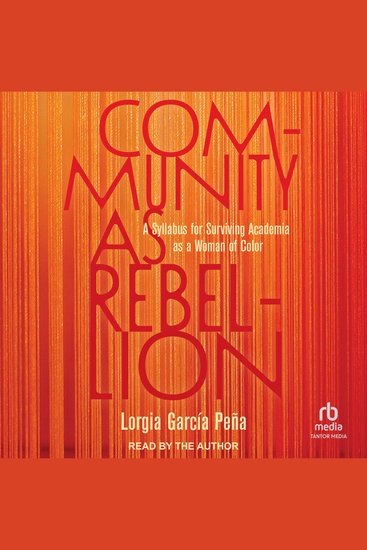
    Weaving personal narrative with political analysis, Community as Rebellion offers a meditation on creating liberatory spaces for students and faculty of color within academia.  Much like other women scholars of color, Lorgia García Peña has struggled against the colonizing, racializing, classist, and unequal structures that perpetuate systemic violence within universities. Through personal experiences and analytical reflections, the author invites listeners—in particular Black, Indigenous, Latinx, and Asian women—to engage in liberatory practices of boycott, abolition, and radical community-building to combat the academic world's tokenizing and exploitative structures. 


    García Peña argues that the classroom is key to freedom-making in the university, urging teachers to consider activism and social justice as central to what she calls "teaching in freedom": a progressive form of collective learning that prioritizes the subjugated knowledge, silenced histories, and epistemologies from the Global South and Indigenous, Black, and brown communities. By teaching in and for freedom, we not only acknowledge the harm that the university has inflicted on our persons and our ways of knowing since its inception, but also create alternative ways to be, create, live, and succeed through our work.
    Ver libro
  • Third Book of John The - The World English Bible Book 64 (Unabridged) - cover

    Third Book of John The - The...

    Various Authors

    • 0
    • 0
    • 0
    The Third Book of John is the third-to-last book of the New Testament and the Christian Bible as a whole, and attributed to John the Evangelist, traditionally thought to be the author of the Gospel of John and the other two epistles of John. The Third Epistle of John is a personal letter sent by "the elder" to a man named Gaius, recommending to him a group of Christians led by Demetrius, which had come to preach the gospel in the area where Gaius lived. The purpose of the letter is to encourage and strengthen Gaius, and to warn him against Diotrephes, who refuses to cooperate with the author of the letter.
    Ver libro
  • Philosophy Unchained - Developments in Post-Soviet Philosophical Thought With a foreword by Christopher Donohue - cover

    Philosophy Unchained -...

    Mykhailo Minakov

    • 0
    • 0
    • 0
    The book analyzes the philosophical enterprise over the last thirty to forty years in Belarus, Georgia, Latvia, Lithuania, Moldova, Russia, Ukraine, and Uzbekistan.
    Ver libro
  • The Poverty of Philosophy - cover

    The Poverty of Philosophy

    Karl Marx

    • 0
    • 1
    • 0
    Marx started work on this book in January 1847, as can be judged from Engel's letter to Marx on January 15, 1847. By the beginning of April 1847, Marx's work was completed in the main and had gone to the press. On June 15, 1847, he wrote a short foreword.Published in Paris and Brussels in 1847, the book was not republished in full during Marx's lifetime. Excerpts from section five of Chapter Two appeared in different years, mostly between 1872 - 1875 in papers such as La Emancipacion, Der Volksstaat, Social-Demokrat, and others. In 1880 Marx attempted to publish the Poverty of Philosophy in the French socialist newspaper L'Égalité, the organ of the French Workers' Party, but only the foreword and section one of Chapter One were published.This translation is from the original 1847 French edition. It has been updated to also include the changes/corrections Marx made in the copy of the book he presented to N. Utina in 1876, as well as the corrections made by Frederick Engels in the second French edition and the German editions of 1885 and 1892. The first English edition of this work was published in 1900 by Twentieth Century Press.
    Ver libro
  • The Apologia - cover

    The Apologia

    Apuleius

    • 0
    • 0
    • 0
    In The Apologia, Roman writer and philosopher Apuleius delivers a brilliant legal defense speech before a Roman court, refuting charges of sorcery brought against him during his stay in Sabratha. With wit, rhetorical skill, and philosophical insight, Apuleius argues that his scholarly pursuits in philosophy, science, and religion are not criminal but reflect the intellectual traditions of the ancient world. The speech reveals much about Roman provincial life, legal procedure, and the suspicion surrounding learned men accused of occult practices. Part courtroom drama, part intellectual manifesto, The Apologia offers a vivid portrait of a thinker unapologetically defending reason, education, and personal freedom in an age wary of foreign ideas and mystical associations.
    Ver libro