Join us on a literary world trip!
Add this book to bookshelf
Grey
Write a new comment Default profile 50px
Grey
Subscribe to read the full book or read the first pages for free!
All characters reduced
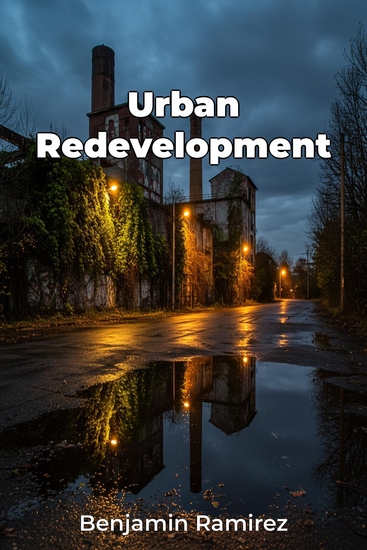
Urban Redevelopment - cover

Urban Redevelopment

Benjamin Ramirez

Translator A AI

Publisher: Publifye

  • 0
  • 0
  • 0

Summary

Urban Redevelopment examines the intricate process of transforming decaying urban areas into thriving communities through strategic urban renewal and revitalization. It explores the crucial intersection of architecture, urban planning, and political strategies necessary for effective and equitable urban development. The book reveals how architectural design can repurpose existing structures, breathing new life into neglected spaces, while political mechanisms either facilitate or obstruct these efforts.

 
The book highlights the importance of community engagement and sustainable development in overcoming urban blight and fostering economic growth. Examining historical successes and failures in urban renewal, the authors argue for a holistic approach that balances economic considerations with social and environmental impacts. It underscores the necessity of informed political decision-making alongside innovative architectural design.

 
Beginning with the core concepts of urban decay, the book progresses through architectural techniques for adaptive reuse and sustainable construction, analyzing political strategies and culminating in best practices for equitable urban renewal. Through diverse case studies, government reports, and interviews, Urban Redevelopment provides practical guidance for policy makers, community activists, and professionals aiming to create vibrant, sustainable urban environments.
Available since: 02/21/2025.
Print length: 86 pages.

Other books that might interest you

  • First In Last Out - An American Paratrooper in Vietnam with the 101st and Vietnamese Airborne - cover

    First In Last Out - An American...

    John D Howard

    • 0
    • 0
    • 0
    A Vietnam veteran recounts his experience through two tours of duty—early in the conflict and then in its final stages. Fresh out of West Point, John Howard arrived for his first tour in Vietnam in 1965, the first full year of escalation when U.S. troop levels increased dramatically, from 23,000 to 184,000. When Howard returned for a second tour in 1972, troop strength stood at 24,000 and would dwindle to a mere fifty the following year. He thus participated in the very early and very late stages of American military involvement in the Vietnam War.   Howard’s two tours—the first as a platoon commander and member of an elite counterguerrilla force, and the second as a senior advisor to the South Vietnamese—provide a fascinating lens through which to view not only one soldier’s experience in Vietnam, but also the country’s.
    Show book
  • What the River Knows - Essays from the Heart of Alaska - cover

    What the River Knows - Essays...

    Michael Engelhard

    • 0
    • 0
    • 0
    Edward Abbey, who never much liked Alaska, called it "our biggest, buggiest, boggiest state." To others, it has been a cure for despair. When Michael Engelhard moved to Fairbanks more than three decades ago, he was a cheechako, a subarctic tenderfoot. Gathering skills and experiences the hard way, he attained "Sourdough" status while realizing there would always be more to learn, see, and do in the land of midnight sun and auroras. 


    En route, Engelhard suffered frostbite, stubborn yaks, grizzly charges, trophy hunters, cold-water immersion, heartbreak, incontinent raptors, one pesky squirrel, and honeymooners from abroad. He tried to rescue a raven and explored Arctic dunes and a glacier's blue heart, and his own as he mingled with caribou on their epic journeys.
    Show book
  • Save the Planet - cover

    Save the Planet

    Raphael Terra

    • 0
    • 0
    • 0
    This audiobook has been recorded using Text to speech (TTS). 
     
    Ever since the end of the Black Death in 1350 the human population has been growing continuously at an alarming rate and there is no sign of it stopping anytime soon. 
     
    The biggest increase has been in most recent times. From the 1950's onward and due largely to medical advancement and the increase in agricultural productivity, the rate of increase has been significant. This in itself should tell us something. That this is a modern problem created recently and we have no precedent, no history to work upon. We don't know exactly what is going to happen. We don't know if a super virus will come along again as it did in 1918 and kill millions of people. We don't know if we will eat ourselves into mass extinction. We don't know if the destruction of natural species such as bees will seal our fate. We don't know if an asteroid will wipe us out or even artificial intelligence. We do know that overpopulation, no matter which way you look at it, is not good. We do know that we are running out of fossil fuels, food supplies, methods of producing more and more power and space. 
     
    What does the future hold for a planet that is swarming in two-legged locusts hell bent on devouring every possible resource the Earth has to offer?
    Show book
  • Stammering Against Truth - Surviving the Unspeakable - cover

    Stammering Against Truth -...

    Wen Gibson

    • 0
    • 0
    • 0
    This intimate and unflinching memoir explores Wen's struggle to survive, and confronts the belief that people don't change. Through appalling abuse and neglect, Wen finds a way to a very different kind of life, embodying resilience, healing and transformation. 
    The story is woven through with the intriguing themes of Wen's life. With humility, understanding and beauty, she delves into the plight of a stammerer, the unbreakable bonds of twinship, and her body's need to dissociate. 
    Wen's evocative imagery transports the reader from the red dirt of Broome, to the streets of India and the mists of Scotland. She crosses the continents, often by bicycle, committing to radical political action and spiritual exploration. These pursuits help forge her growing character. 
    After settling in Scotland, she uncovers buried memories of a terrifying Queensland childhood shrouded in threats and lies, and of her father's links to a Brisbane paedophile gang. 
    'To the outside world, we were the picture-perfect family. No one would have believed me, even if I could have found the words.' 
    She doesn't recoil from facing the truth of her childhood or the unconscionable harm her parents perpetuated. 
    Wen tells how she found her way to her heart and her true gender self. In doing so, she celebrates the power of kindness. Stammering Against Truth is a powerful and empowering book that proves past traumas need not define our futures.
    Show book
  • For The People - Fighting Authoritarianism Saving Democracy - cover

    For The People - Fighting...

    A. C. Grayling

    • 0
    • 0
    • 0
    Around the world the foundations of democracy, freedom, civil liberties are being eroded—what can be done?Are we living through the end of the democratic moment? While democracy once seemed the bedrock of Western societies, the past few decades have revealed a fragile reality. Once liberal countries are turning to authoritarianism, wealthy individuals and corporations are interfering with elections evermore flagrantly, and faith in democracy has plummeted among every demographic. What happened?From gerrymandering and partisanship to corporate interference and tainted donations, A. C. Grayling reveals the forces undermining our democratic ideals and offers bold solutions. An urgent wake-up call to the risks this poses to us all, For The People reminds us why democracy remains worth fighting for.
    Show book
  • The Logic of Hegel - cover

    The Logic of Hegel

    Georg Wilhelm Friedrich Hegel

    • 0
    • 0
    • 0
    A foundational work in the field of philosophy, outlining Georg Wilhelm Friedrich Hegel's influential theory of dialectics and the logical structure of absolute idealism. Hegel's ambitious work explores the evolution of thought through a triadic process of thesis, antithesis, and synthesis, leading to the development of higher concepts and truths. This complex philosophical treatise attempts to understand the nature of reality, history, and human consciousness, making it a seminal work in Western philosophy and an enduring subject of scholarly debate.
    Show book