¡Acompáñanos a viajar por el mundo de los libros!
Añadir este libro a la estantería
Grey
Escribe un nuevo comentario Default profile 50px
Grey
Suscríbete para leer el libro completo o lee las primeras páginas gratis.
All characters reduced
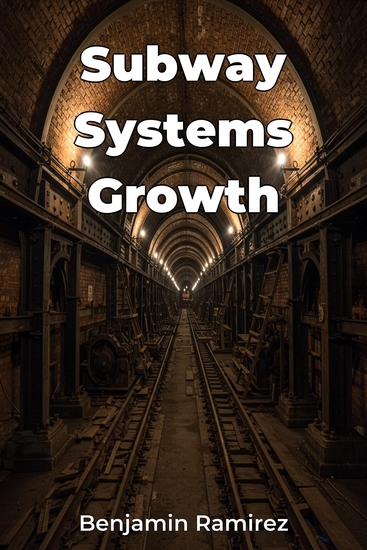
Subway Systems Growth - cover

Subway Systems Growth

Benjamin Ramirez

Traductor A AI

Editorial: Publifye

  • 0
  • 0
  • 0

Sinopsis

Subway Systems Growth explores the fascinating architectural and historical evolution of subway systems as vital subterranean arteries shaping urban landscapes. The book reveals how these underground railways, starting in the 1800s, have been instrumental in urban development and have had a profound impact on society and the economy.

 
Delving beyond mere engineering, the book highlights how subway systems reflect a city's response to evolving societal needs. It offers insights into the pioneering spirit of early construction while also emphasizing the technological advancements that fueled expansion. The book examines subway construction through detailed case studies of major cities, showcasing the unique challenges and solutions encountered.

 
Readers will discover how technological advancements, such as tunnel boring machines, revolutionized urban transit. By incorporating archival research, engineering reports, and even oral histories, Subway Systems Growth connects urban planning, civil engineering, and economic history. The book uniquely focuses on the human element, narrating the stories of those who designed, built, and used these systems.

 
The book progresses logically, beginning with foundational concepts and moving through historical case studies and technological impacts. It concludes with an analysis of the future, considering sustainability and accessibility. The approach is designed to be accessible to all, regardless of technical expertise, making it a valuable resource for anyone interested in urban history, architecture, or engineering.
Disponible desde: 26/02/2025.
Longitud de impresión: 74 páginas.

Otros libros que te pueden interesar

  • Pirates of the Slave Trade - The Battle of Cape Lopez and the Birth of an American Institution - cover

    Pirates of the Slave Trade - The...

    Angela C. Sutton

    • 0
    • 0
    • 0
    No one present at the Battle of Cape Lopez off the coast of West Africa in 1722 could have known that they were on the edge of history. This obscure yet fierce naval battle would have a monumental impact on British colonies and the future of slavery in America. 


    Pirates of the Slave Trade follows three figures whose fates would violently converge: John Conny, a charismatic leader of the Akan people who made lucrative deals with pirates and smugglers while fending off British and Dutch slavers; the infamous pirate Black Bart, who worked his way from an anonymous navigator to one of the British Empire's most notorious enemies in the region; and naval captain Chaloner Ogle, tasked by the Crown with hunting down and killing Black Bart at all costs. At the Battle of Cape Lopez, these three men and the massive historical forces at their backs would finally find each other—and the world would be transformed forever. 


    In this landmark narrative history, historian Angela Sutton outlines the complex network of trade routes spanning the Atlantic Ocean trafficked by agents of empire, private merchants, and brutal pirates alike. Drawing from a wide range of primary historical sources, Sutton offers a new perspective on how a single battle played a pivotal role in reshaping the trade of enslaved people in ways that affect America to this day.
    Ver libro
  • The Cultural Revolution - A Decade of Upheaval - cover

    The Cultural Revolution - A...

    Jun Liu

    • 0
    • 0
    • 0
    The Cultural Revolution, which lasted from 1966 to 1976, was a decade of intense political and social upheaval in China. It was initiated by Mao Zedong, the Chairman of the Chinese Communist Party, as a means to reassert his ideological dominance and eliminate perceived threats within the party and society. The roots of the Cultural Revolution can be traced back to the aftermath of the Great Leap Forward, growing political divisions, and Mao’s desire to reshape China’s ideological landscape. 
    One of the key factors that led to the Cultural Revolution was Mao’s declining influence following the disastrous Great Leap Forward (1958–1962). This economic and social campaign, aimed at transforming China into a communist utopia through rapid industrialization and collectivization, resulted in widespread famine and the deaths of millions. The failures of the Great Leap Forward weakened Mao’s credibility, and he was forced to step back from day-to-day governance, allowing more pragmatic leaders such as Liu Shaoqi and Deng Xiaoping to implement economic reforms. These leaders promoted policies that prioritized economic stability over radical communist ideology, which Mao saw as a betrayal of the revolution’s goals. 
    In response to his diminished authority, Mao sought to reassert control by launching an ideological campaign against those he deemed “capitalist roaders” within the party. By the early 1960s, internal power struggles intensified as Mao and his radical supporters, including Lin Biao and Jiang Qing, clashed with moderate leaders advocating for a more pragmatic approach to governance. Mao viewed the growing influence of his rivals as a direct threat to his vision for China. To counter their policies, he began promoting the idea of a new revolutionary movement that would purify Chinese society and eliminate counterrevolutionary elements.
    Ver libro
  • Ministry of Truth: Book Summary and Analysis - cover

    Ministry of Truth: Book Summary...

    Briefly Summaries

    • 0
    • 0
    • 0
    This is a concise summary and analysis of Ministry of Truth, by Steve Benen.
     
    It is not the original book and is not affiliated with or endorsed by Steve Benen.
     
    Ideal those seeking a quick and insightful overview.


    In Ministry of Truth, the author takes us on a riveting journey through the power and manipulation of truth in society. This thought-provoking audiobook explores the dangerous ways in which information can be controlled and reshaped by those in power, from political regimes to the media, and the profound impact it has on individuals and societies. Through a blend of historical examples and contemporary analysis, the author reveals how truth is not just a matter of facts, but a tool used for control, and how resistance to these manipulations can come at great personal cost.
     
    This audiobook is more than a deep dive into propaganda—it is a call to action for anyone seeking to improve their productivity and reclaim their intellectual autonomy. Every chapter offers valuable insights into how we can protect our mental clarity, make informed decisions, and cultivate environments where truth can flourish. For those striving for success, this book teaches that clarity, integrity, and resilience are not just essential for personal growth—they are the keys to long-term achievement.
    Ver libro
  • The Tempest - cover

    The Tempest

    William Shakespeare

    • 0
    • 0
    • 0
    "THE TEMPEST" is Shakespeare's last book. The story Prospero relates is that he is the rightful Duke of Milan and that his younger brother, Antonio, betrayed him, seizing his title and property. Twelve years earlier, Prospero and Miranda were put out to sea in little more than a raft. Miraculously, they both survived and arrived safely on this island, where Prospero learned to control the magic that he now uses to manipulate everyone on the island. Upon his arrival, Prospero rescued a sprite, Ariel, who had been imprisoned by the witch Sycorax. Ariel wishes to be free and his freedom has been promised within two days.    The last inhabitant of the island is the child of Sycorax and the devil: Caliban, whom Prospero has enslaved. Caliban is a natural man, uncivilized and wishing only to have his island returned to him to that he can live alone in peace.    Soon the royal party from the ship is cast ashore and separated into three groups. The king's son, Ferdinand, is brought to Prospero, where he sees Miranda, and the two fall instantly in love. Meanwhile, Alonso, the king of Naples, and the rest of his party have come ashore on another part of the island. Alonso fears that Ferdinand is dead and grieves for the loss of his son. Antonio, Prospero's younger brother, has also been washed ashore with the king's younger brother, Sebastian.    Antonio easily convinces Sebastian that Sebastian should murder his brother and seize the throne for himself. This plot to murder Alonso is similar to Antonio's plot against his own brother, Prospero, 12 years earlier.    Another part of the royal party — the court jester and the butler — has also come ashore. Trinculo and Stefano each stumble upon Caliban, and each immediately sees a way to make money by exhibiting Caliban as a monster recovered from this uninhabited island. Stefano has come ashore in a wine cask, and soon Caliban, Trinculo, and Stefano are drunk. While drinking, Caliban hatches a plot to murder Prospero and enrolls his two new acquaintances as accomplices. Ariel is listening, however, and reports the plot to Prospero.    Next, Prospero stages a masque to celebrate the young couple's betrothal, with goddesses and nymphs entertaining the couple with singing and dancing. While Ferdinand and Miranda have been celebrating their love, Alonso and the rest of the royal party have been searching for the king's son. Exhausted from the search and with the king despairing of ever seeing his son alive, Prospero has ghosts and an imaginary banquet brought before the king's party. A god-like voice accuses Antonio, Alonso, and Sebastian of their sins, and the banquet vanishes. The men are all frightened, and Alonso, Antonio, and Sebastian run away.    Prospero punishes Caliban, Trinculo, and Stefano with a run through a briar patch and swim in a scummy pond. Having accomplished what he set out to do, Prospero has the king's party brought in. Prospero is clothed as the rightful Duke of Milan, and when the spell has been removed, Alonso rejects all claims to Prospero's dukedom and apologizes for his mistakes. Within moments, Prospero reunites the king with his son, Ferdinand. Alonso is especially pleased to learn of Miranda's existence and that Ferdinand will marry her.    Prospero then turns to his brother, Antonio, who offers no regrets or apology for his perfidy. Nevertheless, Prospero promises not to punish Antonio as a traitor. When Caliban is brought in, Caliban tells Prospero that he has learned his lesson. His two co-conspirators, Trinculo and Stefano, will be punished by the king. Soon, the entire party retires to Prospero's cell to celebrate and await their departure home. Only Prospero is left on stage.    In a final speech, Prospero tells the audience that only with their applause will he be able to leave the island with the rest of the party. Prospero leaves the stage to the audience's applause.
    Ver libro
  • Banished from Johnstown - Racist Backlash in Pennsylvania - cover

    Banished from Johnstown - Racist...

    Cody McDevitt, Tony Norman

    • 0
    • 0
    • 0
    Author and journalist Cody McDevitt tells the story of one of the worst civil rights injustices in Western Pennsylvania history. 


    In 1923, in response to the fatal shooting of four policemen, the mayor of Johnstown ordered every African American and Mexican immigrant who had lived in the city for less than seven years to leave. They were given less than a day to move or would face crippling fines or jail time and were forced out at gunpoint. An estimated two thousand people uprooted their lives in response to the racist edict. Area Ku Klux Klan members celebrated the creation of a "sundown town" and increased their own intimidation practices. Figures such as Marcus Garvey spoke out in Pittsburgh against it as newspapers throughout the country published condemnations.
    Ver libro
  • Summary: 12 Rules for Life - An Antidote to Chaos by Jordan B Peterson & Norman Doidge MD: Key Takeaways Summary & Analysis - cover

    Summary: 12 Rules for Life - An...

    Brooks Bryant

    • 0
    • 0
    • 0
    DISCLAIMER: THIS IS NOT THE OFFICIAL BOOK. 
    This is a summary & it does not accompany the official. 
    In "12 Rules for Life" by Jordan B. Peterson and Norman Doidge MD, readers are treated to a blend of humor, surprising insights, and valuable information. Dr. Peterson offers guidance on various aspects of life, including why it's important to let skateboarding kids be, the perils of overly harsh criticism, and the simple joy of petting a cat on the street. 
    The book explores intriguing questions such as what the nervous system of a lobster can teach us about adopting a confident posture and achieving success, why ancient Egyptians revered the ability to pay attention, and the destructive paths individuals can take when consumed by resentment, arrogance, and vengeance. Dr. Peterson's journey covers topics like discipline, freedom, adventure, and responsibility, distilling the collective wisdom of the world into 12 practical and profound rules for living a meaningful life. "12 Rules for Life" challenges conventional beliefs about science, faith, and human nature, ultimately enriching the minds and spirits of its readers.
    Ver libro