¡Acompáñanos a viajar por el mundo de los libros!
Añadir este libro a la estantería
Grey
Escribe un nuevo comentario Default profile 50px
Grey
Suscríbete para leer el libro completo o lee las primeras páginas gratis.
All characters reduced
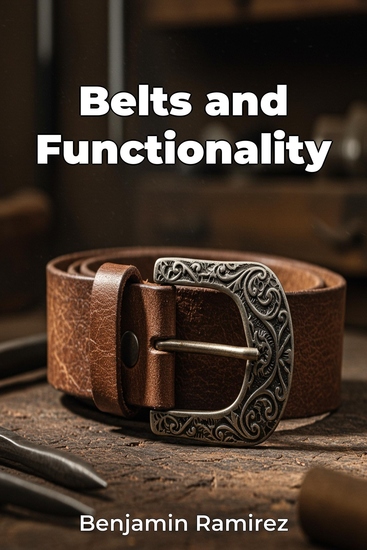
Belts and Functionality - cover

Belts and Functionality

Benjamin Ramirez

Traductor A AI

Editorial: Publifye

  • 0
  • 0
  • 0

Sinopsis

Belts and Functionality explores the surprising journey of belts, transforming from simple garment supports to powerful symbols of fashion and identity. Initially crucial for securing clothing, belts evolved significantly, reflecting societal shifts and technological advancements. The book highlights how social status influenced belt design; for example, elaborate belts once signified wealth and authority, illustrating the cultural significance woven into this everyday item.

 
The book examines the belt's functional development, symbolic representation, and impact on the fashion industry. By tracing its history from ancient civilizations through the Renaissance and into modern fashion trends, the book reveals how belts reflect our enduring need for both practicality and self-expression.

 
From early materials and construction to mass production and designer influences, each chapter unfolds chronologically, culminating in a look at the future of belts in an increasingly sustainable and technologically integrated world. Offering a fresh perspective on an often-overlooked accessory, Belts and Functionality is valuable for fashion enthusiasts, design students, and historians alike. Its detailed research and clear style provide insights into fashion history, making it accessible to anyone curious about the evolution of everyday objects.
Disponible desde: 27/02/2025.
Longitud de impresión: 58 páginas.

Otros libros que te pueden interesar

  • Fashion in Ancient Rome: The History of the Clothes and Jewelry Worn by the Romans - cover

    Fashion in Ancient Rome: The...

    Charles River Editors

    • 0
    • 0
    • 0
    More completely than almost any people before or since, the Romans turned clothing into a legal and political language. Far from being worn simply because they were warm, fine, or fashionable, clothes were a statement about where an individual stood in Rome’s rigid social hierarchy, and that hierarchy very much enforced itself through fashion, sometimes with codified laws. A boy wore one thing and a man another, and the day he changed clothes made him a citizen in the eyes of the state. A senator's shoes differed from a knight's, both differed from what an ordinary citizen put on his feet, and everyone could see the difference at a glance. A candidate for office whitened his toga so aggressively that the practice eventually lent its name to the office he sought. A general who triumphed wore a costume borrowed from a god, albeit for a single day, guarding against the suggestion that he might want to keep it. Even the color purple eventually became something a private person could be executed for wearing. 
    	This was not an accident of taste, because Rome built a society obsessed with status and visible markers, and clothes represented the primary identification. The toga, in particular, carried a weight of meaning that no other garment in the ancient world approached – it was inconvenient, expensive, difficult to wear, and impossible to work in, yet the Romans clung to it for close to a thousand years precisely because its uselessness was the point. A man in a toga announced that he was a Roman citizen at leisure, engaged in the business of public life rather than in labor. Virgil gave the Romans the phrase gens togata, “the people of the toga,” and the poet was not describing what Romans wore around the house. He was very much describing what they thought they were. 
    	Given the incredible expansion of the Roman Empire, it’s little surprise that ancient Roman artifacts of all kinds have survived to document the extent of Roman fashion. 
    Ver libro
  • All About Amy (Little Women Essay) - cover

    All About Amy (Little Women Essay)

    Niina Niskanen

    • 0
    • 0
    • 0
    Join me on a journey to study Amy March and her real-life inspiration May Alcott Nieriker. The misconceptions about Jo´s insecurities and especially about her looks. Society likes to put two characters against one another but is this true to reality? Find out that and more in the Little Women podcast. 
    People often praise Jo for being a tomboy and how she rejects femininity, but Jo´s idealization of the masculine has very toxic elements. Amy is a character who is more governed by her brain, whereas Jo is in fact governed by her emotions, which is considered a feminine trait. In the novel, Jo struggles to show her feelings because she considers that weak and "feminine". When their father is wounded in the war she shouts to her sisters not to cry. A couple of years later Laurie says that she doesn't show emotions and calls her out about it. Because Jo tries to shut down an important human part of herself, simply because she considers it feminine, is actually something that slowly eats her inside and contributes to her loneliness. This is why the umbrella chapter is so important because Friedrich says to Jo that it is okay to be vulnerable. 
    Amy does the opposite. She considers rational marriage with Fred Vaughn because it allows her to secure her family´s financial future. When Laurie reminds Amy that she is her mother´s daughter, and she simultaneously inspires Laurie to become a productive member of society, Amy allows herself to listen to her heart and her own feelings and allowing herself to become more open and it is this inner work that the couples do in Little Women, that makes these relationships work. 
    Unfortunately, the adaptations rarely pay any attention to this. There are people who have not read the novel, have only seen the films, and don´t understand why the couples end up together. This is because the adaptations, never bother to show what actually happens between these people in the novel.
    Ver libro
  • The Vocal Seducer - The Complete Guide towards an Attractive Male Voice - cover

    The Vocal Seducer - The Complete...

    Felix Patschkowski

    • 0
    • 0
    • 0
    The Vocal Seducer - The Complete Guide towards an Attractive Male Voice 
    In this audio book we will work together on fine tuning your personal voice image to turn it into its most attractive male version. While you are on this journey you will also develop another skill and that is listening. The consciousness about voice images and the tools that we will explore will also help you with better reading what your counterpart is communicating. Remember, only 7% of the communication is the words that we are using.Table of Contents 
    Introduction 
    Part I – The Characteristics of an Attractive Male VoiceSpeaking in a Deep VoiceSpeaking with a Slow VoiceSpeaking with a Commanding VoiceSpeaking with the Right Level of EnergySpeaking in a Seductive VoiceLaughter Wins the Hearts and Emoting 
    Part II – Moving Your Personal Voice Image towards its Most Attractive VersionRecording and Listening to Your Own VoiceSharpening the Clarity of Your Voice ImageSpeaking in a Deeper VoiceSlowing Down the Pace of Your VoiceCommanding with Your Voice and Dealing with Conspicuous Features (Filler Words)Seducing with Your VoiceHow to Laugh and Emote the Right WayDealing with Lisp, Stutter, and (Local) Accents 
    Final Thoughts
    Ver libro
  • Timeless Adventures - The Unofficial Story of How Doctor Who Conquered Television - cover

    Timeless Adventures - The...

    Brian J. Robb

    • 0
    • 0
    • 0
    This critical history of Doctor Who covers the series 60 years, from the creation of the show to its triumph as Britain's number one TV drama.
    
    Opening with an in-depth account of the creation of the series within the BBC of the early 1960s, each decade of the show is tackled through a unique political and pop cultural historical viewpoint, exploring the links between contemporary Britain and the stories Doctor Who told, and how such links kept the show popular with a mass television audience.
    
    Timeless Adventures reveals how Doctor Who is at its strongest when it reflects the political and cultural concerns of a mass British audience (the 1960s, 1970s and 21st Century), and at its weakest when catering to a narrow fan-based audience (as in the 1980s). The book also addresses the cancellation of the show in the late 1980s (following the series becoming increasing self-obsessed) and the ways in which a narrowly-focused dedicated fandom contributed to the show's demise and yet was also instrumental in its regeneration for the 21st Century under Russell T. Davies, and analyses the new series to reveal what has made it so popular, reflecting real world issues like consumerism and dieting.
    Ver libro
  • Gradual - The Case for Incremental Change in a Radical Age - cover

    Gradual - The Case for...

    Aubrey Fox, Greg Berman

    • 0
    • 0
    • 0
    Many experts believe that we are at a fulcrum moment in history, a time that demands radical shifts in thinking and policymaking. Calls for bold change are everywhere these days, particularly on social media. But is this actually the best way to make the world a better place? 
     
    In Gradual, Greg Berman and Aubrey Fox argue that, contrary to the aspirations of activists on both the right and the left, incremental reform is the best path forward. They begin by emphasizing that the very structure of American government explicitly and implicitly favors incrementalism. Particularly in a time  
    of intense polarization, any effort to advance radical change will inevitably engender significant backlash. As Berman and Fox make clear, polling shows little public support for bold change. The public is, however, willing to endorse a broad range of incremental reforms that, if implemented, would reduce suffering and  
    improve fairness. To illustrate how incremental changes can add up to significant change over time, Berman and Fox provide portraits of “heroic incrementalists” who have produced meaningful reforms in a variety of areas, from the expansion of Social Security to more recent efforts to reduce crime and incarceration. 
     
    Gradual is a bracing call for a “radical realism” that prioritizes honesty, humility, nuance, and respect in an effort to transcend political polarization and reduce the conflict produced by social media.
    Ver libro
  • As We Remember: A History of Woman’s Relief Corps of Beaufort SC - cover

    As We Remember: A History of...

    Najmah Thomas

    • 0
    • 0
    • 0
    This book documents the remarkable story of a Woman's Relief Corps (WRC) chapter in Beaufort, South Carolina. The WRC is a national organization established as an official auxiliary to the Grand Army of the Republic (GAR) in 1883. A Woman's Relief Corps post has existed in the city of Beaufort, South Carolina, in various forms since 1892 when GAR Post David Hunter No. 9 was established in the city, with statesman Robert Smalls selected as Post Commander in 1894. 
    While much of the record of the early Beaufort WRC was passed on through the esteemed oral history tradition, in 2019 members commissioned a study with the purpose of ensuring their story would be documented in print form and told for many generations to come. That story intentionally centers African American women as lead agents of change and co-creators of the patriotic spirit, an important theme given the fact that historically the national WRC was primarily White-led, and in southern localities like Beaufort, completely segregated. 
    Beyond the Corps' main purpose of documenting their lived experiences as WRC members, this story is compelling in the larger context as the nation contends with changing notions of its national identity and definitions of patriotism.
    Ver libro