¡Acompáñanos a viajar por el mundo de los libros!
Añadir este libro a la estantería
Grey
Escribe un nuevo comentario Default profile 50px
Grey
Suscríbete para leer el libro completo o lee las primeras páginas gratis.
All characters reduced
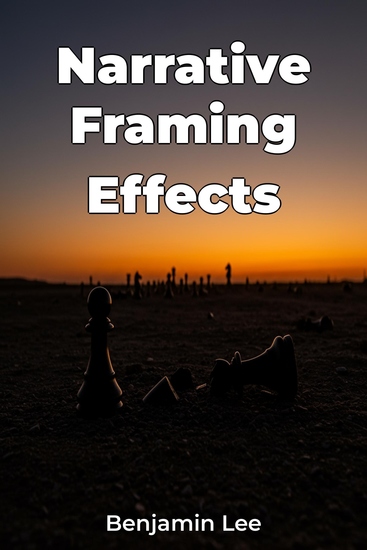
Narrative Framing Effects - cover

Narrative Framing Effects

Benjamin Lee

Traductor A AI

Editorial: Publifye

  • 0
  • 0
  • 0

Sinopsis

Narrative Framing Effects explores how stories shape our views on war and peace, focusing on the power of narrative framing to influence public opinion. It examines how linguistic choices and psychological appeals are strategically used in political narratives, particularly during conflict. The book dissects the mechanics of narrative construction, revealing how techniques like agenda-setting and emotional appeals impact beliefs. For example, the crafting of narratives around conflicts, such as the Vietnam War versus post-9/11 operations, significantly shapes public approval and perceptions of legitimacy. The book investigates the psychological processes that make individuals susceptible to framing effects, such as cognitive biases and pre-existing beliefs. It draws from linguistic analysis, psychology, and political science, using examples from wartime propaganda and peace initiatives to illustrate narrative impact. Chapters progress from introducing core concepts to analyzing narrative dissemination by governments and media, culminating in an examination of peace-building narratives. The book’s analytical approach offers readers tools to critically evaluate narratives and understand their role in shaping attitudes toward war and peace.
Disponible desde: 21/02/2025.
Longitud de impresión: 66 páginas.

Otros libros que te pueden interesar

  • Psychology of Politics The (The Psychology of Everything) - cover

    Psychology of Politics The (The...

    Barry Richards

    • 0
    • 0
    • 0
    How do some political leaders capture popular support? What is the appeal of belonging to a nation? Can democracy thrive?The Psychology of Politics explores how the emotions which underpin everyday life are also vital in what happens on the political stage. It draws on psychoanalytic ideas to show how fear and passion shape the political sphere in our changing societies and cultures, and examines topical social issues and events including Brexit, the changing nature of democracy, activism, and Trump in America.In a changing global political climate, The Psychology of Politics shows us how we can make sense of what drives human conduct in relation to political ideas and action.
    Ver libro
  • Gnosticism: The History and Legacy of the Mysterious Ancient Religion - cover

    Gnosticism: The History and...

    Charles River Editors

    • 0
    • 0
    • 0
    Gnosticism is one of the great mysteries in the history of Western religion. At its core is an ancient Greek word, gnōsis, a word prominent in the writings of Plato which refers to a deep personal knowledge or understanding that often transcends the physical world.[1] The Gnostics painted a picture of a fallen, broken world in which physicality was a product of a lesser deity. This deity was created in defiance of the One and in order to trap humans and blind them to the truths of their predicament and divine origins. By acquiring insight, or gnōsis, in this secret nature of the world, humans might escape their prison. Only through knowledge can people be set free.  
    	As that makes clear, Gnosticism as a belief system is difficult to define since it is not a well-organized or uniform doctrine like Christianity or Judaism, but at one time there was some synchronization with Christianity that nurtured both movements. As a religion and philosophy, Gnosticism flourished alongside Christianity, and it is not easy to say which one came first, but it is certain that both movements influenced each other. To paraphrase John Dominic Crossan, it is unclear whether Gnosticism was a Christian heresy, a Jewish heresy, or an original religion that powerfully merged with both. Gnosticism borrowed elements from Christians, just as the whole of Christianity took a certain Gnostic flavor, to the point that some books of the New Testament, especially the Gospel of John, could easily pass as a proto-Gnostic document. 
    	At the risk of oversimplifying, Gnosticism was the belief that the souls are divine sparks imprisoned in imperfect physical bodies, due to the machinations of a lesser and evil god who created the world. This evil god is identified with the creator of the Genesis and the Hebrew Bible. The material world and the body are prisons separated from the divine realm, from which humans must escape through the ascent of various levels. This is possible through the acquisition of secret knowledge reserved for the elect. This special revelation or gnosis (knowledge) was supposedly disclosed by Jesus to his dearest disciples, and it can be found in the Gnostic books, deliberately written in cryptic language. The acquisition of the secrets necessary for the salvation of the soul in many cases implied a radical asceticism and corporal sacrifice.  
    	Due to such classical roots, it would be easy to conclude that Gnosticism is an ancient philosophy, and a cursory glance might categorize it as simply a way of understanding the world and promoting investigation. However, the term is most often used to describe not a philosophy but a religion, and not just any religion, but a branch of one of the most resilient and influential traditions in history: Christianity. So what exactly is Gnosticism, and why does it remain such a source of confusion, captivation, and charisma for modern scholarship and culture alike? These answers are complex, and indicative of how the many turnings of the last two millennia have unexpectedly unearthed some answers while burying others even deeper.  
    	Gnosticism: The History and Legacy of the Mysterious Ancient Religion looks at the different origins that shaped Gnosticism, what Gnostics believed and practiced, and the influence they had on other religions. Along with pictures depicting important people, places, and events, you will learn about Gnosticism like never before.
    Ver libro
  • America’s Most Notorious Con Artists: The History and Schemes of Successful Cons in the United States - cover

    America’s Most Notorious Con...

    Editors Charles River

    • 0
    • 0
    • 0
    The art of the confidence trick is a controversial craft that is as old as time itself. In the early years of civilization, unscrupulous folks bottled and peddled assortments of fake cures and potions. Snake oil salesmen aside, charlatans posed as mystical beings with supernatural powers, promising to end droughts and other misfortunes of the gullible with what were in reality parlor tricks and illusions.  
    	Indeed, throughout history, unabashedly brazen characters managed to make careers out of deception. 17th century Britain, for instance, was terrorized by William Chaloner, the most infamous serial counterfeiter and con artist of his time before he was ultimately bested by Sir Isaac Newton himself. The British trickster posed as a quack doctor and a clairvoyant who dispensed false fortunes (most likely via an early form of cold reading) and bogus healing antidotes, but these were bush-league frauds in comparison to one of his most renowned claims to fame: he once bribed four Jacobite sympathizers to crank out pamphlets regarding King James II's denunciation of His Royal Highness William, and later double-crossed his co-conspirators by tipping off the cops and swiftly decamping with the 1,000 reward.  
    	Confidence women were equally active players in such dirty, fixed games. Doris Payne was a professional pilferer of jewels whose unconventional vocation spanned six decades. Throughout all her hits across the United States, Europe, and Asia, Payne adhered to a simple, yet effective method of operation: she donned stylish, pricey clothes, singled out impressionable male shopkeepers and distracted them with flirtatious small talk, and secretly palmed jewelry with sleight-of-hand tricks. One of the most recent was Frank Abagnale, a career impersonator, former forger of bank checks turned FBI employee, and the subject of the 2002 film Catch Me If You Can.  
    Ver libro
  • Badass Begums - cover

    Badass Begums

    Anoushka Jain

    • 0
    • 0
    • 0
    History rarely shines a light on the formidable Mughal begums who boldly navigated the imperial courts, brokered powerful deals, reshaped Delhi's skyline, created private spaces for women, fought battles and resisted patriarchy - all from their place behind the purdah.  
    In Badass Begums, Anoushka Jain introduces you to ten such Mughal-era women whose lives rippled with ambition, romance, intrigue and fierce resilience. Jahanara Begum, Shah Jahan's favourite daughter who designed Chandni Chowk and her sister, the firebrand Roshanara Begum, who schemed with Aurangzeb to take over her father's empire; the invincible Begum Samru, a tawaif-turned-ruler, who led her own army into battles; Maham Anga and Mubarak Begum, whose counsel rivalled that of chief ministers, and the resolute Qudsia Begum who built riverfront gardens only to see them battered by rebellions - these and other stories come alive in a riveting narrative and walking tour maps of the places they lived in or curated.  
    Based on rigorous research and written with warmth, Badass Begums is an eye-opening journey through the breathtaking legacies still hidden in the by-lanes of Delhi.
    Ver libro
  • Out of the Sky - An Untold Story of Heroism and Rebirth in Nazi Europe - cover

    Out of the Sky - An Untold Story...

    Matti Friedman

    • 0
    • 0
    • 0
    Was it one of the war’s most memorable feats of valor or an act of desperation, even madness?
     
    In Out of the Sky, Matti Friedman unravels one of the strangest episodes of World War II: In 1944, a team of young women and men who had escaped the Holocaust made the inconceivable choice to parachute back into Nazi-occupied Europe under the cover of a British military operation. Yet by the end of the mission, not a single Nazi was harmed and not a single Jew was saved, and many of the parachutists died in the process. Even so, some of their names would become legendary, especially that of twenty-three-year-old Hannah Senesh, the author of the beloved Hebrew song “Eli, Eli.” Their story would become one of the young state of Israel’s founding myths—but what exactly was the mission, and what had the parachutists actually accomplished? What made them heroes?
     
    Using thousands of original documents from once-secret files, manuscripts, memoirs, and unpublished letters, Matti Friedman follows four of the parachutists from the spring of 1944 to the operation’s dramatic end that winter. In Out of the Sky, he tells the gripping and surprising tale of a forgotten moment, demonstrating how storytelling itself can have a power even greater than warfare. And in exploring the line between myth and reality, heroism and futility, he creates
    an argument that has resonance in our own time. 
    Ver libro
  • Christians and Israel: The Heart of the Matter - A Concise Guide - cover

    Christians and Israel: The Heart...

    David Evans

    • 0
    • 0
    • 0
    David Evans offers a different and sensitive approach in this concise introduction for Christians seeking clarity about Israel, the Jews and the Church. David seeks to clear up some common misunderstandings about 'Christian Zionists ' and avoids a dogmatic position on the order of the End Times events. This book opens up debate about:Scriptures versus the media.God's covenants with the Jews - conditional or unconditional?What is God's ultimate purpose with the Jews?The little-known history of British Christianity and the restoration of the modern state of Israel.Why radical Islam is gaining ground in Britain.The coming fall of Islam.What does 'all Israel will be saved' actually mean?Should Christians unconditionally support Israel?
    Ver libro