¡Acompáñanos a viajar por el mundo de los libros!
Añadir este libro a la estantería
Grey
Escribe un nuevo comentario Default profile 50px
Grey
Suscríbete para leer el libro completo o lee las primeras páginas gratis.
All characters reduced
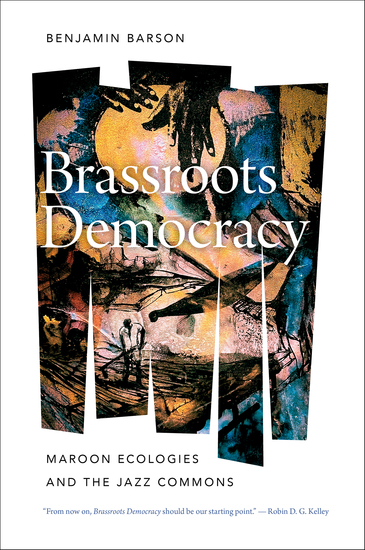
Brassroots Democracy - Maroon Ecologies and the Jazz Commons - cover

Brassroots Democracy - Maroon Ecologies and the Jazz Commons

Benjamin Barson

Editorial: Wesleyan University Press

  • 0
  • 0
  • 0

Sinopsis

Brassroots Democracy recasts the birth of jazz, unearthing vibrant narratives of New Orleans musicians to reveal how early jazz was inextricably tied to the mass mobilization of freedpeople during Reconstruction and the decades that followed. Benjamin Barson presents a "music history from below," following the musicians as they built communes, performed at Civil Rights rallies, and participated in general strikes. Perhaps most importantly, Barson locates the first emancipatory revolution in the Americas—Haiti—as a nexus for cultural and political change in nineteenth-century Louisiana. In dialogue with the work of recent historians who have inverted traditional histories of Latin American and Caribbean independence by centering the influence of Haitian activists abroad, this work traces the impact of Haitian culture in New Orleans and its legacy in movements for liberation.Brassroots Democracy demonstrates how Black musicians infused participatory music practice with innovative forms of grassroots democracy. Late nineteenth-century Black brass bands and activists rehearsed these participatory models through collective performance that embodied the democratic ethos of Black Reconstruction. Termed "Brassroots Democracy," this fusion of political and musical spheres revolutionized both. Brassroots Democracy illuminates the Black Atlantic struggles that informed music-as-world-making from the Haitian Revolution through Reconstruction to the jazz revolution. The work theorizes the roots of the New Orleans brass band tradition in the social relations grown in maroon ecologies across the Americas. Their fruits contributed to the socio-sonic commons of the music we call jazz today.
Disponible desde: 24/09/2024.
Longitud de impresión: 425 páginas.

Otros libros que te pueden interesar

  • Tunes of the Times - An Exploration of Musical Films Through the Ages - cover

    Tunes of the Times - An...

    Lance Brockovich

    • 0
    • 0
    • 0
    Tunes of the Times is your passport to an enthralling journey through the transformative world of musical films. Unearth the origins, celebrate the golden eras, and embrace the innovative present of this beautiful blend of visuals and vocals. 
     
    The silent beginnings were more than just muted movies. They were the canvas on which the foundation of musical cinema was laid. Discover how the early 'talkies' paved the way for a genre that would captivate audiences for generations. Relive the Golden Age of Hollywood, where musicals became a symbol of hope, joy, and sometimes, escapist dreams. The 1930s introduced us to new cinematic possibilities, the 1940s anchored us during wartime with uplifting tunes, and the 1950s painted our screens with the vivacious colors of Technicolor dreams. Each era, with its unique flavor, changed the way we perceived musical films. 
     
    The transitional years of the 1960s and 1970s saw experimentation and rock operas, challenging traditional norms and ushering in new narratives. And as we approached contemporary times, the evolution didn't stop. The influence of pop culture, the Disney renaissance, and the push for innovation and diversity in the 2000s reshaped the landscape of musical cinema. Delve deeper into the themes that make musicals resonate with us—love, romance, social commentary, fantasy. Understand the meticulous effort behind direction, choreography, set design, and the magic of sound and score that binds the narrative. Celebrate the iconic performers, directors, composers, and lyricists who became legends in their own right.  
     
    As we trace the profound impact and legacy of musical films, Tunes of the Times allows us to reflect on cultural mirrors, accolades, and the promising future of this beloved genre. Join us on this melodious journey and understand why, through the ages, musical films have remained an enduring, enchanting, and essential part of our cultural tapestry.
    Ver libro
  • Classic Rock & Rock Radio Commercials - Frank Zappa & Grateful Dead - cover

    Classic Rock & Rock Radio...

    Frank Zappa, The Grateful Dead

    • 0
    • 0
    • 0
    Frank Vincent Zappa (December 21, 1940 - December 4, 1993) was an American composer, singer-songwriter, guitarist, recording engineer, record producer and film director. In a career spanning more than 30 years, Zappa Zappa produced almost all of the more than 60 albums he released with the band, The Mothers of Invention, and as a solo artist. He also directed feature-length films and music videos, and designed album covers. The Grateful Dead was an American rock band formed in 1965 in Palo Alto, California. The founding members were Jerry Garcia (lead guitar, vocals), Bob Weir (rhythm guitar, vocals), Ron "Pigpen" McKernan (keyboards, harmonica, vocals), Phil Lesh (bass, vocals), Bill Kreutzmann (drums) and, later, Mickey Hart (drums).The band was known for its unique and eclectic style, which fused elements of rock, folk, bluegrass, blues, reggae, country, improvisational jazz, psychedelia, and space rock, and for live performances of long musical improvisation. They were inducted into the Rock and Roll Hall of Fame in 1994. This fascinating audio program includes actual radio commercials from the 1960s for each of the bands.
    Ver libro
  • Empire of Ife - The Cradle of Yoruba Culture and the Kingdom of Sculptors - cover

    Empire of Ife - The Cradle of...

    Rolf Hedger

    • 0
    • 0
    • 0
    The origins of Ife are deeply rooted in mythology, oral traditions, and historical accounts, making it one of the most revered ancient cities in West Africa. Ife is often referred to as the cradle of the Yoruba civilization, a place where culture, religion, and governance took form. The story of its beginning is intertwined with Yoruba cosmology, particularly the legend of Oduduwa, who is considered the progenitor of the Yoruba people. 
    According to Yoruba mythology, Olodumare, the Supreme Being, entrusted Oduduwa with the sacred task of creating the earth. He descended from the heavens with a chain, a handful of earth, and a rooster. Upon reaching the watery expanse that covered the world, he spread the earth on the surface, and the rooster scattered it, forming the first landmass. This sacred land became known as Ile-Ife, meaning “The Land of Expansion.” Over time, Oduduwa and his followers established a kingdom that became the center of Yoruba civilization, laying the foundation for its political, spiritual, and artistic traditions. 
    Beyond mythology, historical and archaeological evidence suggests that Ife was already a flourishing city-state by the 9th century, possibly earlier. It grew as a hub of trade, attracting merchants and artisans from different parts of West Africa. Its strategic location allowed for the exchange of goods, ideas, and cultural practices, contributing to the city’s rapid development. The city’s early rulers, often referred to as the Oonis, played a crucial role in consolidating power and maintaining the harmony between religious and political institutions. The Ooni of Ife, regarded as both a king and a divine figure, acted as the intermediary between the people and the gods, reinforcing Ife’s status as a sacred city.
    Ver libro
  • Kiki Man Ray - Art Love and Rivalry in 1920s Paris - cover

    Kiki Man Ray - Art Love and...

    Mark Braude

    • 0
    • 0
    • 0
    In freewheeling 1920s Paris, Kiki de Montparnasse captivated as a nightclub performer, sold out gallery showings of her paintings, starred in Surrealist films, and shared drinks and ideas with the likes of Jean Cocteau and Marcel Duchamp. Her best-selling memoir—featuring an introduction by Ernest Hemingway—made front-page news in France and was immediately banned in America. All before she turned thirty. 


    Kiki was once the symbol of bohemian Paris. But if she is remembered today, it is only for posing for several now-celebrated male artists, including Amedeo Modigliani and Alexander Calder, and especially photographer Man Ray. 


    Kiki and Man Ray met in 1921 during a chance encounter at a café. What followed was an explosive decade-long connection, both professional and romantic, during which the couple grew and experimented as artists, competed for fame, and created many of the shocking images that cemented Man Ray's reputation as one of the great artists of the modern era. 


    Charting their volatile relationship, award-winning historian Mark Braude illuminates for the first time Kiki's seminal influence not only on Man Ray's art, but on the culture of 1920s Paris and beyond.
    Ver libro
  • The Master of Drums - Gene Krupa and the Music He Gave the World - cover

    The Master of Drums - Gene Krupa...

    Elizabeth J. Rosenthal

    • 0
    • 0
    • 0
    From the early 1930s onward, Gene Krupa was a drum-centric rarity in the jazz world. Never before had a drummer been in the forefront as a solo artist. His galvanizing, unrestrained passion for percussion demanded it. Rocking the rafters, Gene thrilled audiences in ballrooms, nightclubs, and movies. 


    Seemingly born jazz-drum crazy in 1909 to a Polish-immigrant working-class family in South Chicago, Gene was a professional by the age of thirteen and soon made his first recordings. By the early 1930s, he was New York City's most in-demand drummer, and in 1934, joined brilliant clarinetist Benny Goodman's band, helped inaugurate the Swing Era, and played the first-ever swing concert at Carnegie Hall. He formed his own band and shattered racial boundaries by sharing the spotlight with the African-American trumpeter Roy Eldridge. But after a skyrocketing ride to the top, Gene experienced a rollercoaster ride of good and bad luck, emotional highs, and devastating depths. 


    In The Master of Drums, biographer Elizabeth J. Rosenthal crafts a celebratory, honest, and exhaustively researched portrait of a twentieth-century music legend. When he died, Gene Krupa may have left behind a world of grieving friends, colleagues, fans, students, and progeny, but as The Master of Drums proves, his dynamic musical and cultural influences live on.
    Ver libro
  • Deeping It - Colonialism Culture & the Criminalisation of UK Drill - cover

    Deeping It - Colonialism Culture...

    Adèle Oliver

    • 0
    • 0
    • 0
    Deeping It analyses drill's fight against moral panic and its fraught relationship with the police and political authority in the UK, exemplified by constant censorship, racism, and moments such as when a drill duo became the first people in British legal history to receive a prison sentence for simply performing a song.
    Policing, policy and criminalisation are the cornerstones of colonial suppression; art, self-expression and collective action are beacons of resistance. Deeping It places drill firmly in the latter category, tracing its production and criminalisation across borders and eras of the British Empire, exploring drill's artistic singularity but also its inherent threat as a Black artform in a world that prioritises whiteness.
    Intervening on this discourse steeped in anti-Blackness, this Inkling 'deeps' how the criminalisation of UK drill cannot be disentangled from histories, technologies, and realities of colonialism and consumerism.
    Ver libro