¡Acompáñanos a viajar por el mundo de los libros!
Añadir este libro a la estantería
Grey
Escribe un nuevo comentario Default profile 50px
Grey
Suscríbete para leer el libro completo o lee las primeras páginas gratis.
All characters reduced
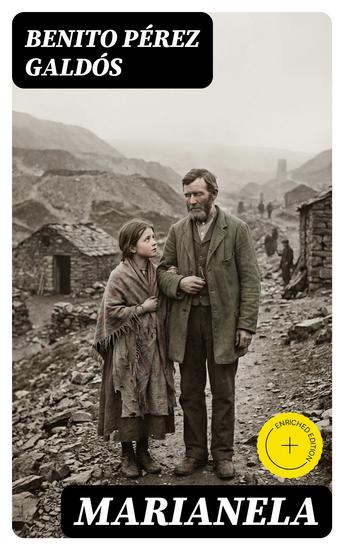
Marianela - Enriched edition - cover

Marianela - Enriched edition

Benito Pérez Galdós

Traductor Clara Bell

Editorial: DigiCat

  • 0
  • 0
  • 0

Sinopsis

In "Marianela," Benito Pérez Galdós crafts a poignant narrative that explores themes of love, beauty, and social disparity through the story of a young blind man, Pablo, and his devoted guide, the impoverished Marianela. Galdós employs a realist literary style, richly imbued with psychological depth and social commentary, reflecting the socio-economic inequalities of 19th-century Spain. The novel intricately weaves romantic and tragic elements, challenging perceptions of physical appearance and the essence of true love amidst the harsh realities of life. Benito Pérez Galdós, a seminal figure in Spanish literature, was deeply influenced by his own experiences of socio-political upheaval and personal encounters with the marginalized. His writings often reflect his commitment to social reform and illuminate the lives of the underprivileged. This empathy for the dispossessed is palpably expressed in Marianela, revealing Galdós's exceptional ability to articulate the struggles and aspirations of those often overlooked by society. For readers seeking a profound exploration of humanity's complexities, "Marianela" offers a compelling narrative that challenges societal norms while evoking empathy for its characters. Galdós's timeless tale serves as both a critique and an ode to love's enduring power, making it a must-read for admirers of classic literature.

In this enriched edition, we have carefully created added value for your reading experience:
- A succinct Introduction situates the work's timeless appeal and themes.
- The Synopsis outlines the central plot, highlighting key developments without spoiling critical twists.
- A detailed Historical Context immerses you in the era's events and influences that shaped the writing.
- An Author Biography reveals milestones in the author's life, illuminating the personal insights behind the text.
- A thorough Analysis dissects symbols, motifs, and character arcs to unearth underlying meanings.
- Reflection questions prompt you to engage personally with the work's messages, connecting them to modern life.
- Hand‐picked Memorable Quotes shine a spotlight on moments of literary brilliance.
- Interactive footnotes clarify unusual references, historical allusions, and archaic phrases for an effortless, more informed read.
Disponible desde: 28/05/2022.
Longitud de impresión: 144 páginas.
Otros libros que te pueden interesar

  • The Alchemist - cover

    The Alchemist

    Ben Jonson

    • 0
    • 0
    • 0
    An outbreak of plague in London forces a gentleman, Lovewit, to flee temporarily to the country, leaving his house under the sole charge of his butler, Jeremy. Jeremy uses the opportunity given to him to use the house as the headquarters for fraudulent acts. He transforms himself into 'Captain Face', and enlists the aid of Subtle, a fellow conman and Dol Common, a prostitute. In The Alchemist, Jonson unashamedly satirizes the follies, vanities and vices of mankind, most notably greed-induced credulity. People of all social classes are subject to Jonson's ruthless, satirical wit. He mocks human weakness and gullibility to advertising and to "miracle cures" with the character of Sir Epicure Mammon, who dreams of drinking the elixir of youth and enjoying fantastic sexual conquests. The Alchemist focuses on what happens when one human being seeks advantage over another. In a big city like London, this process of advantage-seeking is rife. The trio of con-artists - Subtle, Face and Dol - are self-deluding small-timers, ultimately undone by the same human weaknesses they exploit in their victims.Benjamin Jonson was an English playwright and poet. Jonson's artistry exerted a lasting influence upon English poetry and stage comedy.
    Ver libro
  • Mother and Daughter - cover

    Mother and Daughter

    D H Lawrence

    • 0
    • 0
    • 0
    'Mother and Daughter' can be read as one of Lawrence's diatribes against women. Two women do their best to get along without men but in the end, as Lawrence always proposed, a woman cannot be fulfilled without a dominant man, however unsuitable he may be.
    Ver libro
  • The Picture of Dorian Gray - cover

    The Picture of Dorian Gray

    Oscar Wilde

    • 0
    • 0
    • 0
    Discover the captivating world of Oscar Wilde's 'The Picture of Dorian Gray' like never before! Immerse yourself in this timeless classic with our mesmerizing digital audiobook. Let the enchanting narration and spellbinding performances of our talented cast transport you to a realm of opulence, desire, and moral dilemmas. Don't miss this opportunity to experience the haunting tale of Dorian Gray as you've never heard it before. Get your digital audiobook now and embark on a journey of beauty, corruption, and the pursuit of eternal youth!
    Ver libro
  • Jane Eyre - cover

    Jane Eyre

    Charlotte Brontë

    • 0
    • 1
    • 0
    Jane Eyre, the beloved heroine, is for many their first introduction to a truly independent female character in classic literature. Charlotte Bronte develops an assertive and passionate character in Jane, whose search for belonging and freedom remains refreshingly relevant for the modern-day reader. 
    Ver libro
  • Beowulf - cover

    Beowulf

    Unknown Unknown

    • 0
    • 0
    • 0
    Beowulf is an Old English epic poem in the tradition of Germanic heroic legend consisting of 3,182 alliterative lines. It is one of the most important and most often translated works of Old English literature. The date of composition is a matter of contention among scholars; the only certain dating is for the manuscript, which was produced between 975 and 1025. Scholars call the anonymous author the "Beowulf poet". The story is set in pagan Scandinavia in the 6th century. Beowulf, a hero of the Geats, comes to the aid of Hrothgar, the king of the Danes, whose mead hall in Heorot has been under attack by the monster Grendel. After Beowulf slays him, Grendel's mother attacks the hall and is then defeated. Victorious, Beowulf goes home to Geatland and becomes king of the Geats. Fifty years later, Beowulf defeats a dragon but is mortally wounded in the battle. After his death, his attendants cremate his body and erect a tower on a headland in his memory. Scholars have debated whether Beowulf was transmitted orally, affecting its interpretation: if it was composed early, in pagan times, then the paganism is central and the Christian elements were added later, whereas if it was composed later, in writing, by a Christian. Beowulf is written mostly in the West Saxon dialect of Old English, but many other dialectal forms are present, suggesting that the poem may have had a long and complex transmission throughout the dialect areas of England.No definite sources or analogs of the poem can be proven, but many suggestions have been made, including the Icelandic Grettis saga, the Norse story of Hrolf Kraki and his bear-shapeshifting servant Bodvar Bjarki, the international folktale the Bear's Son Tale, and the Irish folktale of the Hand and the Child. Persistent attempts have been made to link Beowulf to tales from Homer's Odyssey or Virgil's Aeneid. More definite are Biblical parallels, with clear allusions to the books of Genesis, Exodus, and Daniel.
    Ver libro
  • The Garden Lodge - cover

    The Garden Lodge

    Willa Cather

    • 0
    • 0
    • 0
    "The Garden Lodge" is a short story by Willa Cather, first published in 1905. It tells the story of a woman asked by her husband if she would agree to tear down their garden lodge and build a new summer house there instead. She grows nostalgic as she remembers spending fond times there with tenor Raymond d'Esquerre when he was visiting. Although a moderate and no-nonsense woman, the singer rekindled her passion for music during his stay. She had to let go of it after her lazy brother killed himself and her father was crippled with debts. She then proceeds to go to the garden lodge and plays a piece of opera that she played with the tenor the previous summer. However, after a night's sleep she comes around and tells her husband she agrees the lodge should go.
    Ver libro