Junte-se a nós em uma viagem ao mundo dos livros!
Adicionar este livro à prateleira
Grey
Deixe um novo comentário Default profile 50px
Grey
Assine para ler o livro completo ou leia as primeiras páginas de graça!
All characters reduced
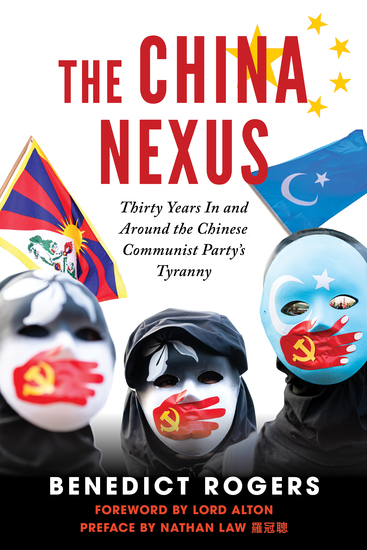
China Nexus - Thirty Years In and Around the Chinese Communist Party’s Tyranny - cover
LER

China Nexus - Thirty Years In and Around the Chinese Communist Party’s Tyranny

Benedict Rogers

Editora: Optimum Publishing International

  • 0
  • 0
  • 0

Sinopse

Benedict Rogers, born in London, England, first went to China at age eighteen to teach English for six months in Qingdao, three years after the Tiananmen Square massacre. That opened the door to a thirty-year adventure with China, from teaching English in schools and hospitals to working as a journalist in Hong Kong for the first five years after the handover to travelling to China’s borders with Myanmar/Burma and North Korea to document the plight of refugees escaping from Beijing-backed satellite dictatorships and then campaigning for human rights in China, especially for Uyghurs, Christians and Falun Gong practitioners, human rights defenders, journalists and dissidents, and the people of Hong Kong.
		 
This book tells the story of his fight for freedom for the peoples of China and neighbouring countries Myanmar and North Korea and sets out how a global movement for human rights in China is emerging and what the free world should do next. It describes the importance of the “China Nexus” in the author’s journey and geopolitics and its challenges. Pioneering international inquiries into forced organ harvesting from prisoners of conscience, the genocide of the Uyghurs and global action for Hong Kong, as well as highlighting the Vatican’s silence, the author has been at the heart of advocacy for human rights in China in recent years.
		 
In 2017, on the orders of Beijing, he was denied entry to Hong Kong, 20 years after he had moved to the city and began his working life as a journalist and activist. Benedict Rogers co-founded Hong Kong Watch and worked with a variety of other international groups at the forefront of the fight for freedom, including the Inter-Parliamentary Alliance for China (IPAC), the Stop Uyghur Genocide Campaign, the China Democracy Foundation, the Conservative Party Human Rights Commission which he co-founded, and the international human rights organization CSW with which he has worked for over 25 years.
		 
This book hits the Chinese Communist Party hard on their lack of Human Rights efficacy, genocide, and despicable and barbaric organ harvesting programs (an estimated $1 billion US a year business).
		 
Rogers takes the readers on a journey through some of the leaders and participants in the Human rights activities that China has suppressed since its inception in 1949. He goes on to dispute and lays to rest all of the specious claims by the tyrants in Beijing that all Chinese citizens are equal and are afforded human and civil rights. Currently, the regime is engaged in re-education, cultural assimilation, and multiple genocides, leading to better citizens for China and the world if one believes Chinese officials.
		 
China’s ambassador to Canada says reports of genocide and forced labour of Uyghur Muslims in Xinjiang province are the “lie of the century,” despite international bodies like the United Nations deeming the reports of such activities “numerous and credible.” The author will completely dispel that notion.
Disponível desde: 25/10/2022.
Comprimento de impressão: 320 páginas.
Outros livros que poderiam interessá-lo

  • University - A Reckoning - cover

    University - A Reckoning

    Lee C. Bollinger

    • 0
    • 0
    • 0
    The American university―one of the most successful institutions in human history―is facing an unprecedented assault from the president of the US. Experts on authoritarianism have drawn comparisons to other countries where strongmen subdued universities as part of their power grabs. Yet as former Columbia president Lee C. Bollinger points out in his account of the university's significance, in such dire times one has no choice but to state clearly and forcefully what one stands for. 
     
    Bollinger reveals how the structure of the university contributes to the success of the American system―because it provides those who study and work within it a degree of creative freedom hard to find elsewhere―and why that structure is both impossible to recreate and vulnerable to outside attack. The fundamental mission of the university is to enhance knowledge, but this is not merely a high-minded idea. It is, as Bollinger demonstrates, a notion rooted deeply in the Constitution, specifically the First Amendment, the basis of our political and social life. The university helps realize the First Amendment; the First Amendment helps make the university. Bollinger argues that, with the press diminished, the university remains the only source of truth-seeking for those who still believe in democracy. The university must be defended if the American experiment is to continue.
    Ver livro
  • The Capitalist and the Activist - Corporate Social Activism and the New Business of Change - cover

    The Capitalist and the Activist...

    Tom C. W. Lin

    • 0
    • 0
    • 0
    2023 Axiom Business Books Award Silver Medalist (Business Commentary) 
    2023 Nautilus Book Award Silver Medalist (Social Change & Social Justice) 
     
    This is the first in-depth examination of the important ongoing fusion of activism, capitalism, and social change masterfully told through a compelling narrative filled with vivid stories and striking studies. 
     
    Corporations and their executives are at the forefront of some of the most contentious and important social issues of our time. Through pronouncements, policies, boycotts, sponsorships, lobbying, and fundraising, corporations are actively engaged in issues like immigration reform, gun regulation, racial justice, gender equality, and religious freedom. 
     
    Despite corporate social activism being everywhere these days-witness how quickly companies and progressives united to oppose North Carolina's "bathroom bill" or support the Black Lives Matter movement-there has been no in-depth examination of the far-reaching consequences of this movement. What first principles should guide businesses' approaches? How should activists engage with businesses in a way that is most beneficial to their causes? What are potential pitfalls and risks associated with corporate social activism for activists, businesses, and society at large? Weaving studies and stories, Temple University professor of law, Tom C. W. Lin offers a road map for how we got here and a compass for where we are going as a nation of capitalists and activists seeking profit and progress.
    Ver livro
  • The Illusory Bargain - Liberty in the Aftermath of the 17th Amendment - cover

    The Illusory Bargain - Liberty...

    Ralph H. Lehman

    • 0
    • 0
    • 0
    Out-of-control debt. Populism. Political vitriol and corruption. Where did America go wrong? Or rather, when did America go wrong?
    
    1913. The Seventeenth Amendment is ratified, allowing the people of America to vote directly for their senators in the US senate. The same year, the Federal Reserve Act is passed, establishing a central bank to oversee monetary policy. In The Illusory Bargain, Ralph H. Lehman demonstrates that these seemingly empowering and people-serving pieces of legislature were just that-an illusion. Tracing the vision of the Founding Fathers as outlined in The Federalist Papers, Lehman reveals how the safety features of the original constitutional framework have eroded since and given way to rampant abuse of power and arbitrary, tyrannical law.
    
    Through fresh, historically informed insights and over twenty years of financial expertise, Lehman reexamines the nation's fundamental values and proposes what may be the only course of action left to restore our liberty.
    Ver livro
  • The Tragic Mind - Fear Fate and the Burden of Power - cover

    The Tragic Mind - Fear Fate and...

    Robert D. Kaplan

    • 0
    • 0
    • 0
    A moving meditation on recent geopolitical crises, viewed through the lens of ancient and modern tragedy 
     
    Some books emerge from a lifetime of hard-won knowledge. Robert D. Kaplan has learned, from a career spent reporting on wars, revolutions, and international politics in Europe, the Middle East, and East Asia, that the essence of geopolitics is tragedy. In The Tragic Mind, he employs the works of ancient Greek dramatists, Shakespeare, German philosophers, and the modern classics to explore the central subjects of international politics: order, disorder, rebellion, ambition, loyalty to family and state, violence, and the mistakes of power. The great dilemmas of international politics, he argues, are not posed by good versus evil—a clear and easy choice—but by contests of good versus good, where the choices are often searing, incompatible, and fraught with consequences. A deeply learned and deeply felt meditation on the importance of lived experience in conducting international relations, this is a book for everyone who wants a profound understanding of the tragic politics of our time.
    Ver livro
  • The Young Turks' Crime against Humanity - The Armenian Genocide and Ethnic Cleansing in the Ottoman Empire - cover

    The Young Turks' Crime against...

    Taner Akçam

    • 0
    • 0
    • 0
    An unprecedented look at secret documents showing the deliberate nature of the Armenian genocideIntroducing new evidence from more than 600 secret Ottoman documents, this book demonstrates in unprecedented detail that the Armenian Genocide and the expulsion of Greeks from the late Ottoman Empire resulted from an official effort to rid the empire of its Christian subjects. Presenting these previously inaccessible documents along with expert context and analysis, Taner Akçam's most authoritative work to date goes deep inside the bureaucratic machinery of Ottoman Turkey to show how a dying empire embraced genocide and ethnic cleansing.Although the deportation and killing of Armenians was internationally condemned in 1915 as a "crime against humanity and civilization," the Ottoman government initiated a policy of denial that is still maintained by the Turkish Republic. The case for Turkey's "official history" rests on documents from the Ottoman imperial archives, to which access has been heavily restricted until recently. It is this very source that Akçam now uses to overturn the official narrative.The documents presented here attest to a late-Ottoman policy of Turkification, the goal of which was no less than the radical demographic transformation of Anatolia. To that end, about one-third of Anatolia's 15 million people were displaced, deported, expelled, or massacred, destroying the ethno-religious diversity of an ancient cultural crossroads of East and West, and paving the way for the Turkish Republic.By uncovering the central roles played by demographic engineering and assimilation in the Armenian Genocide, this book will fundamentally change how this crime is understood and show that physical destruction is not the only aspect of the genocidal process.
    Ver livro
  • Populism - What Everyone Needs to Know - cover

    Populism - What Everyone Needs...

    Paul D. Kenny

    • 0
    • 0
    • 0
    Why do populists come to power? Are they a threat to democracy? Has the rise of global populism reached its peak, or is it just beginning? This book provides answers to these questions and many more, by summarizing in non-technical language the vast research literature on populism that extends across political science, economics, sociology, psychology, and history. Going well beyond the usual cases of Trump and Brexit, Paul D. Kenny provides evidence both of the recurrent global appeal of populism, and of its often deleterious consequences.Populism: What Everyone Needs to Know® advances a new approach to defining populism that helps to make sense of the most robust research findings to date, and that sets up an exciting and dynamic approach in research for the years to come. Populism is, at heart, a political movement that challenges the institutional status quo. The great paradox of populism is that while people are often justifiably resentful of a system they feel is rigged against them, their reliance on charismatic leaders to channel their frustrations usually harms rather than helps democracy.
    Ver livro