Join us on a literary world trip!
Add this book to bookshelf
Grey
Write a new comment Default profile 50px
Grey
Subscribe to read the full book or read the first pages for free!
All characters reduced
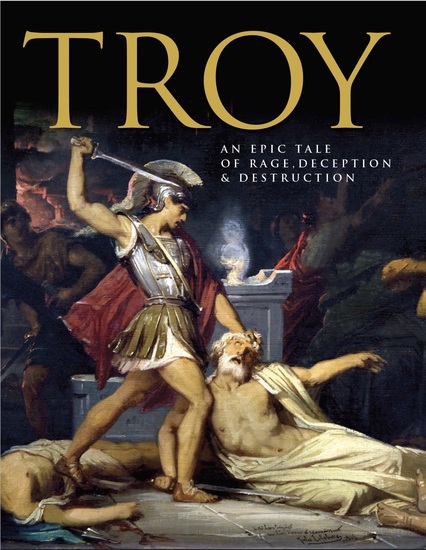
Troy - An Epic Tale of Rage Deception & Destruction - cover

Troy - An Epic Tale of Rage Deception & Destruction

Ben Hubbard

Publisher: Amber Books Ltd

  • 0
  • 0
  • 0

Summary

“Was this the face that launch’d a thousand ships/ And burnt the topless towers of Ilium?” – Christopher Marlowe, Doctor Faustus A story of gods and mortals, of such famous episodes as the Trojan Horse and Achilles mortally wounded in his heel, of warriors such as Odysseus and Hector, of beauties such as Helen, of leaders such as Agamemnon and Menelaus, the Trojan War is a classic story from the ancient world that never ceases to lose its appeal. But how well do we really know it? Do we remember Odysseus feigning madness to avoid the battle? Or Achilles, that great warrior, disguising himself as a woman so that he didn’t have to fight? Troy – An Epic Tale of Rage, Deception & Destruction tells the story of the Trojan War from its beginnings with the sparring of the gods to the love story between Paris and Helen to the war fleet, the siege, and on to the final battles and destruction of the city. From a conflict that’s set in motion by Helen – ‘the face that launched a thousand ships’ – it ends, ten years later, with Odysseus setting sail on what turns out to be his own ten- year voyage home. The book offers a fascinating history that provides a broader context for the war, examining the social and political background, the role of women in Greek society, and the weapons and style of warfare practiced. It also highlights where sources differ on aspects of the story. Illustrated with more than 180 colour and black-and-white artworks, photographs and maps, the book is an expertly written account and investigation of one of the classic stories of ancient mythology.
Available since: 12/19/2024.
Print length: 224 pages.

Other books that might interest you

  • Spare the Rod - Punishment and the Moral Community of Schools - cover

    Spare the Rod - Punishment and...

    Campbell F. Scribner, Bryan R....

    • 0
    • 0
    • 0
    Spare the Rod traces the history of discipline in schools and its ever-increasing integration with prison and policing, ultimately arguing for an approach to discipline that aligns with the moral community that schools could and should be. 
     
    In Spare the Rod, historian Campbell F. Scribner and philosopher Bryan R. Warnick investigate the history and philosophy of America’s punishment and discipline practices in schools. To delve into this controversial subject, they first ask questions of meaning. How have concepts of discipline and punishment in schools changed over time? What purposes are they supposed to serve? And what can they tell us about our assumptions about education? They then explore the justifications. Are public school educators ever justified in punishing or disciplining students? Are discipline and punishment necessary for students’ moral education, or do they fundamentally have no place in education at all? If some form of punishment is justified in schools, what ethical guidelines should be followed?  
     
    The authors argue that as schools have grown increasingly bureaucratic over the last century, formalizing disciplinary systems and shifting from physical punishments to forms of spatial or structural punishment such as in-school suspension, school discipline has not only come to resemble the operation of prisons or policing, but has grown increasingly integrated with those institutions. These changes and structures are responsible for the school-to-prison pipeline. They show that these shifts disregard the unique status of schools as spaces of moral growth and community oversight and are incompatible with the developmental environment of education. What we need, they argue, is an approach to discipline and punishment that fits with the sort of moral community that schools could and should be. 
    Show book
  • White Pine - The Natural and Human History of a Foundational American Tree - cover

    White Pine - The Natural and...

    John Pastor

    • 0
    • 0
    • 0
    America was built on white pine. From the 1600s through the Civil War and beyond, it was used to build the nation's ships and houses, barns, and bridges. Yet this popularity came at a cost: by the end of the nineteenth century, clear cutting had decimated much of America's white pine forests. In White Pine, ecologist and writer John Pastor takes listeners on walk through history, connecting the white pine forests that remain today to a legacy of destruction and renewal. 


    Since the clear-cutting era, naturalists, foresters, and scientists have taken up the quest to restore the great white pine forests. White Pine follows this centuries-long endeavor, illuminating how the efforts shaped Americans' understanding of key scientific ideas, from forest succession to the importance of fire. Pastor shows us why restoring the vitality of these forests has not been simple: a host of other creatures depend on white pine and white pine depends on them. In weaving together cultural and natural history, White Pine celebrates the way humans are connected to the forest—and to the larger natural world. 


    Today, white pine forests have begun to recover, but face the growing threat of climate change. White Pine shows us that hope for healthy forests lies in understanding the lessons of history, so that iconic species survives.
    Show book
  • Secrets to Transforming Education for All - "Unlock the secrets to transformative education for all with immersive audio lessons that inspire success!" - cover

    Secrets to Transforming...

    Caius Merrick

    • 0
    • 0
    • 0
    Secrets to Transforming Education for All 
    ⭐⭐ A Simplified Guide & Explanations Included ⭐⭐ 
    Are you eager to advance your career and solidify your knowledge by successfully navigating the Challenge Perspectives Exam 2025? 
    Looking for a comprehensive resource that encompasses everything you need to excel in the Challenge Perspectives Exam 2025? 
    Your quest ends here! 
    This guide is your ultimate companion for enriching your understanding, applying your skills, and engaging in practical exercises. With it, you're poised for success. 
    Updated for the Challenge Perspectives Exam 2025 Structure. 
    Key features of this enhanced guide: 
    - In-depth insights into the Challenge Perspectives Exam 2025 Certification 
    - Comprehensive explanations of transformative educational concepts 
    - Effective strategies for preparation and problem-solving 
    Our guide stands out through extensive coverage, crucial for your success. Concepts are not merely touched upon; they are thoroughly explored with precision.  
    Structured for clarity and simplicity, our Challenge Perspectives Exam Guide 2025 ensures seamless transitions between topics. Say goodbye to complex jargon and embrace clear, concise, and technically accurate content.  
    So, why delay? Click the BUY NOW button, secure your guide, and embark on your journey towards success in the Challenge Perspectives Exam 2025! 
    Unlock the secrets to transforming education for all and ignite change through profound understanding!
    Show book
  • Justice for Marcus Garvey - Look for Me in the Whirlwind - cover

    Justice for Marcus Garvey - Look...

    Ta-Nehisi COATES

    • 0
    • 0
    • 0
    Marcus Garvey (1887-1940) was a Black political activist, journalist, entrepreneur, and orator who founded the Universal Negro Improvement Association and African Communities League, which had a following of more than six million African descended people worldwide. Despite his massive popularity, this Jamaican born international leader was wrongfully sentenced to prison by the U.S. government on trumped-up mail-fraud charges. 


    While exoneration efforts began immediately and have continued since his sentencing, a new groundswell movement for Garvey's posthumous pardon is underway—led by his nonagenarian, still-spirited son, Julius Garvey. 


    Edited by Julius Garvey, Justice for Marcus Garvey is a collection of informative essays and personal narratives about the senior Garvey's life and work, demonstrating his essential influence on current social justice movements. The book features contributions from thought leaders and activists, including a foreword by bestselling author Ta-Nehisi Coates. Contributors include Paul Coates, founder/director of Black Classic Press; Goulda Downer, president of the Caribbean-American Political Action Committee; Justin Hansford, professor at Howard University School of Law; and Maulana Karenga, widely known as the creator of the holiday Kwanzaa.
    Show book
  • What It Is America - cover

    What It Is America

    Tyrus

    • 0
    • 0
    • 0
    “Tyrus has always been a Great Fighter, who will never let you down. This Book is fantastic—Enjoy!” —President Donald J. Trump 
     
    A vivid collection of trademark classic Tyrus stories, from his personal and professional life, that offer unfiltered insights into the heart of the nation while holding leaders accountable and celebrating the diverse experiences that define the American spirit. 
     
    In his third captivating collection of stories, What It Is, America, Tyrus invites readers to step into his world as he crisscrosses America and performs his sold-out one-man show. With his quintessential unfiltered and unapologetic style, Tyrus takes us on a tour of the essence of our nation, reflecting on the vibrant tapestry of connections he makes along the way. 
     
    Having met countless people from all walks of life, Tyrus offers readers a thorough glimpse into the heart of America, showcasing a variety of experiences that shape our country. Through his colorful storytelling and bare-knuckle approach to the issues, he continues to hold leaders accountable—no matter which side of the aisle they occupy. He flies the flag of common sense, fearlessly addressing topics that may ruffle feathers but are essential for meaningful dialogue. 
     
    Get ready for sharp wit and candid observations as Tyrus tackles current events, shares tales from his school of hard knocks, and navigates the complex landscape of American politics. Experience intimate behind-the-scenes moments, including a profound encounter with then presidential candidate Donald Trump at the Gutfeld! show, which highlights the unique relationships he forms on his journey. 
     
    In What It Is, America, Tyrus gets to the heart of the matter, reminding us why he is America’s favorite everyman. Prepare for a rollercoaster ride filled with humor, honesty, and the real pulse of the country today. 
    Read less
    Show book
  • The Battle of Britain - How the RAF Defended the Skies and Changed the Course of the War - cover

    The Battle of Britain - How the...

    Sage Winters

    • 0
    • 0
    • 0
     The Battle of Britain was not an isolated event. It was the culmination of a series of escalating tensions, military buildups, and ideological confrontations that had been brewing for years. By 1939, Europe was on the brink of war. The world watched as Adolf Hitler's ambitions for territorial expansion grew, and the Nazi regime began implementing its aggressive policies across Europe. 
      
    The rise of Nazi Germany under Hitler was a response to the humiliation the country had suffered after World War I. With the Treaty of Versailles in 1919, Germany was burdened with harsh reparations, which led to economic instability and social unrest. In this environment, Hitler’s National Socialist party capitalized on the public’s desire for national renewal. He began rearming Germany in the early 1930s, violating the treaty’s restrictions and asserting military strength across Europe. 
      
    By the mid-1930s, Britain and France found themselves at odds with Germany’s expanding influence. In 1938, Hitler annexed Austria and then demanded control over Czechoslovakia’s Sudetenland. When the Munich Agreement failed to halt his expansionist ambitions, Britain began to realize that appeasement would not work. The threat of war was no longer theoretical; it was imminent.
    Show book