Rejoignez-nous pour un voyage dans le monde des livres!
Ajouter ce livre à l'électronique
Grey
Ecrivez un nouveau commentaire Default profile 50px
Grey
Abonnez-vous pour lire le livre complet ou lisez les premières pages gratuitement!
All characters reduced
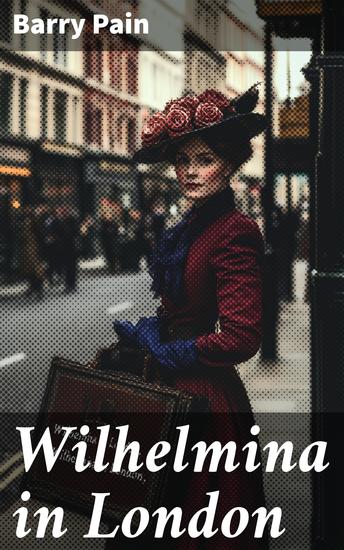
Wilhelmina in London - cover

Wilhelmina in London

Barry Pain

Maison d'édition: Good Press

  • 0
  • 0
  • 0

Synopsis

In "Wilhelmina in London," Barry Pain crafts a nuanced narrative that deftly intertwines humor and social commentary within the backdrop of early 20th-century England. The story follows the titular character, Wilhelmina, as she navigates the complexities of urban life in London, portraying the city's vibrant yet challenging atmosphere with rich, engaging prose. Through Pain's deft depiction of societal norms and individual aspirations, the book reflects the broader literary context of the time—where themes of modernity and personal agency were increasingly explored, as well as the intersection of gender and class dynamics. Barry Pain, an English author known for his sharp wit and insightful observations, drew upon his experiences living in London and his keen understanding of human nature to create this work. His background in literature and familiarity with the changing societal landscape during the late Victorian and Edwardian eras inform his portrayal of Wilhelmina's struggles and triumphs, making her both relatable and emblematic of contemporary women's experiences. "Wilhelmina in London" is a must-read for those interested in character-driven narratives that combine humor with incisive social critique. Pain's writing resonates with both modern and historical relevance, ensuring that readers will find themselves both entertained and provoked to reflect on the intricacies of urban life and gender roles.
Disponible depuis: 02/03/2025.
Longueur d'impression: 150 pages.

D'autres livres qui pourraient vous intéresser

  • The Oval Portrait - cover

    The Oval Portrait

    SAMPI Books, Edgar Allan Poe

    • 0
    • 0
    • 0
    Edgar Allan Poe's "The Oval Portrait" recounts the obsession of a painter who captures his wife's vitality in a portrait, consuming her life in the process. The narrative unfolds through the observation of a wounded man who discovers the tragic story behind the painting in an abandoned castle.
    Voir livre
  • The Cloak - cover

    The Cloak

    Nikolai Gogol

    • 0
    • 0
    • 0
    "The Cloak" (sometimes translated as "Overcoat") is a short story by Russian author Nikolai Gogol, published in 1842. The story and its author have had great influence on Russian literature, as expressed in a quote attributed to Fyodor Dostoyevsky: "We all come out from Gogol's 'Overcoat'." The story narrates the life and death of titular councillor Akaky Akakievich Bashmachkin, an impoverished government clerk and copyist in the Russian capital of St. Petersburg. Akaky is dedicated to his job, though little recognized in his department for his hard work. Instead, the younger clerks tease him and attempt to distract him whenever they can. His threadbare overcoat is often the butt of their jokes. Akaky decides it is necessary to have the coat repaired, so he takes it to his tailor, Petrovich, who declares the coat irreparable, telling Akaky he must buy a new overcoat.
    The cost of a new overcoat is beyond Akaky's meager salary, so he forces himself to live within a strict budget to save sufficient money to buy the new overcoat. Meanwhile, he and Petrovich frequently meet to discuss the style of the new coat. During that time, Akaky's zeal for copying is replaced with excitement about his new overcoat, to the point that he thinks of little else. Finally, with the addition of an unexpectedly large holiday salary bonus, Akaky has saved enough money to buy a new overcoat.
    Voir livre
  • Dark Dignum - From their pens to your ears genius in every story - cover

    Dark Dignum - From their pens to...

    Bernard Capes

    • 0
    • 0
    • 0
    Bernard Edward Joseph Capes was born on the 30th August 1854 in London.  He was one of 11 children. 
    His early work was as a journalist and this developed into writing many short stories for the periodicals of the time including Blackwood's, Cassell's, Cornhill Magazine, Illustrated London News, Macmillan's Magazine, Mall Magazine, Pearson's Magazine, The Idler, and The Queen. 
    It took him many years to decide that writing full-time could be a sustainable career path.  His initial success came with ‘The Mill of Silence’.  As well as being published it garnered second prize at a competition sponsored by the Chicago Record.  He exceeded that by winning it the following year with ‘The Lake of Wine’.   
    Capes quickly became both prolific and popular.  As well as his stories and articles for the periodicals he wrote around 40 volumes across novels, poetry, history as well as romance and mystery novels. 
    Bernard Capes died on 2nd November 1918 in the flu epidemic.
    Voir livre
  • Twenty Years After Volume 3 - cover

    Twenty Years After Volume 3

    Alexandre Dumas

    • 0
    • 0
    • 0
    In "Twenty Years After Volume 3" by Alexandre Dumas, the legendary Musketeers reunite to navigate the perilous currents of political chaos and strife. As France stands divided between royalists and revolutionaries, d'Artagnan, Athos, Porthos, and Aramis face their fiercest trials yet. Amid conspiracies and shifting alliances, their courage and loyalty are tested in daring exploits. Dumas crafts a riveting narrative where old friendships rekindle amidst turmoil and adventure.
    Voir livre
  • Freckles - From their pens to your ears genius in every story - cover

    Freckles - From their pens to...

    William Pett Ridge

    • 0
    • 0
    • 0
    William Pett Ridge was born at Chartham, near Canterbury, Kent, on 22nd April 1859. 
    His family’s resources were certainly limited. His father was a railway porter, and the young Pett Ridge, after schooling in Marden, Kent became a clerk in a railway clearing-house. The hours were long and arduous, but self-improvement was Pett Ridge’s goal.  After working from nine until seven o’clock he would attend evening classes at Birkbeck Literary and Scientific Institute and then to follow his passion; the ambition to write.  He was heavily influenced by Dickens and several critics thought he had the capability to be his successor. 
    From 1891 many of his humourous sketches were published in the St James's Gazette, the Idler, Windsor Magazine and other literary periodicals of the day. 
    Pett Ridge published his first novel in 1895, A Clever Wife. By the advent of his fifth novel, Mord Em'ly, a mere three years later in 1898, his success was obvious.  His writing was written from the perspective of those born with no privilege and relied on his great talent to find humour and sympathy in his portrayal of working class life. 
    Today Pett Ridge and other East End novelists including Arthur Nevinson, Arthur Morrison and Edwin Pugh are being grouped together as the Cockney Novelists.   
    In 1924, Pugh set out his recollections of Pett Ridge from the 1890s: “I see him most clearly, as he was in those days, through a blue haze of tobacco smoke. We used sometimes to travel together from Waterloo to Worcester Park on our way to spend a Saturday afternoon and evening with H. G. Wells. Pett Ridge does not know it, but it was through watching him fill his pipe, as he sat opposite me in a stuffy little railway compartment, that I completed my own education as a smoker... Pett Ridge had a small, dark, rather spiky moustache in those days, and thick, dark, sleek hair which is perhaps not quite so thick or dark, though hardly less sleek nowadays than it was then”. 
    With his success, on the back of his prolific output and commercial success, Pett Ridge gave generously of both time and money to charity. In 1907 he founded the Babies Home at Hoxton.  This was one of several organisations that he supported that had the welfare of children as their mission.  
    His circle considered Pett Ridge to be one of life's natural bachelors. In 1909 they were rather surprised therefore when he married Olga Hentschel.  
    As the 1920’s arrived Pett Ridge added to his popularity with the movies. Four of his books were adapted into films.  
    Pett Ridge now found the peak of his fame had passed. Although he still managed to produce a book a year he was falling out of fashion and favour with the reading public and his popularity declined rapidly.  His canon runs to over sixty novels and short-story collections as well as many pieces for magazines and periodicals. 
    William Pett Ridge died, on 29th September 1930, at his home, Ampthill, Willow Grove, Chislehurst, at the age of 71. 
    He was cremated at West Norwood on 2nd October 1930.
    Voir livre
  • The Taming of the Shrew - cover

    The Taming of the Shrew

    William Shakespeare

    • 0
    • 1
    • 0
    Shakespeare’s controversial comedy about a man’s quest to break the will of his headstrong wife.Whether this tale is motivated by misogyny, or is simply a satirical critique of men’s treatment of women is a matter up for much debate. Regardless of its potentially polarizing intentions, The Taming of the Shrew is one of William Shakespeare’s most intriguing comedies. Framed as a play within a play, it tells the story of the assertive Katherina’s marriage to Petruchio, who resorts to all sorts of psychological abuse in order to force her to be a traditional obedient wife. The inspiration for the Broadway play Kiss Me, Kate, The Taming of the Shrew is a fascinating glimpse into the sexual politics of the Elizabethan era.
    Voir livre