Join us on a literary world trip!
Add this book to bookshelf
Grey
Write a new comment Default profile 50px
Grey
Subscribe to read the full book or read the first pages for free!
All characters reduced
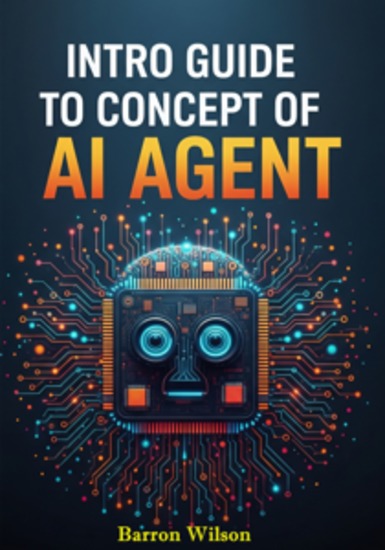
Intro Guide To Concept of Ai Agent - cover

Intro Guide To Concept of Ai Agent

Barron Wilson

Publisher: Publisher s21598

  • 0
  • 0
  • 0

Summary

So you want to know what AI agents are all about? Great! Think of this as your friendly, easy-to-digest intro to one of the most exciting trends in tech today — no jargon, no complicated theories, just simple ideas and real-world examples.An AI Agent isn’t just a chatbot or a bot that follows strict rules. It’s more like a smart assistant that can understand your goals, make plans, use tools, and even adapt when things don’t go as expected. Imagine telling an AI: “Find me the best flight to London next week,” and it actually figures out how to do that using different websites, compares prices, checks for availability, and books it — all on its own. That’s the power of an AI agent.This guide breaks everything down into bite-sized pieces so anyone can understand. You’ll learn:What makes an AI agent different from regular botsHow they work behind the scenes — think of them having a brain (powered by large language models), a toolkit (like APIs, apps, databases), memory, and a rulebook (your instructions).Real-life examples , like AI assistants handling customer service or helping coders debug software.How to start experimenting with automation using visual tools like n8n, Zapier, or Make — no coding required!Important safety tips — because building smart systems also means thinking about ethics, privacy, and responsibility.One of the coolest parts is seeing how multiple AI agents can work together like a team. Just like humans divide up tasks, AI agents can split up complex problems, help each other out, and get things done faster and smarter.The guide also gives you a peek into the future — where you can start building your own AI agents using development kits from big companies like Google. But here’s the key advice: start simple . Don’t jump into complex systems unless you really need to. Often, a clear instruction or a basic workflow is all you need.And if you're inspired and want to go further, the book recommends diving into "AI Agents Made Easy" — a hands-on guide to building your own digital helpers using no-code tools.In short, this pocket guide is perfect for beginners who want to understand AI agents, see how they can change the way we work, and take the first step toward building their own. Whether you're a business owner, student, or just plain curious, this is your doorway into the future of AI — and it's already here.
Available since: 06/06/2025.

Other books that might interest you

  • Earwitness - A Search for Sonic Understanding in Stories - cover

    Earwitness - A Search for Sonic...

    Ed Garland

    • 0
    • 0
    • 0
    In his twenties, Ed Garland came close to suicide but later discovered reading to help him cope with hearing loss and tinnitus. In this unique blend of memoir and literary criticism, right at the cutting edge of research drawing on both the literary and the medical worlds, the author reveals his own journey – through music then fiction – towards an understanding of sonic loss and, ultimately, towards healing. A genre-busting mix of literary criticism, sound studies and memoir, the essays explore what fictional sonic experiences can tell us about sound in everyday life. Written with humorous honesty about the ups and downs – mostly downs – of a young man's mental health, this is a thoughtful and original exploration of recovey, and of literature's ability to challenge preconceptions.
    The English-language fiction classics of Wales explored include the work of Margiad Evans, Bernice Rubens, and Deborah Kay Davies. The international titles are by Annie Proulx and Samuel Beckett. Earwitness amplifies the rich connections between literature, auditory perception and mental wellbeing.
    Show book
  • Not How It Was Supposed to Be - Seasons of Loss and Shadows of Grace in the Journey with Lewy Body Dementia - cover

    Not How It Was Supposed to Be -...

    Allison Crabtree

    • 0
    • 0
    • 0
    The world wasn't ready for Gloria Saylor.But God was.The day beautiful green-eyed Gloria came into the world a storm was brewing both off the Texas coast and in her dysfunctional home. Brilliant and more than a tad rebellious, Gloria eventually found her dreams of education and independence would never be realized. The solution? Build a wall of emotional isolation, remaining aloof even from her only child.In Not How It Was Supposed to Be, author Allison Crabtree takes a poignant look at her mom's obsessive and eccentric life, and the complexities of a mother-daughter relationship fraught with tension and disappointment.After a rapid decline and eventual diagnosis of Lewy body dementia, Gloria did not get to write the final chapter of her story. But, true to form, she wrote the final paragraph. In the throes of the disease's final horrors, Allison describes one last attempt to convince her mother to call on Jesus. Would she turn to him after a lifetime of feeling too far gone for redemption? And, more importantly, would the Savior show up to answer the call?
    Show book
  • Ending Human Trafficking - A Handbook of Strategies for the Church Today - cover

    Ending Human Trafficking - A...

    Shayne Moore, Sandra Morgan,...

    • 0
    • 0
    • 0
    Author Sandra Morgan awarded Wilberforce Award
    Human trafficking is one of the most pressing social justice issues of our time, and in recent years there has been renewed interest among Christians, as many have been stirred up to take their part in the ongoing battle.
    This is a wonderful thing—and yet misinformed and misguided efforts can do more harm than good. Ending Human Trafficking is a handbook designed to educate churches and parachurch organizations for truly effective work.
    In collaboration with The Global Center for Women and Justice at Vanguard University, Ending Human Trafficking is an accessible and compelling resource for Christian leaders, written by seasoned leaders in the struggle against modern slavery. Grounded in a theological response to the issue and filled with stories, up-to-date data, and practical tools and tips, it promises to be an invaluable resource for years to come.
    Show book
  • Malört - The Redemption of a Revered and Reviled Spirit - cover

    Malört - The Redemption of a...

    Josh Noel

    • 0
    • 0
    • 0
    Malört may be the worst thing you'll ever taste. 


    Known primarily for its intense bitterness, the infamous Chicago liqueur has been compared to "a forest fire, if the forest was made of earwax." Yet lurking in the horror and the mockery lies the truth of Malört: we keep going back for more. For nearly a hundred years, we've gone back. 


    Jeppson's Malört could have died a hundred deaths in that time. Its survival wasn't always a given. There were cultural shifts and fortunate timing that helped transform a drink rooted in centuries-old Swedish tradition into the American sensation it is today. 


    Malört is a story of love, relationships, and how one generation finds meaning where generations before did not. 


    Author and beer expert Josh Noel unpacks a uniquely American tale, equal parts culture, business, and personal relationships—involving secret love, federal prison, a David vs. Goliath court battle, and the 2018 sale of Jeppson's Malört, which made Pat Gabelick, a seventy-five-year-old Chicago woman who spent much of her life as a legal secretary, into an unlikely millionaire. 


    Malört isn't just the story of one brazen liquor—it is the story of modern tastes and cultural shifts.
    Show book
  • Visual Friendlies Tally Target - How Close Air Support in the War on Terror Changed the Way America Made War: Volume II: Surges - cover

    Visual Friendlies Tally Target -...

    Ethan Brown

    • 0
    • 0
    • 0
    Visual Friendlies, Tally Target: Surges continues the story of the role of forward air controllers (JTACs) and Close Air Support (CAS), picking up in 2006 and continuing through 2013. This volume covers the evolution of Joint Fires through the colloquial "second phase" of the War on Terror—the "surges" of Iraq in 2007 and Afghanistan in 2010–2011. Vol. II recounts the evolution of air power during the rising counterinsurgencies, as well as the psychology and mental makeup of these exclusive tribes. Notable accounts include the recovery mission of EXTORTION17, the first withdrawal from Iraq, previously unreported missions against insurgent strongholds, and instances where the situational awareness and decision-making of forward air controllers prevented civilian casualties and fratricide. 


    The story carries with it a continuation of the strategic lessons learned from America's longest war: where tactical successes and innovation failed to achieve a strategic outcome amidst ambiguous grand strategy, flawed policy and a failure to understand the new battlefields of the twenty-first century, as recounted by the men whose air power tribes went into the breach again and again. Volume II concludes as the "War on Terror" nominally ended in 2013, as the final phase of the post-9/11 wars transitioned to the "Train, Advise, and Assist" missions in Iraq and Afghanistan.
    Show book
  • The Anglo-Saxons at War - 800-1066 - cover

    The Anglo-Saxons at War - 800-1066

    Paul Hill

    • 0
    • 0
    • 0
    In this compelling new study, Paull Hill reveals what documentary records and the growing body of archaeological evidence can tell us about war and combat in the age of the great Anglo-Saxon kings. The violent centuries before the Norman Conquest come to life in this detailed account of how and why the Anglo-Saxons fought, how their warriors were armed and trained, how their armies were organized, and much more. 


    The role of combat in Anglo-Saxon society is explored, from the parts played by the king and the noblemen to the means by which the men of the fyrd were summoned to fight in times of danger. Land and naval warfare are both explored in depth. Hill also covers the politics and diplomacy of warfare, the conduct of negotiations, the taking of hostages, the use of treachery, and the controversial subject of the use of cavalry. 


    The weapons and armor of the Anglo-Saxons are described, including the spears, scramsaxes, axes, bows, swords, helmets, shields, and mail that were employed in the close-quarter fighting of the day. Drawing on this wealth of information, Hill presents a vivid recreation of the actual experience of fighting in the campaigns against the Danes; the battles of Ashdown, Maldon and Stamford Bridge; and the sieges at Reading and Rochester.
    Show book