¡Acompáñanos a viajar por el mundo de los libros!
Añadir este libro a la estantería
Grey
Escribe un nuevo comentario Default profile 50px
Grey
Suscríbete para leer el libro completo o lee las primeras páginas gratis.
All characters reduced
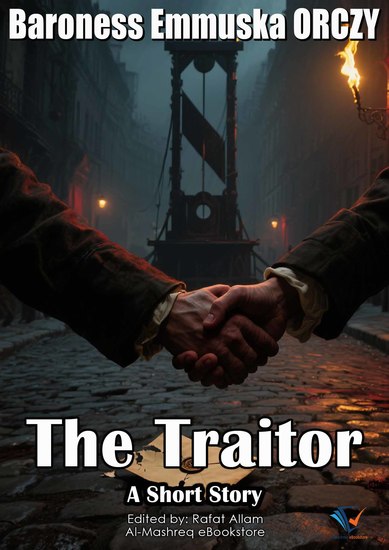
The Traitor - A Short Story - cover

The Traitor - A Short Story

Baroness Emmuska Orczy

Editorial: Al-Mashreq eBookstore

  • 0
  • 0
  • 0

Sinopsis

The Traitor is a gripping early tale by Baroness Orczy that foreshadows the suspense and intrigue of her later works. Set in the perilous days of Revolutionary France, the story explores the thin line between loyalty and betrayal, where a single act of treachery can condemn friends, lovers, or family to the guillotine. With her flair for atmosphere and tension, Orczy paints a portrait of desperate choices in a world ruled by suspicion and fear. Short yet powerful, The Traitor delivers an emotional punch, reminding readers that courage and betrayal often walk hand in hand in times of upheaval.
Disponible desde: 01/09/2025.
Longitud de impresión: 32 páginas.
Otros libros que te pueden interesar

  • Her Turn - From their pens to your ears genius in every story - cover

    Her Turn - From their pens to...

    D H Lawrence

    • 0
    • 0
    • 0
    David Herbert Lawrence was born on the 11th September 1885 in Eastwood, Nottinghamshire, a coal mining town where the reality of a harsh life was only useful as experiences for future literary works. 
    He was educated at Beauvale Board School and became the first local boy to receive a scholarship to attend Nottingham High School. After 3 years he became a junior clerk in Haywood’s surgical appliances factory. He was also attempting a literary career which, in the short term, led to a teacher training position in Eastwood and later a teaching qualification from University College, Nottingham.  
    Lawrence’s first efforts were poems, short stories and a draft of ‘The White Peacock’. Moving to London and a teaching position in Croydon his writing attracted the attention of Ford Madox Ford, editor of The English Review, and he commissioned him to write ‘Odour of Chrysanthemums’.  
    Wanting to write full-time he now began work on what would become ‘Sons and Lovers.   
    In 1912 he met the older and married mother-of-three Frieda Weekley. They eloped to Germany and here Lawrence could see for himself the growing tensions with France.  So keen was his interest that he was arrested and accused of being a British spy.  
    In early 1914 Frieda obtained her divorce and they returned to Britain to be married just days before the outbreak of war. Owing to her German parentage, and his own public dislike of militarism and violence, the couple were treated with contempt and suspicion throughout the war years.  
    Despite this he continued to write but his reputation in England was so tarnished and, mirrored by his own disdain for the country, he and Frieda left England in November 1919, first for Europe and then America via Ceylon and Australia. 
    They bought a ranch in Taos, New Mexico and visited Mexico several times. The third visit in March 1925 caused a near fatal attack of malaria. To convalesce they moved to Florence. Here he continued work on ‘Lady Chatterley’s Lover’ which for many years would cause controversy. A renewed interest in oil painting resulted in an exhibition in 1929 which was raided by the police and several works were confiscated.  
    D H Lawrence died of complications arising from a bout of tuberculosis on the 2nd of March 1930 in Vence, France.  He was 44.
    Ver libro
  • The Summerland Stories - Magical love stories when the Fae cross into our world - cover

    The Summerland Stories - Magical...

    Lisa Kessler

    • 0
    • 0
    • 0
    Step across the veil where magic meets mankind... 
    Across the Veil - Princess Talia from Summerland has been hiding in the human world as actress, Natalie Thurmont, but her new life is shattered when the past comes knocking at her door. 
    Forbidden Hearts - Princess Kathryn crosses the veil for one last adventure before her life is sacrificed to save her people, but a human kindles forbidden desires in her heart, and vows to change her fate. 
    A Winter's Wish - Abriette is a warrior elf, searching for the Wisher's blood to save the Winter Realm. Instead she finds a mall Santa and a love that could cost her everything.
    Ver libro
  • Her Lover - From their pens to your ears genius in every story - cover

    Her Lover - From their pens to...

    Maxim Gorky

    • 0
    • 0
    • 0
    Alexei Maximovich Peshkov was born on 28th March 1868, in Nizhny Novgorod, Russia. 
    Better known as Maxim Gorky he was orphaned at 11 and ran away from home at 12.  At 19 he had already attempted suicide and thereafter travelled, by foot, across the Russian Empire for 5 years. 
    His first book ‘Essays & Stories’ in 1898 was a sensation and so began a long career as an author of short stories, novels and plays.  Gorky saw writing as a moral and political act that would help to change the unjust world around him.  He was an ardent early advocate of the emerging Marxist movement and publicly opposed the Tsarist regime leading several times to his arrest.  
    In 1904 he began his own theatre but the censor banned every play and Gorky was forced to abandon the project. 
    But Gorky was a financially successful author, editor, and playwright and gave monies to political parties as well as for civil rights and social reform.  The brutal shooting of workers, which set in motion the Revolution of 1905, pushed Gorky more decisively toward radical solutions.  
    In 1906 he went to the United States to raise funds for the Bolsheviks. Those experiences including a scandal over travelling with his lover and not his wife deepened his contempt for the ‘bourgeois soul.’ 
    Gorky now moved to Capri in Italy, both for health reasons and to escape the increasingly repressive times in Russia.  
    An amnesty for the 300th anniversary of the Romanov dynasty saw him return to Russia in 1914. His politics remained close to the Bolshevik cause.  But soon, after the 1918 revolution, his essays referred to Lenin as a tyrant for his senseless arrests and repression.  He was soon appealing to the outside world for food aid after the catastrophic crop failure. 
    In October 1921 Gorky returned to Italy, now in Fascist hands, and settled in Sorrento until 1932.  His health worsened with the onset of tuberculosis. 
    He wrote several successful books there but now decided to find an understanding with the communist regime. Stalin invited him home and his return was hailed as a major propaganda victory.  He was decorated with the Order of Lenin, and a province, a park, and various streets re-named in his honour. 
    But he had his faults too.  In 1933, Gorky co-edited a book on the White Sea-Baltic Canal and denied even a single prisoner died during its construction, but thousands had. As well, knowing that some Nazis were homosexual, a phrase was attributed to him that said ‘exterminate all homosexuals and fascism will vanish’.  Although he was himself was quoting another he was decidedly homophobic. 
    With the increase of Stalinist repression in 1935 Gorky was placed under unannounced house arrest. 
    Maxim Gorky died on the 18th June 1936 from pneumonia.  He was 68. 
    Stalin and Molotov were among those who carried Gorky's urn of ashes at his funeral.
    Ver libro
  • Frigid Relations - A Powers Masks and Capes Short Story - cover

    Frigid Relations - A Powers...

    Tao Wong

    • 0
    • 0
    • 0
    Yukon Quest Saved by Local Hero!  
    Meet the local hero and Power that saved the internationally renowned annual sled dog race, hear his thoughts on the event and what living in Dawson City year round is like. Read about his remarkable story, the process of freezing the Yukon river and future plans.  
    Article submitted by local correspondent Kelly Loval.  
    Written by bestselling author of the post-apocalyptic LitRPG, the System Apocalypse, and xianxia, A Thousand Li , Tao Wong.
    Ver libro
  • Thomas Hardy - Chapter & Verse - Poetry and prose together from literary greats - cover

    Thomas Hardy - Chapter & Verse -...

    Thomas Hardy

    • 0
    • 0
    • 0
    Literature is a world of words and wonder, able to take us on almost unimaginable journeys from the wild and fantastic to the grind and minutiae of life. 
     
    An author’s ideas are his building blocks, his architecture of the mind, building a structure on which all else will rest; the narrative, the characters, the words - those few words that begin the adventure. 
     
    In this series we look at some of our leading classic authors across two genres: the short story and the poem.  In this modern world there is an insatiable need to categorise and pigeon-hole everyone and everything.  But ideas, these grains and saplings of the brain, need to roam, to explore and find their perfect literary use vehicle.  Our authors are masters of many literary forms, perhaps known for one but themselves favouring another. 
     
    Story. Poems. Story.  Within these boundaries come all manner of invention and cast of characters.  And, of course, each author has their own way of revealing their own chapter and verse.    
     
    1 - Chapter & Verse - Thomas Hardy - An Introduction 
    2 - An Imaginative Woman by Thomas Hardy 
    3 - A Broken Appointment by Thomas Hardy 
    4 - The Mother Mourns by Thomas Hardy 
    5 - Rain on a Grave by Thomas Hardy 
    6 - The Dead Man Walking by Thomas Hardy 
    7 - Rome - Building a New Street in the Ancient Quarter, April 1887 by Thomas Hardy 
    8 - At the Royal Academy by Thomas Hardy 
    9 - In the Moonlight by Thomas Hardy 
    10 - The Seasons of Her Year  by Thomas Hardy 
    11 - Birds at Winter Nightfall (Triolet) by Thomas Hardy 
    12 - The Darkling Thrush by Thomas Hardy 
    13 - The Calf by Thomas Hardy 
    14 - The Oxen by Thomas Hardy 
    15 - The Fiddler of the Reels by Thomas Hardy
    Ver libro
  • Dhoya - From their pens to your ears genius in every story - cover

    Dhoya - From their pens to your...

    W B Yeats

    • 0
    • 0
    • 0
    William Butler Yeats was born in Sandymount in County Dublin, Ireland on 13th June 1865. 
    His early years moved between Ireland and England. By his mid-teens he was writing but those works were described as ‘entirely Un-Irish’.  With Ernest Rhys he founded the Rhymers Club. Based at Ye Olde Cheshire Cheese in Fleet Street it’s best described as a drinking club for performing poets.  Yeats later cited them as ‘The Tragic Generation’.  By now Yeats was writing and publishing poetry and stories that were profoundly based in Irish folklore.   
    Yeats is perhaps best described as Ireland’s national poet in addition to being one of the major twentieth-century literary figures of the English tongue. He represents the ‘Romantic poet of modernism,’ with an extraordinary style created from the outward emphasis on the expression of emotions and the extensive use of symbolism, imagery and allusions.  
    In 1923 his fame was brought to an even wider audience when he received the Nobel Prize in Literature.  
    His personal life was driven by his many relationships in love and by his great interest in oriental mysticism and occultism.  Yeats also wrote prose and drama and, as an ardent Nationalist, established himself as a spokesman of the Irish cause and served as an Irish senator for two terms.  
    W B Yeats died at the Hôtel Idéal Séjour, in Menton, France, on 28th January 1939.  He was 73.
    Ver libro