Junte-se a nós em uma viagem ao mundo dos livros!
Adicionar este livro à prateleira
Grey
Deixe um novo comentário Default profile 50px
Grey
Assine para ler o livro completo ou leia as primeiras páginas de graça!
All characters reduced
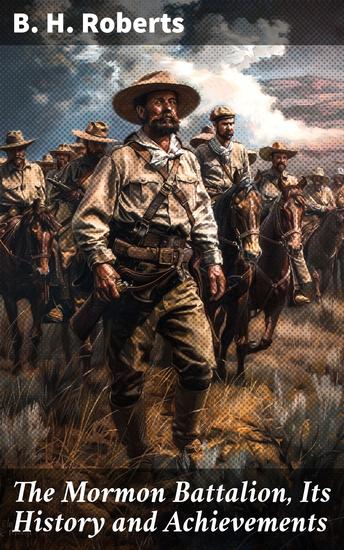
The Mormon Battalion Its History and Achievements - A Unique Military Unit: The Brave Journey of Mormon Pioneers in the Mexican-American War - cover
LER

The Mormon Battalion Its History and Achievements - A Unique Military Unit: The Brave Journey of Mormon Pioneers in the Mexican-American War

B. H. Roberts

Editora: Good Press

  • 0
  • 0
  • 0

Sinopse

In "The Mormon Battalion, Its History and Achievements," B. H. Roberts constructs a vivid historical narrative that chronicles the remarkable journey of the Mormon Battalion during the Mexican-American War. Through a meticulous blend of archival research and personal accounts, Roberts employs a compelling literary style that is both informative and engaging, weaving together the themes of faith, sacrifice, and perseverance. This work not only documents the battalion's contributions to American history but also contextualizes their experiences within the broader tapestry of 19th-century American society, illuminating the complexities faced by this unique group of pioneers. B. H. Roberts was a noted historian, scholar, and leader in the early 20th-century Mormon community. Raised in a culture steeped in the legacy of the Mormon pioneers, his firsthand knowledge and passion for the history of the Latter-day Saints profoundly influenced his writing. Roberts's extensive involvement in Church history and his role as a member of the Quorum of the Seventy provided him with unique insights into the motivations and experiences of the Mormon Battalion. I recommend this book to readers interested in American history, military studies, or the intricate narratives of faith-based communities. Roberts's work is not only a valuable historical account but also a profound exploration of the human spirit, making it essential reading for anyone seeking to understand the multifaceted nature of pioneer life.
Disponível desde: 18/09/2023.
Comprimento de impressão: 73 páginas.

Outros livros que poderiam interessá-lo

  • Chinese Civil War - Nationalists vs Communists and the Birth of Modern China (1927–1950) - cover

    Chinese Civil War - Nationalists...

    Daniel Wrinn

    • 0
    • 0
    • 0
    The Chinese Civil War was a decades-long battle between the Nationalists and Communists that not only reshaped China but also sent shockwaves across the world. 
    In this compelling audiobook, you'll be guided through the war’s pivotal early battles, the devastating impact of the Japanese invasion during World War II, and the final confrontation that forced Chiang Kai-shek to retreat to Taiwan. Through concise yet thorough narration, you'll explore the ideologies, strategies, and global consequences of this monumental conflict, which became a defining moment in Cold War history. 
    In this audiobook, you will discover:The political and social upheaval that led to the fall of the Qing Dynasty.The rise of the Kuomintang and the Chinese Communist Party.The Long March and Mao Zedong’s rise to power.The impact of foreign intervention from Japan, the Soviet Union, and the United States.The decisive battles and the founding of the People’s Republic of China.The enduring impact on global politics, particularly the tension between China and Taiwan. 
    Whether you're a history enthusiast or curious about the complex forces that shaped modern China, this audiobook provides an insightful journey through a conflict that continues to shape global relations today.
    Ver livro
  • Beat the Bots - A Writer's Guide to Surviving and Thriving in the Age of AI - cover

    Beat the Bots - A Writer's Guide...

    Jane K. Cleland

    • 0
    • 0
    • 0
    Beat the Bots offers science-based creativity techniques that guide you through the writing process to unlock your imagination and create compelling stories that resonate with emotional truth in ways AI can’t match. 
      
    Even though artificial intelligence is based on a technology called “machine learning,” computers can’t learn to be creative—but you can. This book will show you the way. AI is, by definition, derivative, not creative. It can’t bring rational judgment to determine the quality or value of its work. When you bring those capabilities to your writing, your stories will touch readers’ hearts and minds. 
      
    Just as real food is better for us than processed food, and actual social interactions are more meaningful than social media, when it comes to writing your story, artificial intelligence can’t replicate your individual human intelligence, imagination, and sensibility. Technical wizardry can’t tell your story. Only you can do that. Your uniqueness is what separates you from a chatbot, and explains why you can’t be replaced by an algorithm. You’ll succeed because you’re human, not in spite of it. 
      
    Through engaging FAQs, invaluable “Pro Tips,” and “AI Weighs In” revelations, you’ll be able to apply the writing lessons and creativity tactics to all aspects of storytelling, bringing your distinctive vision and voice to your projects in ways AI simply can’t. Thought-provoking, science-based guided exercises challenge you to apply each chapter’s lessons to your own writing. Whether you’re writing a novel, literary nonfiction, or a memoir, you’ll be able to write stories that are fresh and compelling—your stories—and those are the books that publishers want and readers crave. That’s how you’ll beat the bots.
    Ver livro
  • Integrity - The Foundation of Trust: Upholding Your Principles in Every Situation - cover

    Integrity - The Foundation of...

    Esther Jameson

    • 0
    • 0
    • 0
    Integrity is the cornerstone of trust, and trust is essential in every aspect of our lives. Whether in personal relationships, the workplace, or society as a whole, integrity is what binds us together and ensures that we can rely on one another. Without integrity, trust is compromised, and relationships become fragile, leading to misunderstandings, broken bonds, and lost opportunities. It is the foundation upon which all other virtues are built, and it is a key element that defines who we are as individuals and how we are perceived by others. 
    At its core, integrity is about being true to one’s principles and values, regardless of the circumstances. It means doing the right thing, even when no one is watching, and maintaining consistency between one’s beliefs, actions, and words. Integrity is not about perfection; rather, it is about being honest, transparent, and committed to doing what is right, even when it’s difficult or inconvenient. 
    One of the most powerful aspects of integrity is its ability to build trust. When we demonstrate integrity, others come to rely on our word and actions. Trust is built over time through repeated demonstrations of honesty, consistency, and reliability. Integrity fosters an environment where people feel safe, respected, and valued. It is the glue that holds relationships together, whether in families, friendships, or workplaces. People with integrity are seen as dependable, ethical, and authentic, making them natural leaders and role models.
    Ver livro
  • Emotional Intelligence Book The: Improve Your Social Communication & Conversation Skills Master Your Relationships & Supercharge Professional Success With EQ Optimization - cover

    Emotional Intelligence Book The:...

    Chris M. Brooks

    • 0
    • 0
    • 0
    If you've always wanted to build deep, meaningful connections, communicate with confidence, and elevate your career to new heights but struggle with social interactions and misunderstandings, then keep reading… 
    Are you sick and tired of not being able to express yourself clearly or connect with others in the way you desire? 
    Have you tried countless other methods to improve your communication skills, but nothing seems to stick? 
    Do you finally want to say goodbye to feeling misunderstood and discover something that truly works for you? 
    If so, then you've come to the right place. 
    You see, mastering emotional intelligence doesn't have to be difficult. 
    Even if you've tried assertiveness training, public speaking classes, or endless self-help books with little success, this book can make the difference. 
    In fact, it's easier than you think. 
    Here's just a tiny fraction of what you'll discover in The Emotional Intelligence Book:The 7 essential strategies to develop emotional intelligence and connect with others effortlesslyWhy forcing yourself to be more "positive" is actually hurting your progress – and what to do insteadHow to read people's emotions without them saying a word5 harmful myths about EQ that are holding you backHow to save hours of frustration with one simple change in your mindsetThe 3 best tools to help you stay emotionally balanced even under pressure 
    …and much, much more! 
    So even if you're someone who struggles with social anxiety or has been told you're "too sensitive," you can achieve mastery in emotional intelligence with the guidance in this book. 
    And if you have a burning desire to transform your relationships, supercharge your career, and finally feel understood, then scroll up and click "add to cart".
    Ver livro
  • China Nexus - Thirty Years In and Around the Chinese Communist Party’s Tyranny - cover

    China Nexus - Thirty Years In...

    Benedict Rogers

    • 0
    • 0
    • 0
    Benedict Rogers, born in London, England, first went to China at age eighteen to teach English for six months in Qingdao, three years after the Tiananmen Square massacre. That opened the door to a thirty-year adventure with China, from teaching English in schools and hospitals to working as a journalist in Hong Kong for the first five years after the handover to travelling to China’s borders with Myanmar/Burma and North Korea to document the plight of refugees escaping from Beijing-backed satellite dictatorships and then campaigning for human rights in China, especially for Uyghurs, Christians and Falun Gong practitioners, human rights defenders, journalists and dissidents, and the people of Hong Kong.
    		 
    This book tells the story of his fight for freedom for the peoples of China and neighbouring countries Myanmar and North Korea and sets out how a global movement for human rights in China is emerging and what the free world should do next. It describes the importance of the “China Nexus” in the author’s journey and geopolitics and its challenges. Pioneering international inquiries into forced organ harvesting from prisoners of conscience, the genocide of the Uyghurs and global action for Hong Kong, as well as highlighting the Vatican’s silence, the author has been at the heart of advocacy for human rights in China in recent years.
    		 
    In 2017, on the orders of Beijing, he was denied entry to Hong Kong, 20 years after he had moved to the city and began his working life as a journalist and activist. Benedict Rogers co-founded Hong Kong Watch and worked with a variety of other international groups at the forefront of the fight for freedom, including the Inter-Parliamentary Alliance for China (IPAC), the Stop Uyghur Genocide Campaign, the China Democracy Foundation, the Conservative Party Human Rights Commission which he co-founded, and the international human rights organization CSW with which he has worked for over 25 years.
    		 
    This book hits the Chinese Communist Party hard on their lack of Human Rights efficacy, genocide, and despicable and barbaric organ harvesting programs (an estimated $1 billion US a year business).
    		 
    Rogers takes the readers on a journey through some of the leaders and participants in the Human rights activities that China has suppressed since its inception in 1949. He goes on to dispute and lays to rest all of the specious claims by the tyrants in Beijing that all Chinese citizens are equal and are afforded human and civil rights. Currently, the regime is engaged in re-education, cultural assimilation, and multiple genocides, leading to better citizens for China and the world if one believes Chinese officials.
    		 
    China’s ambassador to Canada says reports of genocide and forced labour of Uyghur Muslims in Xinjiang province are the “lie of the century,” despite international bodies like the United Nations deeming the reports of such activities “numerous and credible.” The author will completely dispel that notion.
    Ver livro
  • Opium Wars and Sino-Japanese Wars The: The History of the Conflicts that Ended China’s Standing as a World Power - cover

    Opium Wars and Sino-Japanese...

    Editors Charles River

    • 0
    • 0
    • 0
    The 19th century saw the rise of one of the largest, most powerful empires of the modern era. The sun never set on the British Empire, whose holdings spanned the globe, in one form or another. Its naval supremacy linked the Commonwealth of Canada with the colonies in South Africa and India, and through them trade flowed east and west. An integral but underutilized part of this vast trade network included China, a reclusive Asian kingdom closed off from the Western world that desired none of its goods. Unfortunately for China, the British had the might of an empire and economic force, not to mention modern arms, on their side. Breaking into China’s lucrative trade markets nearly destroyed the nation, severely discredited the Chinese dynasty, wreaked havoc on its people, and further propelled Britain’s empire into a dominant economic and military position. The collision of these two empires took many years and caused much bloodshed. In fact, the troubles started well before the eventual hostilities, festering as frustration mounted until finally boiling over. 
    Though both nations modernized, and China far outweighed Japan in terms of men and materiel potential, the island nation handily won its first modern war. The conflict resulted in Japan’s short-term gains in the wake of victory, and the long term disaster for both sides’ new roles in Asia, for with the end of Chinese dominance in East Asia came a new era for the region as a whole.  
    In 1937, the Empire of Japan once more went to war with China, a nation broken into petty warlord fiefdoms and wracked by civil war. The most modern Asian nation enacted a brutal campaign over the fragmented realms that made up China, committing atrocities just as horrendous as their Axis ally in Europe. Despite this, the sheer size of China, coupled with Japan’s overextension, allowed the larger, less developed nation to endure.
    Ver livro