Junte-se a nós em uma viagem ao mundo dos livros!
Adicionar este livro à prateleira
Grey
Deixe um novo comentário Default profile 50px
Grey
Assine para ler o livro completo ou leia as primeiras páginas de graça!
All characters reduced
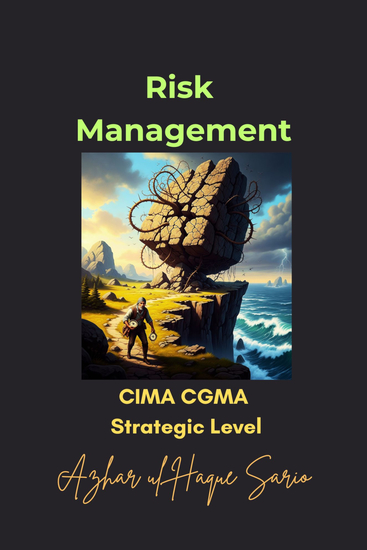
Risk Management - CIMA CGMA Strategic Level - cover
LER

Risk Management - CIMA CGMA Strategic Level

Azhar ul Haque Sario

Editora: Azhar Sario Hungary

  • 0
  • 0
  • 0

Sinopse

Ready to conquer risk and excel in your CIMA Strategic Level exam?


This guide is your essential partner for mastering risk management. We cover everything you need to know. The book breaks down complex topics into simple parts. You will learn all about enterprise risk. We explore how to see the big picture of risk across an entire organization. We then dive into strategic risk. This is about the risks tied to your company's most important decisions. Learn how to align your risk appetite with your corporate strategy. The book also provides a clear view of internal controls. These are not just rules to follow. They are tools for success and stability. You will understand how to design and implement controls that work. Finally, we tackle the critical area of cyber risk. In today's world, digital threats are everywhere. We show you how to identify and manage these modern dangers effectively. Each chapter is focused and gets straight to the point, preparing you for exam success.


Many textbooks are dense and full of abstract theories. They can be difficult to read and even harder to apply. This book is different. We believe learning should be practical and engaging. Instead of just presenting facts, we explain the 'why' behind the concepts. Our guide uses real-world scenarios and mini case studies that you can relate to. This approach helps you connect the dots between theory and what actually happens in business. You won't just be memorizing definitions for your exam; you will be building a deep, lasting understanding of how to manage risk strategically. Our competitive advantage is clarity and application. We bridge the gap between passing your CIMA exam and becoming a confident, capable finance professional who can add real value from day one.


Disclaimer: The author has no affiliation with the Chartered Institute of Management Accountants (CIMA). This book is independently produced under the principle of nominative fair use to help students prepare for their exams.
Disponível desde: 26/07/2025.
Comprimento de impressão: 202 páginas.

Outros livros que poderiam interessá-lo

  • Structuring Inequality - How Schooling Housing and Tax Policies Shaped Metropolitan Development and Education - cover

    Structuring Inequality - How...

    Tracy L. Steffes

    • 0
    • 0
    • 0
    How inequality was forged, fought over, and forgotten through public policy in metropolitan Chicago. As in many American metropolitan areas, inequality in Chicagoland is visible in its neighborhoods. These inequalities are not inevitable, however. They have been constructed and deepened by public policies around housing, schooling, taxation, and local governance, including hidden state government policies.In Structuring Inequality, historian Tracy L. Steffes shows how metropolitan inequality in Chicagoland was structured, contested, and naturalized over time even as reformers tried to change it through school desegregation, affordable housing, and property tax reform. While these efforts had modest successes in the city and the suburbs, reformers faced significant resistance and counter-mobilization from affluent suburbanites, real estate developers, and other defenders of the status quo who defended inequality and reshaped the policy conversation about it. Grounded in comprehensive archival research and policy analysis, Structuring Inequality examines the history of Chicagoland’s established systems of inequality and provides perspective on the inequality we live with today.
    Ver livro
  • The Great Book of Journaling - How Journal Writing Can Support a Life of Wellness Creativity Meaning and Purpose - cover

    The Great Book of Journaling -...

    Eric Maisel, Lynda Monk

    • 0
    • 0
    • 0
    Learn how to quell worry and anxiety and fuel creativity with journaling in this informative guide. 
     
    From psychotherapist Eric Maisel and Lynda Monk, Director of the International Association for Journal Writing, a guide to journal writing for higher self-esteem. This is the next-generation book on journaling techniques that introduces a younger generation to the immense benefits of journaling and provides all journal writers with the tools they need to grow, heal, and deepen their personal writing experience. 
     
    Therapeutic journal writing can promote individual healing, creativity, and community-building. The Great Book of Journaling offers multiple perspectives on journaling techniques in an easy-to-use, practical format, along with providing a comprehensive introduction to various techniques and methods for deepening your personal writing. 
     
    Learn from the best.We’ve rounded up forty of the top journal experts in the world to explain exactly what journal writing can do for you! The Great Book of Journaling is full of practical tips, evidence-based research, and rich anecdotes from their coaching, teaching, therapy work with journal writers, or their personal journal writing. 
     
    The Great Book of Journaling can help:Create high self-esteem, self-love, and self-confidenceImprove your health and your sense of wellbeingCalm your worry and anxietyServe your creative needsDeepen your personal writing 
     
    Readers of books on journal writing such as Mindfulness Journal, The Self-Discovery Journal, or No Worries will love The Great Book of Journaling.
    Ver livro
  • Burnout Divide - Why Some Thrive While Others Collapse - cover

    Burnout Divide - Why Some Thrive...

    Alice Jackson

    • 0
    • 0
    • 0
    Why do some people flourish under relentless pressure while others fall apart? Burnout Divide reveals the hidden factors that separate resilience from collapse — and how you can harness them to thrive in an unforgiving world. 
    Drawing on cutting-edge neuroscience, psychology, and real-world case studies, this book takes you beyond the surface symptoms of stress to expose the biological, mental, and social forces that determine your breaking point. You’ll discover:The early warning signs of burnout are most people ignore until it’s too lateWhy high achievers are often more vulnerable — and how to protect yourselfThe resilience habits that allow some to sustain high performance for decadesThe role of relationships, environment, and purpose in keeping you energizedA step-by-step framework to reset your energy, focus, and drive — without sacrificing results 
    Packed with gripping stories and practical tools, Burnout Divide is your blueprint for building unshakable stamina in a high-demand world. Whether you’re leading a team, chasing a dream, or simply trying to stay afloat, this book will help you stop the spiral of exhaustion and step into a state of sustainable success. 
    In today’s fast-paced reality, the gap between thriving and collapsing is growing wider. 
     This is your guide to staying on the right side of the divide.
    Ver livro
  • Bricks that Build Us Book 4 - CommunityFamilyBeliefsLawsConflictAndSocio-Political Remedies - cover

    Bricks that Build Us Book 4 -...

    Rob Howat

    • 0
    • 0
    • 0
    A socio-psychological look at what has formed our society and suggestions of where it is going seriously wrong. Planned development, demonstrated self-discipline, calm discussion with clear beliefs and community traditions enable stability within a growing worldwide society. Stable family and educational experiences are the key to each child's happy and successful development. Neo-liberal lax and soft society is destroying stability as well as our future. Previous guides such as politeness, manners, quality, and uncorrupted religion are just as relevant when we venture beyond neglect and doctrinal corruption.
    Ver livro
  • End of the Bronze Age The: The History of the Kingdoms that Dominated the Near East in the Late Bronze Age - cover

    End of the Bronze Age The: The...

    Charles River Editors

    • 0
    • 0
    • 0
    When scholars look at the passage of history, certain epochs and transitions to new periods tend to stand out. The transition from the early modern to the Industrial Age in the late 18th century and the collapse of the Roman Empire are two of the more well known, but the transition from the Bronze to the Iron Age during the late 13th and early 12th centuries BCE arguably changed the structure and course of world history more fundamentally than any period before or since. During this period, numerous wealthy and enduring kingdoms of the eastern Mediterranean Sea region collapsed, and new ones rose in their places.  
    At the center of this period of turmoil was a group of people known today as the Sea Peoples, the English translation of the name given to them by the Egyptians. Despite their prominent role in history, however, the Sea Peoples remain as mysterious as they were influential; while the Egyptians documented their presence and the wars against them, it has never been clear exactly where the Sea Peoples originated from, or what compelled them to invade various parts of the region with massive numbers. Whatever the reason, the Sea Peoples posed an existential threat to the people already living in the region. 
    	Naturally, the mystery surrounding the Sea Peoples has led to all kinds of theories aiming to identify them. While plenty of theories are plausible, there are other fanciful theories that have attempted to associate the Sea Peoples with the Atlantic Ocean and even Troy.
    Ver livro
  • What We Don't Do - Inaction in the Face of Suffering and the Drive to Do More - cover

    What We Don't Do - Inaction in...

    Nick Cooney

    • 0
    • 0
    • 0
    When we think about whether we are good people leading a good life, we usually think about actions. Bad people do bad things that hurt others. Good people do good things that help others, and they avoid doing bad things. Simple. 


    But while our actions certainly have consequences, today our inactions have far greater and far graver consequences. Bad actions can result in the suffering of a few or several dozen others; inaction can result in the extreme misery of thousands. 


    For nearly our entire history as a species, we lived in small groups with minimal resources, leaving our ability to help others limited. Thanks to massive global populations, huge wealth disparities, and modern technologies, the average person now has more power to improve the lives of others than nearly anyone who has ever lived. But the flip side of that great power is the dizzyingly high cost of inaction, in which lives can hang in the balance with each dollar and hour of time we spend. 


    This is a book about what we don't do. It's about our failures to act and the suffering others endure as a result. It's also about the incredible good that can be achieved when we cultivate an internal drive to do more.
    Ver livro