Junte-se a nós em uma viagem ao mundo dos livros!
Adicionar este livro à prateleira
Grey
Deixe um novo comentário Default profile 50px
Grey
Assine para ler o livro completo ou leia as primeiras páginas de graça!
All characters reduced
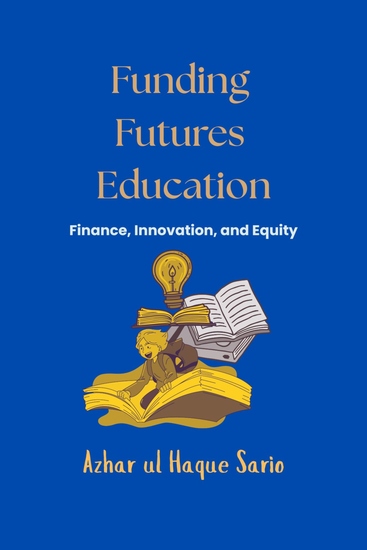
Funding Futures Education - Finance Innovation and Equity - cover
LER

Funding Futures Education - Finance Innovation and Equity

Azhar ul Haque Sario

Editora: Royal Co.

  • 0
  • 0
  • 0

Sinopse

"Funding Futures Education: Finance, Innovation, and Equity" takes you on a comprehensive journey exploring the economic underpinnings of educational policies and their impacts on various global contexts. This book delves deep into how economic theories guide the transfer of educational policies across cultural lines, revealing both the financial barriers and opportunities that shape these endeavors.


The narrative starts by examining how educational policies are adapted in diverse cultural settings, focusing on cost-effectiveness and the financial feasibility that influences policy success or failure. As we move through the chapters, the book addresses the pressing issue of the digital divide—analyzing its financial implications and the strategies that can bridge this gap through innovative funding solutions.


Further exploration leads to an insightful discussion on the financing of teacher training and professional development, emphasizing economic barriers in developing countries and showcasing cost-effective models that promise sustainability and improved educational outcomes. The connection between education and social mobility is scrutinized through economic lenses, providing a detailed comparative analysis of how educational investments can alter socio-economic dynamics across different regions.


The book also tackles gender disparities in STEM education, presenting an economic analysis that looks at the societal norms and financial incentives influencing gender participation in STEM fields. This is complemented by a critical examination of the political economy surrounding educational reforms, where financial strategies are devised to navigate the complexities of political and economic challenges in reform implementation.


As the chapters unfold, "Funding Futures Education" ventures into discussions about public and private funding models, the unique challenges faced by small island developing states, and the role of technology in enhancing economic efficiency within educational systems. The book doesn't shy away from the sensitive topics of language policies in education, providing a robust cost-benefit analysis of bilingual programs and the financial impacts of preserving language diversity.


Each chapter is meticulously crafted to offer insights into how public-private partnerships can revolutionize STEM education globally and how educational finance can be reformed to enhance global competitiveness. By synthesizing economic theories with real-world applications, this book not only serves as an academic resource but also as a guide for policymakers, educators, and financial strategists dedicated to fostering equitable and quality education worldwide.


With "Funding Futures Education," readers are invited to rethink educational finance through a lens that values equity and innovation, providing a blueprint for future reforms that aspire to balance educational quality with economic viability. This book is a call to action for anyone invested in crafting sustainable educational policies that do not just react to global economic pressures but anticipate and creatively overcome them.
Disponível desde: 27/11/2024.
Comprimento de impressão: 59 páginas.

Outros livros que poderiam interessá-lo

  • Nathaniel Hawthorne: A short biography - 5 Minutes: Short on time - long on info! - cover

    Nathaniel Hawthorne: A short...

    5 Minutes, 5 Minute Biographies,...

    • 0
    • 0
    • 0
    Nathaniel Hawthorne, American writer of the 19th century: Life and work in a short biography! Everything you need to know, brief and concise. Infotainment, education and entertainment at its best!
    Ver livro
  • Thesis on God - cover

    Thesis on God

    A. Parthasarathy

    • 0
    • 0
    • 0
    The human race has accepted the word God unquestionably from time immemorial. Which has resulted in an avalanche of diverse faiths warring with each other. To circumvent this and present the true nature of God the thesis provides adequate literature. God is the supreme Self, a Sakshi, a detached Witness of activities of the body, mind and intellect. A role in beings which fits in with that of petrol in vehicles. Petrol is a sakshi which activates vehicles while witnessing the best or worst of their performances.
    Ver livro
  • Wartime Britain - The Darkest Hours of World War 2 in Great Britain - cover

    Wartime Britain - The Darkest...

    Liam Dale

    • 0
    • 0
    • 0
    Join The History Journals for an hourly historical exploration of the war's diverse aspects. In this edition, uncover the impact of Hitler's forces on the people of Great Britain. 
     
    Travel back to London in 1940, and while familiar landmarks like Buckingham Palace and St. Paul's Cathedral still stand tall, you'd witness a city and a nation under siege. This year marked a stark realization for the people of Great Britain as they faced the impact of a world at war for the second time in the 20th century. 
     
    Winston Churchill's resounding leadership resonated with the nation, and as he called upon the British people to rally to the battle cry, they responded with unwavering determination. It was, without a doubt, the finest hour of a nation. 
     
    Explore: 
    - Winston Churchill's timely leadership 
    - British wartime economizing 
    - The coveted Christmas gift during wartime 
    - The Treaty of Versailles as a precursor to WW2
    Ver livro
  • Why Intelligent People Do Stupid Things - The Paradox of Smart Decision-Making - cover

    Why Intelligent People Do Stupid...

    John Harpoon

    • 0
    • 0
    • 0
    Intelligence is often seen as the key to making sound decisions, yet many highly intelligent individuals find themselves making choices that defy logic and reason. This paradox is at the heart of why even the smartest people can sometimes act in ways that are seemingly irrational. Despite possessing vast knowledge, sharp problem-solving skills, and an ability to think critically, intelligent people often fall victim to cognitive biases, emotional triggers, and societal pressures that lead them to make poor decisions. Understanding why this happens requires an exploration into the intricate relationship between intelligence and decision-making. 
      
    At the core of this paradox lies the idea that rationality and intelligence do not always go hand in hand. While intelligence may increase the ability to process information and analyze complex scenarios, it does not always shield individuals from the cognitive biases that distort perception and judgement. In fact, many intelligent individuals are even more susceptible to these biases because they rely heavily on their analytical skills, assuming that their logic will always lead them to the right conclusion. However, this overreliance can blind them to the emotional and social factors that influence decision-making, causing them to overlook key details or make choices based on faulty assumptions. 
      
    Furthermore, decision-making is not solely a rational process; emotions play a crucial role in guiding our actions, and they can often override logic. Intelligent individuals are not immune to emotional influences such as stress, fear, or the desire for instant gratification. These emotions can cloud judgement, leading to impulsive decisions or the failure to consider long-term consequences. This is particularly true in high-pressure situations where the stakes are high, and the need to make quick decisions can push even the most intelligent person into making mistakes.
    Ver livro
  • Legendary Commanders Who Challenged Ancient Rome - cover

    Legendary Commanders Who...

    Editors Charles River

    • 0
    • 0
    • 0
    In the history of war, only a select few men always make the list of greatest generals. Napoleon. Caesar. Alexander. They are always joined by Hannibal, who has the distinction of being the only man who nearly brought Rome to its knees before its decline almost 700 years later. Rome never suffered a more horrifying defeat in its history than at Cannae, and indeed, Hannibal nearly rewrote the course of Western history during the Second Punic War.  
    	Spartacus is the world’s most famous slave, and one of the most notorious figures of Ancient Rome. A slave enamored of freedom and willing to fight and die for it, he became especially popular in the years following the Enlightenment, after which he was widely viewed as a poignant champion of liberty in the 18th and 19th centuries. As a result, he became a symbol during struggles like the French Revolution, the American Revolution, the American Civil War and the struggle for emancipation. Today, his dual life as a gladiator and a “freedom fighter” makes him fascinating to audiences around the world.  
    	Attila, Emperor of the Hunnic Empire and thus most commonly known as Attila the Hun, is an idiosyncratic figure who has become more myth than man, not least because much of his life is shrouded in mystery. Perhaps the most famous “barbarian” in history, Attila was the lord of a vast empire spanning two continents, but he is best remembered for what he did not conquer. Though he seemingly had Rome at his mercy in 452, he ultimately decided not to sack the Eternal City, and a year later he had suffered a mysterious death. Naturally, the dearth of information and the passage of time have allowed myths and legends to fill in the most important details of Attila’s life. Why did a man at war with the Roman Empire for so long decide not to sack Rome in 452? Did a meeting with Pope Leo the Great convince him to spare the capital of the Western half of the empire? 
    Ver livro
  • Reading Made Fun: Engaging Games for Young Learners - "Supercharge reading skills! Discover fun games and captivating audio lessons tailored for young learners!" - cover

    Reading Made Fun: Engaging Games...

    Lysander Crowe

    • 0
    • 0
    • 0
    Reading Made Fun: Engaging Games for Young Learners 
    ⭐⭐ A Simplified Guide with Easy Explanations ⭐⭐ 
    Are you eager to enhance your career and deepen your knowledge in a fun and interactive way? 
    Searching for a complete resource filled with engaging activities designed to make learning enjoyable for young learners? 
    Your quest ends here! 
    This audiobook is your ultimate companion for enriching your understanding while actively participating through exciting games. With this resource, you're all set for success. 
    Updated for the latest educational trends and approaches. 
    Key Features of this Interactive Audiobook: 
    - Insightful techniques that transform your understanding of learning. 
    - Thorough explanations of educational concepts. 
    - Effective strategies for interactive learning and engagement. 
    Our audiobook stands out through its comprehensive and engaging content, ensuring a thorough exploration of concepts instead of superficial coverage. 
    Please note that this resource is an independent creation and is not affiliated with any official educational entity. 
    Crafted with a clear structure and accessible language, our audiobook guarantees smooth transitions between different activities and concepts. Say farewell to complex terminology and embrace straightforward, precise, and engaging content. 
    So, why delay? Grab your headphones, dive into the fun, and embark on an exciting journey of learning today!
    Ver livro