Junte-se a nós em uma viagem ao mundo dos livros!
Adicionar este livro à prateleira
Grey
Deixe um novo comentário Default profile 50px
Grey
Assine para ler o livro completo ou leia as primeiras páginas de graça!
All characters reduced
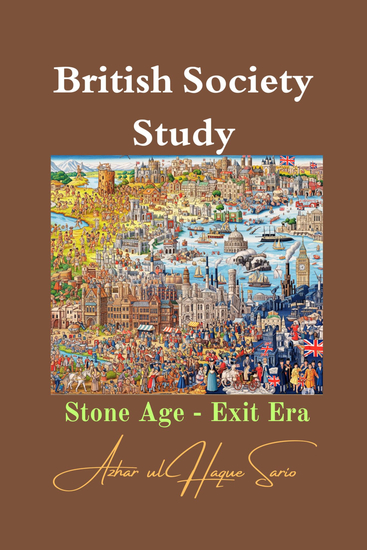
British Society Study - Stone Age - Exit Era - cover
LER

British Society Study - Stone Age - Exit Era

Azhar ul Haque Sario

Editora: Azhar Sario Hungary

  • 0
  • 0
  • 0

Sinopse

Journey through British history from the Stone Age to Brexit in "British Society Study."Explore prehistoric Britain, the Bronze Age, and the lasting impact of Roman invasions. Delve into the Dark Ages, the Industrial Revolution, and the World Wars that shaped modern Britain.

 
Discover how pivotal events like the Magna Carta and Women's Suffrage influenced human rights. Uncover the cultural tapestry of Britain, from The Beatles to the monarchy, and its journey to becoming a diverse and welcoming nation.

 
"British Society Study" offers a captivating exploration of Britain's rich history and the forces that shaped its society.
Disponível desde: 24/06/2025.
Comprimento de impressão: 124 páginas.

Outros livros que poderiam interessá-lo

  • How to Become a Middle School Teacher Career Professional Development Planning Audio Book - With Job Interview Preparation & Coaching Guide for Men Women Teens & Young Adults - cover

    How to Become a Middle School...

    Brian Mahoney

    • 0
    • 0
    • 0
    End Money Worries! 
    How to Become a Middle School Teacher Career Professional Development Planning Audio Book 
    With Job Interview Preparation & Coaching Guide for Men, Women, Teens & Young Adults 
    by Brian Mahoney  
           Discover... 
    * What a Middle School Teacher does 
         * How to Become a Middle School Teacher  
          * What is the salary of a Middle School Teacher  
             * What is the Middle School Teacher Work Environment like 
                 * What is the future Job outlook for a Middle School Teacher  
             * how long does it take to become a Middle School Teacher 
          * How to Prepare for Your Job Interview 
       * Tips the pros use to Ace their Job Interview 
    * You'll be confident with the best answers for the toughest job interview questions 
    The knowledge and ability to change your life all for less than the cost of 1 movie ticket! 
     If you are ready to get started & want the knowledge, help & motivation to change your life now!... 
    Then this Book is for you!!! 
                         So Don't wait. You'll wait your life away...
    Ver livro
  • I Think I Own That - John Locke’s Guide to Justifying Land Theft with Polite Language - cover

    I Think I Own That - John...

    Sophia Blackwell

    • 0
    • 0
    • 0
    John Locke: Enlightenment philosopher, father of liberalism, inventor of “natural rights,” and accidental spiritual patron of land developers, libertarians, and your uncle who won’t shut up about property taxes. 
    In this gloriously sarcastic takedown of one of Western philosophy’s most over-quoted minds, Sophia Blackwell (Kant You Not, No Self, No God, No Clue) guides you through Locke’s greatest hits—including: 
    The blank slate theory, which basically says you’re born dumb and the world makes you worse 
    His ideas on identity, which collapse the second you forget your phone password 
    His version of consent, which mostly consists of “You didn’t leave, so I assume you’re fine with it.” 
    And of course, property rights—where mixing your labor with the earth somehow makes it yours, and stealing land becomes morally correct as long as you bring a shovel 
    Locke’s political philosophy inspired democracies, revolutions, and every 400-comment Reddit thread titled “Taxation is theft.” 
    This is not a respectful biography. 
    This is a roast. A eulogy. A survival guide for understanding how Locke gave us: 
    Liberalism 
    Landlords 
    Legal headaches 
    And a political system that thinks fencing off a patch of dirt = moral superiority 
    Perfect for: 
    Recovering philosophy students 
    Political skeptics 
    Enlightenment haters 
    Property law survivors 
    And anyone who wants to laugh while questioning whether government is just a giant metaphor for a really passive-aggressive roommate agreement 
    You don’t need to read Two Treatises of Government. 
    You just need to know Locke said, “I think I own that,” and people believed him.
    Ver livro
  • Albert Einstein – The Genius Who Redefined Physics - The Life Discoveries and Legacy of the World’s Most Influential Scientist - cover

    Albert Einstein – The Genius Who...

    Jake Rose

    • 0
    • 0
    • 0
    Albert Einstein was not just a scientist—he was a revolutionary thinker who changed the way we understand the universe. From his groundbreaking theory of relativity to his contributions in quantum mechanics, Einstein’s genius reshaped modern physics and left a lasting impact on science and humanity. 
    This audiobook takes you through his early struggles, scientific breakthroughs, and personal life, revealing the man behind the equations. How did Einstein’s ideas influence everything from atomic energy to space exploration? What made him one of history’s most recognizable and influential figures? 
    Albert Einstein – The Genius Who Redefined Physics is a must-listen for science lovers, history enthusiasts, and those fascinated by brilliant minds that changed the world.
    Ver livro
  • Egyptian Mythology - The Gods and Legends of Ancient Egypt - cover

    Egyptian Mythology - The Gods...

    Julia Blacksmith

    • 0
    • 0
    • 0
    Egyptian mythology is one of the most fascinating and enduring belief systems in human history. Rooted in the ancient civilization along the Nile, these myths shaped the religious, social, and political landscape of Egypt for thousands of years. Unlike many other mythologies, Egyptian beliefs were not static; they evolved over time, incorporating new deities, merging legends, and adapting to the needs of the people. The gods and stories of Egypt were deeply intertwined with daily life, influencing everything from temple rituals to the rule of pharaohs. Understanding Egyptian mythology provides insight into the values, fears, and aspirations of one of history’s most influential civilizations.  
      
    The origins of Egyptian mythology date back to the early dynastic period and possibly even before. Ancient Egyptians believed that the universe emerged from a vast, chaotic primordial ocean called Nun. From this cosmic void, the first gods appeared, bringing order to existence. Myths about creation, divine rule, and the afterlife were passed down through oral traditions and recorded in hieroglyphic texts found on temple walls, coffins, and papyrus scrolls. These stories explained natural phenomena, justified the authority of the pharaohs, and provided a spiritual roadmap for the journey beyond death.  
      
    Mythology played a central role in ancient Egyptian life, influencing art, architecture, and governance. Temples were constructed as homes for the gods, and elaborate religious festivals reenacted mythological events to ensure cosmic balance. The pharaoh, considered the living embodiment of Horus and the son of Ra, was both a political and religious leader, serving as the bridge between the gods and the people. Myths were not merely symbolic; they were an active force shaping society’s structure and rituals. 
    Ver livro

  • Holy Roman Empire’s Conflicts with the Vatican The: The History of the Medieval Wars that Fractured Germany and Italy - cover

    Holy Roman Empire’s Conflicts...

    Charles River Editors

    • 0
    • 0
    • 0
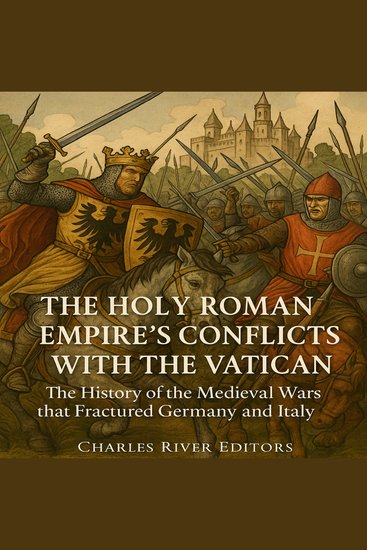
    It has been famously pointed out that the Holy Roman Empire was neither holy, nor Roman, but it was also not an empire in the sense people expect when hearing the term. In theory, the emperor was the highest prince in Christendom, and his dominion extended the length and breadth of Western Europe. The empire had been created by the papacy in 801 when Pope Leo the Third famously crowned the supposedly unwitting Charlemagne in Saint Peter’s Basilica, intending to recreate the Western Roman Empire. In truth, the imperial power did not extend beyond central Europe, which by the beginning of the 16th century included Germany, northern Italy, and the Netherlands. Even in these lands, however, the emperor struggled to command obedience. His dominion over northern Italy was theoretical only, the cities of the Netherlands were deeply conscious of their ancient rights and privileges, and Germany had long ceased to be compliant. The latter had become a collection of principalities, dukedoms and bishoprics which vied with each other and pursued their own agendas. They were, however, united in only one sense: denying the emperor power and resisting attempts to centralize the government.  
    	At the same time, the secular sovereigns frequently butted heads with religious authorities back in Rome, and arguably none of the conflicts were as crucial as the War of the Keys and the Investiture Controversy. The tensions between the Holy Roman Empire and Church over the power to invest bishops with authority led to decades of civil war in Germany on the way to establishing the relationship between Church and state, elevating the status of the papacy and weakening the Holy Roman Empire. What is crucial in understanding the conflicts is to not view them with the benefit of hindsight. Most importantly, no nation as people recognize it today yet existed, as England, France, Germany, and Italy were largely geographical expressions, not national identities.
    Ver livro
  • Delhi Sultanate The: The History and Legacy of the Medieval Islamic Dynasty in India - cover

    Delhi Sultanate The: The History...

    Editors Charles River

    • 0
    • 0
    • 0
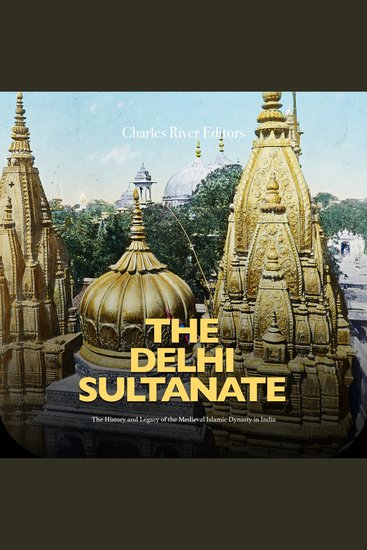
    India has been the location of many different empires throughout its long history. The Indus Valley Civilization was home to one of the world’s first civilizations more than 5,000 years ago, which was followed by the Aryan-Vedic culture and then a host of other kingdoms that flourished across the Sub-Continent. India has also been the birthplace of many religions. The Vedic religion of the Aryans evolved into the Hindu religion, and Buddhism and Jainism were also born in India. By the Middle Ages, India was home to many different religions and ethnic groups, with dozens of languages being spoken, making India less of a single, unified country and more of a land of many countries. Despite India’s tradition of cultural and political pluralism, several rulers attempted to place the entire Sub-Continent under the rule of one dynasty or government with a dominant religion. Most of these would-be rulers were far from successful, although a few came close, setting the template for later conquerors.  
    	The Delhi Sultanate was comprised of five dynasties that expanded their borders, and Islam, at sword point, but also through diplomacy and trade. The Delhi Sultanate became known as a state that welcomed the expertise of foreigners, no matter their religion, and promoted the welfare of its citizens through a host of social programs. Eventually, the Delhi Sultanate grafted ideas and inspiration from India’s pre-Islamic past with those of Islam to create a state that was quite unique and powerful. The Delhi sultans were themselves descended from Turks and brought with them ideas from Persia. Furthermore, as their empire grew, they invited scholars from throughout the Islamic world to their country, and as Muslim scholars, scientists, and administrators from the Near East made their way into India, the Delhi sultans also incorporated some of the cultural ideas of the native Hindu Indians to create a state that was as unique as any the world had ever seen.
    Ver livro