Rejoignez-nous pour un voyage dans le monde des livres!
Ajouter ce livre à l'électronique
Grey
Ecrivez un nouveau commentaire Default profile 50px
Grey
Abonnez-vous pour lire le livre complet ou lisez les premières pages gratuitement!
All characters reduced
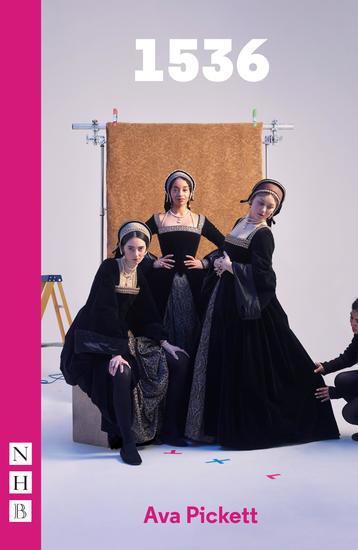
1536 - cover

1536

Ava Pickett

Maison d'édition: Nick Hern Books

  • 0
  • 3
  • 0

Synopsis

'Kings don't kill their wives alright? It's not – it just don't happen. It doesn't.'
Tudor England. A field in Essex. Three women hurry to their childhood meeting place, thirsty for gossip from London. Word spreads of a clash between King Henry VIII and his Queen, Anne Boleyn. Closer to home, another rumour threatens to catch fire.
As these women realise the parallels between their ordinary, rural lives and the royal drama taking place at a distance, they are faced with several choices, all of which end in violence.
1536 is a fiendishly smart and funny play which asks whether female solidarity can survive in a world where barbarism and misogyny are state sanctioned.
Ava Pickett's play won the Susan Smith Blackburn Prize in 2024 and was first performed at the Almeida Theatre, London, in 2025, directed by Lyndsey Turner. This new and revised edition was published alongside the 2026 West End production at the Ambassadors Theatre.
Ava Pickett was named Best Writer at the 2025 Stage Debut Awards and Most Promising Playwright at both the 2025 London Standard Theatre Awards and the 2026 Critics' Circle Theatre Awards.
Disponible depuis: 15/05/2025.
Longueur d'impression: 112 pages.

D'autres livres qui pourraient vous intéresser

  • The Sunshine Kid - Sunday Times bestselling author - cover

    The Sunshine Kid - Sunday Times...

    Harry Baker

    • 0
    • 0
    • 0
    When Harry Baker first started writing rap infused poetry he was advised to "write about what you know" so instead of writing about killing people, or driving fast cars (over people), he wrote about mathematics.
    
    It is not all complex maths and algebra however but throughout Harry applies his mathematician's mind to conjuring complex rhythms that have to be read out loud to be believed.
    Voir livre
  • Glut - cover

    Glut

    Ramona Herdman

    • 0
    • 0
    • 0
    Ramona Herdman's Glut is a lush, entertaining, and bittersweet collection of poems about how we live together and find meaning through rules and rituals around food, family, alcohol, work, nature, sex and love. These vividly-realised, nimble poems probe at the delicate balancing acts we – our bodies and our minds – perform in life: between power and trust, between convention and rebellion, and between what is enough and what is too much.
    All the time, Herdman's spry poetry keeps a gimlet eye on our impulse to make sense of it all – of how we live and work together, and what strategies will help us to navigate our way through the tangled undergrowth of negotiation and misunderstanding. Glut is a lustrous, darkly funny, open-hearted book on the distance between people, on satisfying appetites, and on seeking both pleasure and consolation.
    Voir livre
  • To My Most Dearly Beloved Friend - Michael Drayton has often been neglected down the centuries This poem will make you question just why that happened - cover

    To My Most Dearly Beloved Friend...

    Michael Drayton

    • 0
    • 0
    • 0
    Michael Drayton was born in 1563 at Hartshill, near Nuneaton, Warwickshire, England. The facts of his early life remain unknown.  Drayton first published, in 1590, a volume of spiritual poems; The Harmony of the Church.  Ironically the Archbishop of Canterbury seized almost the entire edition and had it destroyed.  In 1593 he published Idea: The Shepherd's Garland, 9 pastorals celebrating his own love-sorrows under the poetic name of Rowland. This was later expanded to a 64 sonnet cycle.  With the publication of The Legend of Piers Gaveston, Matilda and Mortimeriados, later enlarged and re-published, in 1603, under the title of The Barons' Wars. His career began to gather interest and attention.  In 1596, The Legend of Robert, Duke of Normandy, another historical poem was published, followed in 1597 by England's Heroical Epistles, a series of historical studies, in imitation of those of Ovid. Written in the heroic couplet, they contain some of his finest writing.  Like other poets of his era, Drayton wrote for the theatre; but unlike Shakespeare, Jonson, or Samuel Daniel, he invested little of his art in the genre. Between 1597 and 1602, Drayton was a member of the stable of playwrights who worked for Philip Henslowe. Henslowe's Diary links Drayton's name with 23 plays from that period, and, for all but one unfinished work, in collaboration with others such as Thomas Dekker, Anthony Munday, and Henry Chettle. Only one play has survived; Part 1 of Sir John Oldcastle, which Drayton wrote with Munday, Robert Wilson, and Richard Hathwaye but little of Drayton can be seen in its pages.  By this time, as a poet, Drayton was well received and admired at the Court of Elizabeth 1st. If he hoped to continue that admiration with the accession of James 1st he thought wrong.  In 1603, he addressed a poem of compliment to James I, but it was ridiculed, and his services rudely rejected.  In 1605 Drayton reprinted his most important works; the historical poems and the Idea. Also published was a fantastic satire called The Man in the Moon and, for the for the first time the famous Ballad of Agincourt.  Since 1598 he had worked on Poly-Olbion, a work to celebrate all the points of topographical or antiquarian interest in Great Britain. Eighteen books in total, the first were published in 1614 and the last in 1622.  In 1627 he published another of his miscellaneous volumes.  In it Drayton printed The Battle of Agincourt (an historical poem but not to be confused with his ballad on the same subject), The Miseries of Queen Margaret, and the acclaimed Nimphidia, the Court of Faery, as well as several other important pieces.  Drayton last published in 1630 with The Muses' Elizium.  Michael Drayton died in London on December 23rd, 1631.  He was buried in Westminster Abbey, in Poets' Corner.  A monument was placed there with memorial lines attributed to Ben Jonson.
    Voir livre
  • Kristianna Angel of Joy! - The Christmas Announcement! - cover

    Kristianna Angel of Joy! - The...

    Myron Hieronymous Thomas

    • 0
    • 0
    • 0
    In this original poem the story of the birth of the Christ Child is told from the perspective of heaven and the angel who would announce the birth to shepherds below.
    Voir livre
  • The Huntress and Her Muse - cover

    The Huntress and Her Muse

    Abby O'Keefe

    • 0
    • 0
    • 0
    This first collection of poems is a celebration of the human experience and the complex relationship between the body and mind. With themes of anxiety, gratitude, womanhood, motherhood, outer expectations, and internal dialogue, I hope you find words that make you feel less alone.
    Voir livre
  • The Garden of Eros - Poem honouring the memory of some legendary poets - cover

    The Garden of Eros - Poem...

    Oscar Wilde

    • 0
    • 0
    • 0
    Oscar Fingal O'Flahertie Wills Wilde was born on the 16th October 1854 in Dublin Ireland.  The son of Dublin intellectuals Oscar proved himself an outstanding classicist at Dublin, then at Oxford. With his education complete Wilde moved to London and its fashionable cultural and social circles.  With his biting wit, flamboyant dress, and glittering conversation, Wilde became one of the most well-known personalities of his day.  
    His only novel, The Picture of Dorian Gray was published in 1890 and he then moved on to writing for the stage with Salome in 1891.  His society comedies produced enormous hits and turned him into one of the most successful writers of late Victorian London.  
    Whilst his masterpiece, ‘The Importance of Being Earnest’, was on stage in London, Wilde had the Marquess of Queensberry, the father of his lover, Lord Alfred Douglas, prosecuted for libel.  The trial unearthed evidence that caused Wilde to drop his charges and led to his own arrest and trial for gross indecency. He was convicted and imprisoned for two years' hard labour.  It was to break him.  
    On release he left for France. There he wrote his last work, ‘The Ballad of Reading Gaol’ in 1898.  He died destitute in Paris at the age of forty-six sipping champagne a friend had brought with the line ‘Alas I am dying beyond my means’.
    Voir livre